Weekly Press Review – 28 March 2014

In a week characterised by one disaster after the next: from missing airliners over the Indian Ocean, to mud slides in Washington state, I guess we should be grateful that there has been little or no maritime news as it would undoubtedly not have been good.

However, once again a story featuring the amazing creatures of our oceans has made the news this week.  Scientists in the US have tracked a group of Cuvier’s beaked whales as they dived to incredible depths off the Californian coast.  The tagged whales dived to depths of up to 2 992 metres, spending two hours and 17 minutes under-water before surfacing for air.

These dives represent both the longest and deepest dives ever recorded for any marine mammal.

Greg Schorr of Cascadia Reseach Collective in Olympia, Washington, says:  “Many creatures live at the depths these whales dive to.  However, there is a major difference between these whales and other creatures living deep in the ocean – the fundamental requirement to breathe air at the surface. Taking a breath at the surface and holding it while diving to pressures over 250 times that at the surface is an astounding feat.”

The whales were tracked using satellite-linked tags attached to the dorsal fins.

There is still much to be learned from the ocean that we so readily take for granted and abuse.

Other than that – there has been the usual to-and-fro between the minister of fisheries and her detractors in the press and via social media.


Weekly Press Review – 20 March 2014

As if the threatened impeachment of our president this week was not enough to bring embarrassment to our nation, a member of the police Sea Border Unit, and his wife, have been arrested after 1,819 abalone were found at their home in Fisherhaven.

Along with the abalone, police also seized crayfish tails, a boat and a car.  The estimated value of the total find is around R1.3 million.

Is there no end to the corruption in this country?  In this case, the very person charged with protecting our oceans is responsible for poaching and stealing from it.  Where to from here?

In happier news, a whale that was entangled in the ropes of a whelk trap off False Bay was freed thanks to the joint efforts of the South African Whale Disentanglement Network and the National Sea Rescue Institute.  The young whale was trapped to such a degree that it was struggling to reach the surface of the water to breathe. After two of the five ropes that it had become entangled in were cut, it was able to free itself and witnesses later reported seeing it swimming strongly in the vicinity of Murdoch Valley.

Another successful operation assisting one of our sea creatures in distress.

Tina took two hours of my time

I  wasted almost two hours of my Sunday by responding to Minister Tina Joemat-Pettersson’s invitation to a press briefing to discuss her response to the Public Protector’s report: Docked Vessels.

  • 25 minute drive to town
  • 10 minutes to park and get through parliament security
  • 10 minutes wait
  • 2 minute introduction to panel
  • 6 minutes to read press statement in English
  • 6 minutes to read press statement in Afrikaans
  • 7 minutes of largely inadequate question and answer time
  • 30 seconds of shutting books and watching the panel high tailing it out of the room
  • 10 minutes leaving parliament and returning to car
  • 25 minutes drive home

The Minister should note that should she just wish to issue a statement, that the Department of Agriculture Forestry and Fisheries’ website would probably be an appropriate place to publish a press statement. Should she wish to ensure that the journalists saw this – she could even go as far as asking her communications team to send it to their list of relevant reporters.

But to call a press conference and essentially thwart any real engagement with the journalists present is a waste of her time; the panels’ time (consisting of legal counsel and senior communications officers from the Department) and our time too.

And so what was the ultimate crux of newsworthy information at the core of her statement?

“I will be asking the North Gauteng High Court to declare that the Report including the findings and recommendations, are reviewed, corrected and/or set aside.”

Any real questions from the floor were shut down and many left unanswered such as:

  • Has she discussed the report with the president?
  • Should the report, in the main, found to be accurate and should she be appointed in her current position after the elections, would she step down?
  • What of the lack of patrol capacity and state of illegal fishing currently continuing in our waters?

I look forward to reading what the reporters from the dailies write in tomorrow’s paper and will continue to follow the progress of this story as it now proceeds into our court system.


Weekly Press Review – 14 March 2014

In a week where the murder trial of Oscar Pistorius has dominated every news outlet,  there has been little attention paid to anything else.

However, two heart warming maritime stories did manage to make this weeks headlines.  A dolphin duo, trapped in shallow water in the Langebaan Lagoon, were rescued thanks to the joint efforts of local rescuers and bystanders.

The two dolphins were spotted by kite surfers and, with the assistance of Wildlife Rescue in Kraal Bay as well as the national Sea Rescue Institute Mykonos,  were transported to the open water near Jutton Island.

As both dolphins seemed to be in good health and swam away confidently, experts are satisfied that they will survive the ordeal.

The SPCA also made the news this week after rescuing a young seal pup spotted heading up a canal towards a local kelp processing plant.  Factory employees in the area spotted the pup and called the SPCA who transported it back to Seal Island in a dog crate.  It is suspected that the pup’s mother left the island to gather food and the unattended pup simply swam off.

SPCA inspectors Gareth Petterson and Megan Reid were confident that the seal would be reunited with its mother as each pup has a unique call, which its mother would instinctively recognise.

Weekly Press Review – 7 March 2014

The Department of Agriculture, Forestry and Fisheries (DAFF) is back in the news this week with staff of the fisheries branch handing a document to members of parliament complaining of: wasteful expenditure, fraud, nepotism and the scrapping of critical posts.

Urgent intervention has been called for.

To add to the Department’s woes a large group of people from local coastal towns descended on the city this week to hand over an official memorandum addressed to DAFF Minister, Tina Joemat-Pettersson and director-general Edith Vries, calling for the reinstatement of ousted fisheries chief Desmond Stevens.

Stevens was removed from his position after he was vocal about feeling slighted by the Minister’s comments that there seemed to be “legitimate concerns, either relating to poor administration of the fishing rights allocation process or questionable judgments by the elected officials.” She has called for an audit to investigate the matter.

Those calling for Stevens’ reinstatement described him as accessible and approachable with a “passion about transforming the fishing sector.”

We all know that it is impossible to please all of the people, all of the time, but it would seem that DAFF is unable to please any of the people, any of the time.

On a more somber note, the body Department of Environmental Affairs technician, Johannes Hoffman, who died on Gough Island last week, has been returned to Cape Town. Our condolences to his family and colleagues.

The penguins of the Stony Point Penguin Colony near Betty’s Bay are still being closely monitored this week, after 10 000 litres of diesel was spilled when a fishing trawler ran aground in the area.

About 4,000 penguins and 400 nests of various seabirds were exposed to the spilled diesel and the area was temporarily closed as authorities examined the birds for diesel contamination.

The South African Maritime Safety Authority (SAMSA) principal said that fortunately the spilled diesel would eventually evaporate and would not remain an environmental threat forever. That is good news, but does not help those birds already contaminated.

Weekly Press Review – 28 February 2014

Minister Tina Joemat-Pettersson finally made the announcement this week that fishermen who lost their traditional linefish rights at the end of 2013 will be allowed to continue fishing until the end of April 2014.

The Minister said,”There do seem to be legitimate concerns either relating to poor administration of the applications or questionable judgements by the delegated officers.  I do want to deal with these questions of propriety before I can consider any appeals that may be lodged.”

I think that most people would agree that firstly, this was a very mild summing up of the problems that have plagued the fishing rights allocation process and also that it seems far too little, too late for those fishermen who are struggling to maintain their livelihoods.

We will see what the minster comes back with after “”dealing with” these questions and whether the process shall then continue as is or, as many are calling for, be completely re-examined.  Perhaps a fresh start is what is called for.   Certainly many lessons can be learnt from the errors of the last 12 months alone.

After listening to a variety of radio reports about a grounded vessel yesterday that all seemed to get the news incorrect; it was reported in the press that a Hout Bay-based crayfish boat ran aground near Betty’s Bay resulting in the death of one man.

Unfortunately the vessel, Connect, ran aground in a Marine Protected Area and the resulting  10,000 litre diesel spill is endangering the nearly 4,000 penguins and other seabirds and animals in the area.

Justin Lawrence, spokesman for Cape Nature said, “What makes the situation dangerous is the fact that the diesel is not visible, therefore, we cannot determine how far it has spread.  We are trying to rescue as many penguins and seabirds as we can.“

The vessel is also believed to be carrying 80 litres of engine oil.

Weekly Press Review -21 February 2014

The name Arnold Bengis has made its way back into the South African press this week as the former Hout Bay fishing magnate is suing the South Africa government for $11 million (R121m) for the part that they played in assisting the United States courts to jail him for smuggling in 2003, as well as for having to pay $22.5 million restitution to the government.

In 2003 Bengis, his son David and his former business partner, Jeffrey Noll, were arrested in the US on charges of conspiracy to smuggle South African lobster and Patagonian toothfish into the US.  In 2004, all three were sentenced to jail time and have since served their time.  Now living in the United Kingdom, all three accused have brought an application against the South African government, three cabinet minsters, the former legal adviser of fisheries and members of the former Scorpions, saying that the assistance that the US criminal prosecution received from these parties was unconstitutional and unlawful.  They are claiming $11 351 703 in damages.

I am no legal expert, but these men were caught, tried, found guilty and convicted of their crime.  They have served their time and this certainly feels like an interesting stretch to essentially challenge this ruling on these grounds.  We shall wait and see where this case goes.

Robben Island has also made the news this week as the issue of the unreliable ferry system to and from the island is finally being addressed.  The Robben Island Museum has invited tenders for two new ferries  with a capacityof 150 to 180 passengers.  The museum’s chief executive, Sibongiseni Mkhize said, “We have had problems with our operations in December and the council took a decision to look to the market and procure new vessels.  We realised that our current operational model is not working.”

A tender opportunity of this magnitude will certainly be of interest to the local shipbuilding community.

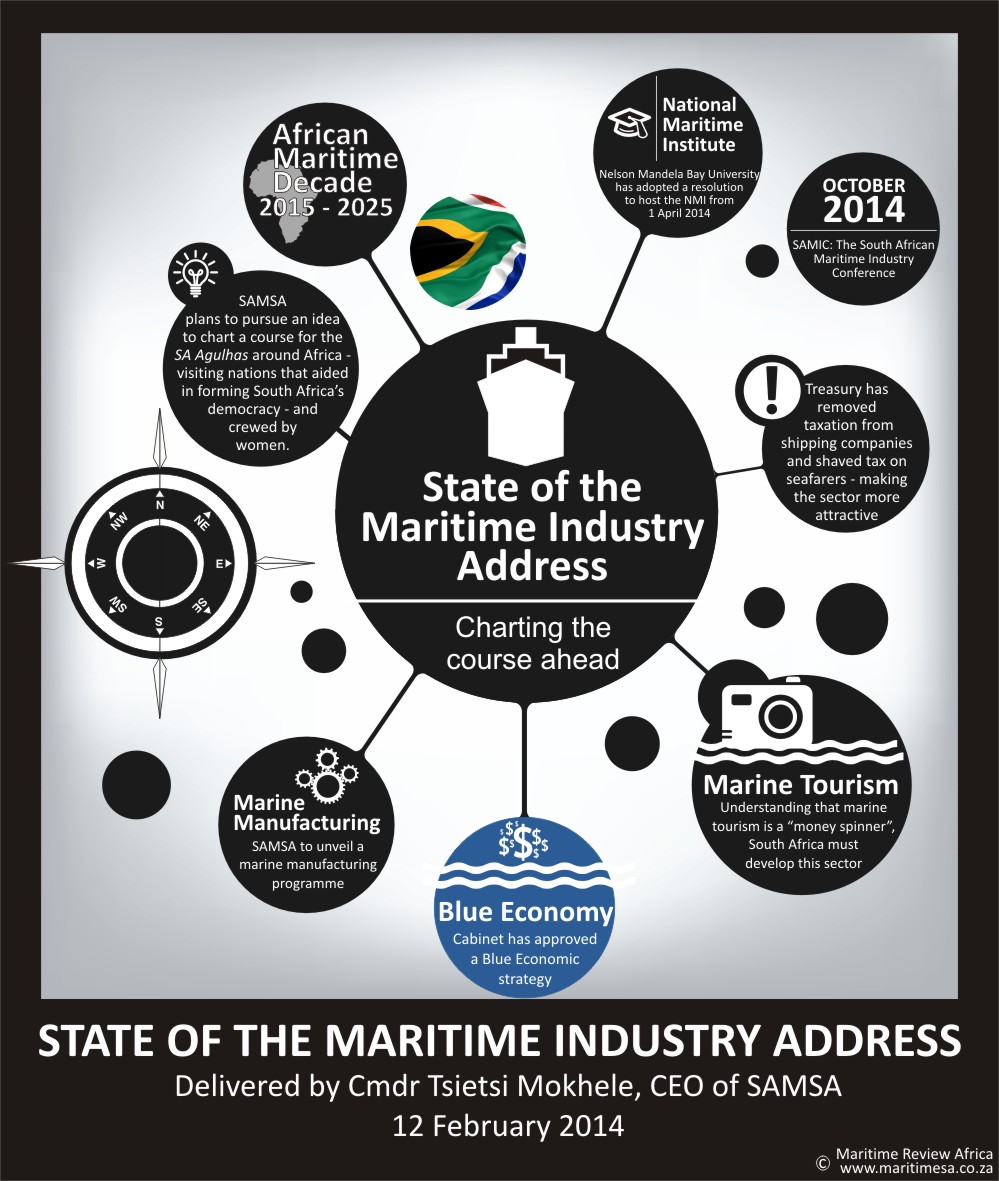
State of the Maritime Industry Address

I am not going to comment on the State of the Nation Address (SONA) made last week by President Jacob Zuma except to say I did hear him mention the maritime industry as he acknowledged the importance of the fishing industry; the need to develop our ports and the focus on oil and gas for the development of Cape Town and Saldanha Bay. I am, however, going to comment on a speech made the night before SONA by Commander Tsietsi Mokhele, CEO of the South African Maritime Safety Authority (SAMSA).

Anyone who has ever listened to the CEO speak will know that he is constantly pushing the South African maritime agenda – and it seems that, while there is still much to be done, a lot of groundwork has been covered.

State of Maritime Industry

Here are a few highlights of his speech:

TREASURY TICKS OFF TAXATION: Mokhele highlighted the decision by South African Treasury last year to remove all forms of taxation on shipping. “I never thought in my living days that I would see South Africa Treasury moving on shipping tax when we have waited and worked so hard on the tonnage tax,” he said adding that although the industry was willing to accept a nominal tax, this gesture to help develop the industry was welcomed. Treasury has shaved tax contributions of seafarers; removed taxation on the sale of assets; and paved the way for shipping companies to trade in any international currency.

“I never thought in my living days that I would see South Africa Treasury moving on shipping tax when we have waited and worked so hard on the tonnage tax.”

THE BLUE ECONOMIC STRATEGY: In a similarly positive light, Mokhele reported that Cabinet had approved The Blue Economic Strategy for the country. “It talks to helping improve the lives of our people by taking and leveraging the assets of the industry; the expertise that is there. It is a strategy about development; it is a strategy about progress – and about giving the economy an upliftment,” he said. 

THE AFRICAN MARITIME DECADE: Coupled to the approval of the African Integrated Maritime Strategy (AIMS) 2050 made by the African Union Commission at the end of January was the announcement that 2015 to 2025 would be dedicated to the maritime industry.

“It means that the maritime sector has arrived where it needed to be. It has become an asset of of our people, politically endorsed, industry recognised opportunities and communities are involved,” said Mokhele.

NATIONAL MARITIME INSTITUTE: Having completed a feasibility study to assess the impact of establishing a National Maritime Institute, SAMSA has successfully concluded a deal with the Nelson Mandela Metropolitan University. On November 12 last year, the University passed a resolution to accept the custodianship of the National Maritime Institute. According to Mokhele, the Institute will be operational from April 1 this year and will coordinate efforts in maritime education. “We are not displacing the existing infrastructure, but providing cohesion in the development of programmes that are geared to the development of technology and innovation,” he said. 

MARINE TOURISM STRATEGY: Understanding that 80 percent of the United States of America’s tourism revenue originates from marine tourism, Mokhele’s announcement that SAMSA would unveil a Maritime Tourism Strategy during the course of the year, makes sense as a strategy to open the maritime sector to new entrants.

“Water programmes sell. They sell real estate, they sell activities, they sell everything – and therefore our marine strategy is going to be inclusive of the tourism strategy that we are going to unveil before the end of this year.”

MARINE MANUFACTURING STRATEGY: Another strategy scheduled to be unveiled during the course of the year is one that speaks to the marine manufacturing sector. Mokhele spoke about the need to develop the capabilities of the ship repair and ultimately the shipbuilding sectors.  Alluding to the potential of gearing up for the offshore oil and gas industry, Mokhele said “South Africa has to gear themselves up to become the hub service centre for the gas industry that is emerging on the east, but also to play a part on the existing oil and gas industry that is already established on the west of the continent.”

CELEBRATING SOUTH AFRICA’S 20 YEARS OF DEMOCRACY: Perhaps the most ambitious plans that Mokhele revealed were those relating to a planned cruise around the African continent. He aims to see an all-female crew navigate the SA Agulhas to visit nations in Africa that supported the liberation of South Africa. The cruise aims to also set up a fund for the development of women in Africa’s maritime sectors. SAMSA will approach industry to help sponsor this initiative.

SAMIC IS BACK ON THE CALENDAR: If you remember the landmark conference initiated by SAMSA in 2012, you may be pleased to hear that it is scheduled to return to the calendar in October this year. It will be a good opportunity to report back on resolutions taken at the last edition and decide whether the industry, government and other stakeholders have stepped up to the plate to see real development of the industry.

While these topics remain the highlights of Tsietsi Mokhele’s speech, he also spoke of the success of the cadetship programme; the ambitions to see ships return to the ships registry as well as the interest from various shipping companies to source South African seafarers to crew their fleets.

Yes, he told a good story, but we still all need to roll up our sleeves and get back to work. It makes no sense to endlessly debate the merits of a report back if we are not prepared to go back to our desks – irrespective of our views – and make things happen.

Weekly Press Review – 14 February 2014

The fishing rights allocation process made headlines again this week as a discussion of a report by the fisheries department, explaining the controversial allocation process, was not discussed by the portfolio committee as scheduled.

The reason:  the appeals process is still not 100 percent complete and the report is, therefore, still  regarded as “a work in  progress.”

Needless to say there were angry responses from both DA MPs Pieter van Dalen and Annette Steyn.  They both described the urgency with which the allocation process needed to be discussed, saying there was a “crisis out there” as many fishers lost their livelihoods at the end of last year.

It is shocking that a situation which obviously requires immediate attention is not met with the urgency that is necessary to resolve the issues as quickly as possible.

In some sad news this week, a Department of Environmental Affairs technician, involved in an expedition on Gough Island has died.  Johannes Hoffman, aged 36, apparently choked on his own vomit and doctors on site were unable to save him.

Colleagues who worked with Hoffman are obviously in shock and are receiving counseling from a psychologist who is also charged with bringing Hoffman’s body back to Cape Town.

Of course, today’s media attention will focus on the president’s State of the Nation Address last night – which did at least nod in the direction of the maritime industry by mentioning the importance of the fishing industry; progress relating to port development as well as the imminent importance of the offshore oil and gas industries to Saldanha Bay and Cape Town.


Weekly Press Review – 7 February 2014

Transnet National Ports Authority (TNPA), the SA Revenue Service (SARS) and the SA Maritime Safety Authority (SAMSA) are reported to be working together to finalise “benefits that would be flourished to vessels bearing a South African flag.” (sic)  The purpose of the exercise, obviously, to attract companies to the South African ships register.

The authorities are looking for a collection of benefits from various sources, not only port-related benefits.  Tau Morwe, TNPA chief executive, said:  “We could look at benefits such as berthing priority.  We could look at benefits in terms of port costs and benefits of what actually happens in ports.”

It would seem that things are moving in a positive direction with regard to securing vessels for the South African ships’ registrar.  The major players are  working together to come up with a plan that will really excite, inspire and motivate ship owners to look at the South African ships registry as a realistic and preferred option.

This week, the Italian flagship aircraft carrier, Cavour, docked in Cape Town on a truly humanitarian mission.  The vessel is functioning as a mobile hospital.  In conjunction with the Red Cross and the Operation Smile, the staff of 40 volunteer medical professionals on board are here to perform free facial surgeries on children born with cleft lips and palates.

Italy’s ambassador to South Africa, Vincenzo Schioppa, said, “This is not a ship for war.  This is a ship for peace, a ship for friendship and for collaboration.”

Australia’s shark culling programme made headlines again this week as a group of South African protesters gathered outside the Cape Town International Convention Centre to protest the culling.  It is good to see South Africans supporting wildlife concerns in other countries, although I suspect the demonstration would have made little impact on Australian shores.  Interesting that we do not see much protesting to protect our own endangered wildlife being “culled “on an almost daily basis.

Finally, the South Africa Ship Society hosted a viewing of the documentary “Nazi Titanic” earlier this week.  We invite those present to please offer some feedback.