Weekly Press Review – 2 October 2015

The tragedy aboard the MFV Lincoln which ran into trouble near False Bay resulting in the deaths of 11 fishermen received a lot of coverage in the press this week.  The search for the remaining missing crew member continues.

According to survivor Peter Julies, the weather was extremely turbulent and the boat started taking water on the port side.  Soon the boat was leaning completely to the one side.

“I jumped from the starboard side into the freezing water.  Soon I could not feel my legs.  The rain was pelting and the gale-force wind had no mercy.  Fortunately help did not take too long.  But it was too late for some of my friends.”

The Financial Director of Viking Fishing, who own the vessel, said that their first priority was to support the families of those who lost loved ones.

The vessel has been towed to Cape Town harbour and SAMSA is investigating the incident.

History was made this week with the vessel, the Cape Orchid, being the first merchant vessel to register in South Africa since 1985.

Tsietsi Mokhele, SAMSA chief executive said, “About 98 percent of the country’s internationally bound trade is carried by ships and at least R160bn a year is paid for shipping services to foreign owners and operators.”

The Department of Transport said that the Cape Orchid “would be a boost to our maritime economy.”

According to the press many residents from Walker Bay are expressing their concern about mother and baby whales being harassed by over eager onlookers entering the bay during the whale breeding season and disturbing the mammals.

The question has been raised as to why the Department of Environmental Affairs is not monitoring whale-watching tourism boats and other vessels in the bay.  Residents are saying that complaints to government, the local authority and the tourism body are simply receiving no response.

Environmental Affairs Oceans and Coasts spokesperson Zolile Nqayi confirmed that Walker Bay was in fact a sanctuary and that no unauthorised boats were allowed in the bay during whale season.

He appealed to the public to report any incidents of boats getting to close to the whales to the department.

Access denied: flirting with the maritime economy?

There’s a general movement that is gaining traction in the maritime sectors that aims to boost the industry’s contribution to job creation and the GDP. The Blue Economy is on everyone’s lips and national, regional, continental and even international strategies are being developed to see our oceans contribute meaningfully to our human desire to produce and prosper.

With so much attention it should, therefore, not be surprising to see a whole new set of eyes flirting with the possibility of developing a long term relationship with the ocean sector. It’s time to give them a dance ticket and allow them onto the dance floor.

At the South African Maritime Industry Conference (SAMIC) organised some three years ago by the South African Maritime Safety Authority (SAMSA), there were people from every sector and plenty who saw themselves as merely standing on the side line hoping for an opportunity to show their moves.

Paul Maclons, Managing Director of Smit Amandla Marine, was unequivocal in his statement during one of the panel discussions at the conference: that the solution for a full and inclusive dance floor was not in promoting the practice of cutting in on existing dancers – but rather on extending the party and mixing it up from the DJ’s box. Well, okay Paul did not mention anything about dancing or DJ’s, but his message was clear – we need to expand the industry to accommodate newcomers.

The truth is though that the industry is expanding and there are more opportunities, but equally the economic reality of a capital-intensive international industry is seeing more consolidation and joint ventures as existing companies seek relationships with other established partners that can offer them the opportunity to extend their own dance cards.

Does that mean that there is no opportunity for newcomers? Are they destined always to be wallflowers?

The quick answer to that has to be NO! There are some newcomers to the industry aiming to show off their signature moves on the dance floor. Our job is not to stop mid beat and point or jeer. Our job is to make sure that there is space for them even if their rhythm is a little different to ours. Our job is to learn a little from the new beat.

This year’s SAMSA Maritime Industry Awards aims to recognise the new dancers on our floor. If you’ve recently launched or know of a company that has launched into our space – please take the time to nominate. It takes courage to start something in any industry and especially into one so entrusted to the “old guard”.

http://www.maritimeawards.co.za  


What is a Maritime Maestro?

Maritime Maestros have salt in their veins. They are committed to the industry in a way that goes beyond the scope of a 9 to 5 job description. They give passionately and devote their energies to develop the future of the industry as a whole. They lead the industry and often pioneer new paths – they are Maritime Maestros.

Two years ago we recognised Okke Grapow as a Maritime Maestro at the 2012/13 SAMSA Maritime Industry Awards. He was living out his maritime family heritage that had been passed down to him from his father and subsequently onto his own children. His dedication to offer himself beyond the confines of a 9 to 5 servant to the industry certainly benefitted the development of the South African maritime industry – and today he continues to inspire others.

This year we are once again appealing to the industry to get out of their comfort zones and to start to recognise the impact that their peers, colleagues and even competitors are making in the industry. Nominations are open for the 2014/15 SAMSA Maritime Industry Awards. Read more about the various categories and start nominating today!

http://www.maritimeawards.co.za


Have you read the Minister’s speech?

Have you read the Minister’s speech? That’s the question being most asked this month at maritime functions and it refers to Minister of Transport, Dipuo Peters’ discourse at the South African Maritime Safety Authority’s (SAMSA) AGM at the end of September where she called for “immediate action from the (SAMSA) Board in order to resolve the appalling state of affairs at SAMSA”.

What usually follows the opening question in these chats amongst maritime colleagues are the knowing nods and ensuing discussion on the schism that we all believe to exist between the Department of Transport and its subsidiary body – as if this could be the explanation as to why the minister was so severe in her deliberations.

This leads into a conversation on the three pillars of SAMSA’s mandate and how many seem to believe that it is clear that the Authority has taken to heart the third point: to promote South Africa’s maritime interests as its over-arching purpose – perhaps to the detriment of the first two tenets of its existence which relate to the preservation of life, environment and property at sea.

It is an interesting dilemma for the industry. We’ve lauded the Authority, and particularly its CEO Commander Tsietsi Mokhele, for his foresight and passion to champion the maritime cause. We’ve watched him weave the maritime thread into the government conversation. And, as we begin to see a level of recognition across a number of government departments, we are told take stock of an entity that requires some oversight.

One cannot fain surprise that expenditure on conferences and advertisements ballooned from R12m in 2012 to R54 million in 2013. Most conference organisers and many publications have viewed the Authority as an unofficial Lotto pay-out as they cashed in their rate cards and sponsorship tiers. SAMSA has been visual at most events on the calendar including one hosted by us – the Maritime Industry Awards.

Was this a waste of resources? I dare to say that a little discernment could have been applied, but that some of the television slots highlighting the cadets on the SA Agulhas were well timed and could have contributed to a broader maritime awareness amongst our youth. So too do career and job summits, but a rubber stamp of approval associated with the sponsorship and exhibition stands of just about every maritime exhibition and conference could have been undertaken with some introspection.

What the industry has been waiting for is a follow-up to the successful and refreshingly different South African Maritime Industry Conference (SAMIC). Organised by the Authority, the conference has the ability to knock many conferences off the calendar by providing one unified thought tank for the industry.

Envisioned to fill a gap left by the demise of the National Maritime Conference of the 1990’s organised by industry for industry – SAMIC was well positioned to meet the needs of an industry ready and willing to move forward. It seems a pity, however, that this conference, anticipated to take place before the end of 2014, may now never take its rightful place on the calendar.

But this is not the only reason the minister pegs the Authority to be “in serious trouble”. Citing plummeting cash flows (a 350 percent decline), irregular expenditure (R28.8 million), fruitless and wasteful expenditure (R1.1 million), a total asset decline of 96 percent and the cost escalation associated to the SA Agulhas of 31 percent – Peters did not mince her words when she asked that “immediate actions be taken” to make the entity viable and able to deliver on its legislative mandate.

The SA Agulhas may lie at the heart of many of SAMSA’s reported woes, but most in the industry will agree that the Authority’s sheer determination to create a dedicated training vessel for their cadetship programme should not go unapplauded. It was never going to be an easy or cheap endeavour – something that is clearly realised by the Authority. Their Annual Report highlights the need for projects such as the cadetship programme and the SA Agulhas to be funded externally.

“Projects will therefore be funded only to the extent to which project funding is available and the organisation’s core revenue will not be used. The SA Agulhas and the cadetship projects, which contributed significantly to the deficits will soon no longer be funded by SAMSA,” it states in the report.

But perhaps what is most alarming and does not come across clearly in the visually alluring Annual Report is the “lack of reliability of reported information”. The Annual Report provides performance targets that are generally reported as being met or at least mostly met, but the Auditor General raises concerns that these targets are “not specific, measurable or time bound”.

In addition, what is not evident in the Annual Report, but is highlighted in the Minister’s speech is anomalies of data – or data spike for the fourth quarter of the reported year. For instance the tally of inspections of both local and foreign going vessels catapults rather unrealistically in the fourth quarter – calling into question the validity of what is presented.

Similarly, although a 100 percent target of audited training institutions is reported at year-end, according to the speech, data allegedly reveals that no audits were carried out within the first three quarters of the year.

“The fact that the auditors could not validate the performance results and that the third quarter results of some KPI’s seem to be far apart from the fourth quarter results, call for an objective independent performance audit of the 2013/2014 performance information,” she says.

With much more fodder to chew on in both the Annual Report as well as Minister Peters’ speech, it would be unfair to try and unpack the issues here. And as transport month draws to a close and we mull the pronouncements of Operation Phakisa, perhaps our closing issue of Maritime Review Africa for the year will delve a little deeper into the state of South Africa as a maritime nation on the continent.

If you have anything to say on this topic, we welcome your input both on and off the record.

THE ABOVE ARTICLE APPEARS AS THE EDITOR’S COLUMN IN THE SEPT/OCTOBER ISSUE OF MARITIME REVIEW
You can read the full magazine HERE

Weekly Press Review – 7 March 2014

The Department of Agriculture, Forestry and Fisheries (DAFF) is back in the news this week with staff of the fisheries branch handing a document to members of parliament complaining of: wasteful expenditure, fraud, nepotism and the scrapping of critical posts.

Urgent intervention has been called for.

To add to the Department’s woes a large group of people from local coastal towns descended on the city this week to hand over an official memorandum addressed to DAFF Minister, Tina Joemat-Pettersson and director-general Edith Vries, calling for the reinstatement of ousted fisheries chief Desmond Stevens.

Stevens was removed from his position after he was vocal about feeling slighted by the Minister’s comments that there seemed to be “legitimate concerns, either relating to poor administration of the fishing rights allocation process or questionable judgments by the elected officials.” She has called for an audit to investigate the matter.

Those calling for Stevens’ reinstatement described him as accessible and approachable with a “passion about transforming the fishing sector.”

We all know that it is impossible to please all of the people, all of the time, but it would seem that DAFF is unable to please any of the people, any of the time.

On a more somber note, the body Department of Environmental Affairs technician, Johannes Hoffman, who died on Gough Island last week, has been returned to Cape Town. Our condolences to his family and colleagues.

The penguins of the Stony Point Penguin Colony near Betty’s Bay are still being closely monitored this week, after 10 000 litres of diesel was spilled when a fishing trawler ran aground in the area.

About 4,000 penguins and 400 nests of various seabirds were exposed to the spilled diesel and the area was temporarily closed as authorities examined the birds for diesel contamination.

The South African Maritime Safety Authority (SAMSA) principal said that fortunately the spilled diesel would eventually evaporate and would not remain an environmental threat forever. That is good news, but does not help those birds already contaminated.

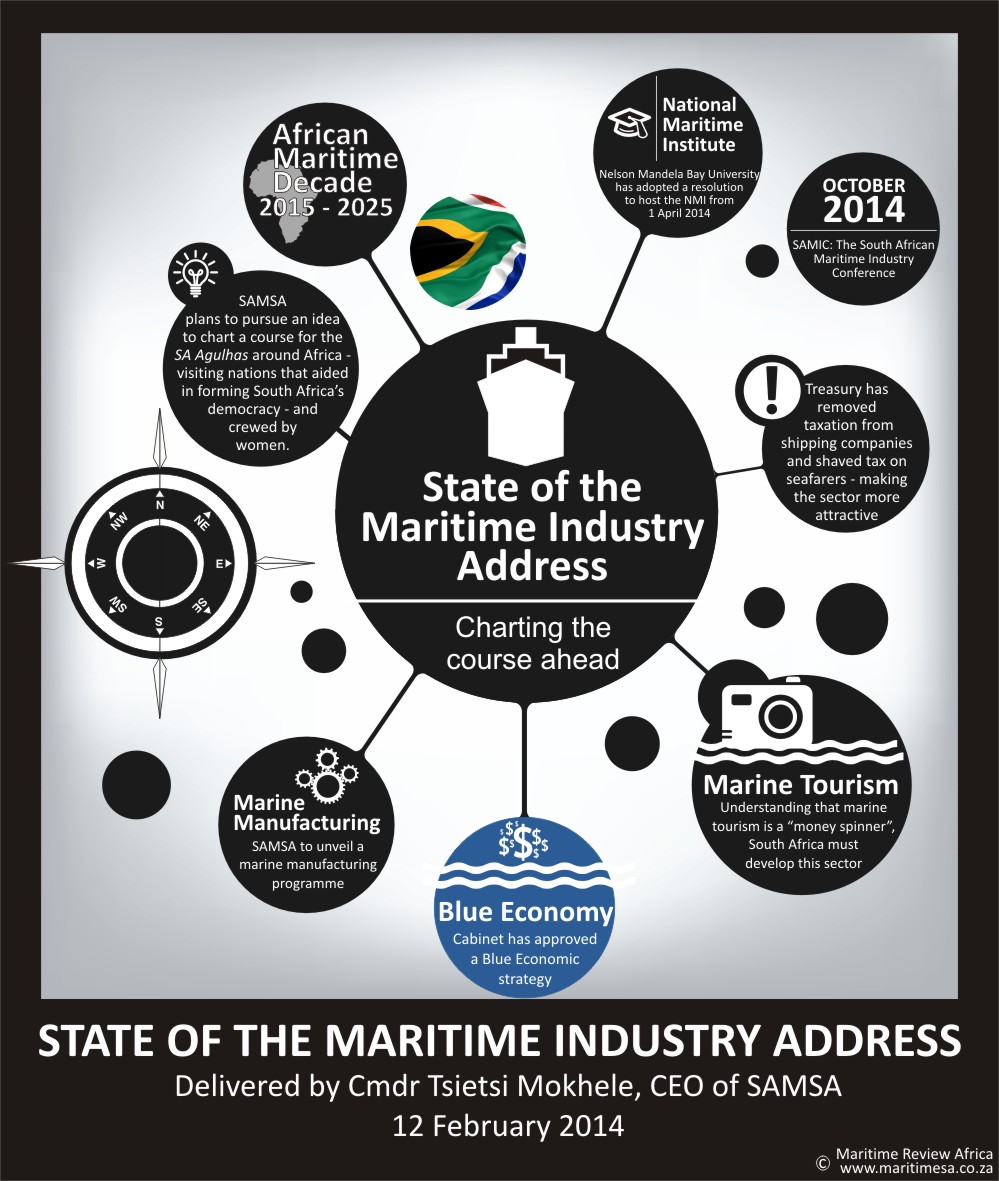
State of the Maritime Industry Address

I am not going to comment on the State of the Nation Address (SONA) made last week by President Jacob Zuma except to say I did hear him mention the maritime industry as he acknowledged the importance of the fishing industry; the need to develop our ports and the focus on oil and gas for the development of Cape Town and Saldanha Bay. I am, however, going to comment on a speech made the night before SONA by Commander Tsietsi Mokhele, CEO of the South African Maritime Safety Authority (SAMSA).

Anyone who has ever listened to the CEO speak will know that he is constantly pushing the South African maritime agenda – and it seems that, while there is still much to be done, a lot of groundwork has been covered.

State of Maritime Industry

Here are a few highlights of his speech:

TREASURY TICKS OFF TAXATION: Mokhele highlighted the decision by South African Treasury last year to remove all forms of taxation on shipping. “I never thought in my living days that I would see South Africa Treasury moving on shipping tax when we have waited and worked so hard on the tonnage tax,” he said adding that although the industry was willing to accept a nominal tax, this gesture to help develop the industry was welcomed. Treasury has shaved tax contributions of seafarers; removed taxation on the sale of assets; and paved the way for shipping companies to trade in any international currency.

“I never thought in my living days that I would see South Africa Treasury moving on shipping tax when we have waited and worked so hard on the tonnage tax.”

THE BLUE ECONOMIC STRATEGY: In a similarly positive light, Mokhele reported that Cabinet had approved The Blue Economic Strategy for the country. “It talks to helping improve the lives of our people by taking and leveraging the assets of the industry; the expertise that is there. It is a strategy about development; it is a strategy about progress – and about giving the economy an upliftment,” he said. 

THE AFRICAN MARITIME DECADE: Coupled to the approval of the African Integrated Maritime Strategy (AIMS) 2050 made by the African Union Commission at the end of January was the announcement that 2015 to 2025 would be dedicated to the maritime industry.

“It means that the maritime sector has arrived where it needed to be. It has become an asset of of our people, politically endorsed, industry recognised opportunities and communities are involved,” said Mokhele.

NATIONAL MARITIME INSTITUTE: Having completed a feasibility study to assess the impact of establishing a National Maritime Institute, SAMSA has successfully concluded a deal with the Nelson Mandela Metropolitan University. On November 12 last year, the University passed a resolution to accept the custodianship of the National Maritime Institute. According to Mokhele, the Institute will be operational from April 1 this year and will coordinate efforts in maritime education. “We are not displacing the existing infrastructure, but providing cohesion in the development of programmes that are geared to the development of technology and innovation,” he said. 

MARINE TOURISM STRATEGY: Understanding that 80 percent of the United States of America’s tourism revenue originates from marine tourism, Mokhele’s announcement that SAMSA would unveil a Maritime Tourism Strategy during the course of the year, makes sense as a strategy to open the maritime sector to new entrants.

“Water programmes sell. They sell real estate, they sell activities, they sell everything – and therefore our marine strategy is going to be inclusive of the tourism strategy that we are going to unveil before the end of this year.”

MARINE MANUFACTURING STRATEGY: Another strategy scheduled to be unveiled during the course of the year is one that speaks to the marine manufacturing sector. Mokhele spoke about the need to develop the capabilities of the ship repair and ultimately the shipbuilding sectors.  Alluding to the potential of gearing up for the offshore oil and gas industry, Mokhele said “South Africa has to gear themselves up to become the hub service centre for the gas industry that is emerging on the east, but also to play a part on the existing oil and gas industry that is already established on the west of the continent.”

CELEBRATING SOUTH AFRICA’S 20 YEARS OF DEMOCRACY: Perhaps the most ambitious plans that Mokhele revealed were those relating to a planned cruise around the African continent. He aims to see an all-female crew navigate the SA Agulhas to visit nations in Africa that supported the liberation of South Africa. The cruise aims to also set up a fund for the development of women in Africa’s maritime sectors. SAMSA will approach industry to help sponsor this initiative.

SAMIC IS BACK ON THE CALENDAR: If you remember the landmark conference initiated by SAMSA in 2012, you may be pleased to hear that it is scheduled to return to the calendar in October this year. It will be a good opportunity to report back on resolutions taken at the last edition and decide whether the industry, government and other stakeholders have stepped up to the plate to see real development of the industry.

While these topics remain the highlights of Tsietsi Mokhele’s speech, he also spoke of the success of the cadetship programme; the ambitions to see ships return to the ships registry as well as the interest from various shipping companies to source South African seafarers to crew their fleets.

Yes, he told a good story, but we still all need to roll up our sleeves and get back to work. It makes no sense to endlessly debate the merits of a report back if we are not prepared to go back to our desks – irrespective of our views – and make things happen.

Weekly Press Review – 7 February 2014

Transnet National Ports Authority (TNPA), the SA Revenue Service (SARS) and the SA Maritime Safety Authority (SAMSA) are reported to be working together to finalise “benefits that would be flourished to vessels bearing a South African flag.” (sic)  The purpose of the exercise, obviously, to attract companies to the South African ships register.

The authorities are looking for a collection of benefits from various sources, not only port-related benefits.  Tau Morwe, TNPA chief executive, said:  “We could look at benefits such as berthing priority.  We could look at benefits in terms of port costs and benefits of what actually happens in ports.”

It would seem that things are moving in a positive direction with regard to securing vessels for the South African ships’ registrar.  The major players are  working together to come up with a plan that will really excite, inspire and motivate ship owners to look at the South African ships registry as a realistic and preferred option.

This week, the Italian flagship aircraft carrier, Cavour, docked in Cape Town on a truly humanitarian mission.  The vessel is functioning as a mobile hospital.  In conjunction with the Red Cross and the Operation Smile, the staff of 40 volunteer medical professionals on board are here to perform free facial surgeries on children born with cleft lips and palates.

Italy’s ambassador to South Africa, Vincenzo Schioppa, said, “This is not a ship for war.  This is a ship for peace, a ship for friendship and for collaboration.”

Australia’s shark culling programme made headlines again this week as a group of South African protesters gathered outside the Cape Town International Convention Centre to protest the culling.  It is good to see South Africans supporting wildlife concerns in other countries, although I suspect the demonstration would have made little impact on Australian shores.  Interesting that we do not see much protesting to protect our own endangered wildlife being “culled “on an almost daily basis.

Finally, the South Africa Ship Society hosted a viewing of the documentary “Nazi Titanic” earlier this week.  We invite those present to please offer some feedback.

Weekly Press Review – 24 January 2014

A case of “modern day slavery” has made the headlines this week when ten foreign vessels were found to be fishing illegally off the coast of South Africa.

The fisheries patrol vessel Victoria Mxenge escorted three of the vessels from offshore Camps Bay to Cape Town harbour and the vessels were seized. The crew onboard, who were mainly Taiwanese and Indonesian, were found to be working in horrific conditions and many had been working for up to five years without pay.

Bernard Ledemann of fisheries’ law enforcement said, “It was basically modern-day slavery. If we had not intervened this treatment would have gone on unnoticed. At least we have got the vessels out of commission.”

According to SAMSA the vessels were not fit to sail. On investigation another seven vessels belonging to the same owner were found docked in Cape Town harbour.

The fisheries department is following up with the owners and the vessels are to be forfeited to the department.

Local fishermen are now turning to the law in an attempt to force the Department of Agriculture, Forestry and Fisheries (DAFF) to review and set aside the linefish rights allocation process.

The SA Commercial Linefish Association has given chairman Wally Croome the mandate to apply to the courts to have the decisions made by DAFF re-examined. Croome says, “The only way forward is to go for a court interdict and challenge this process.”

DAFF maintains that the allocation process has been fair and legal, but still encourages fishermen to submit their appeals.

Many a struggle ahead as the fishing rights allocation process goes on …… and on.

Weekly Press Review

The issue of South Africa’s ship register was back in the press this week.  According to a report by the South African Maritime Safety Authority (SAMSA), South Africa’s ship register is largely regarded as “uncompetitive”, resulting in not a single merchant ship being listed.  “This means that South Africa’s economy and its security of trade are dependent on ships owned and regulated in foreign countries.”

According to the newspaper reports, the issue relates to South African companies choosing to flag their vessels in foreign jurisdictions.

SAMSA believes that If we want to see the South African maritime economy truly boom, we need to find a way to offer ship owners incentives to flag their vessels in South Africa. We believe the issue is not so black and white and will pursue this debate further in the magazine.

On a less serious note, but still maritime related, a large male fur seal caused some minor traffic congestion after wandering from the dunes to find some warmth on the tar of Baden Powell drive in Muizenberg.

The SPCA was called and Wildlife Unit manager Brett Glasby responded to the call.  “When I got there, the male seal was still lying in the middle of the road and traffic officials were diverting traffic around it.  I just used a beach towel to herd him over the dunes until the road was out of sight and he could see the ocean again.”

Looks like South Africa’s Big 5 could have a little competition from our maritime mammals.

World Maritime Day

Today is World Maritime Day today. This day, set aside for the last week of September each year, offers a day to reflect on how the maritime industry has influenced our lives over the past year and also offers an opportunity for organisations, companies and individuals to actively do something to acknowledge the people involved in an industry that so many take for granted.

This year South Africa is recognising the day with various events around the country. Transport Deputy Minister, Honourable Sindisiwe Chikunga will host the World Maritime Day Career Expo and Exhibition in Kimberley in the Northern Cape. The celebrations are being held under the theme: “Sustainable Development: International Maritime Organisation’s contribution beyond Rio+20.”
The event is being attended by school children from previously disadvantaged communities who will be given the chance to display their knowledge of the maritime sector through educational displays and exhibitions.

Schools around the Northern Cape will participate in a competition involving: ship designing, essay writing, drama and art competition.

The South African Maritime Safety Authority (SAMSA), the Department of Environmental Affairs, Transnet National Ports Authority (TNPA), Transnet Port Terminals (TPT), Grindrod Shipping Company, Smit Amandla Marine and various other key maritime stakeholders will engage with the learners, providing information surrounding various activities within the maritime industry.

The day will be closed with a gala dinner.

The South Africa Navy is also acknowledging the day and participating in the celebrations.

World Maritime Day in South Africa also serves as a platform to create awareness around the career opportunities available within the maritime industry. It’s just a bit of a pity that the industry seems to rely on the usual suspects (see the list above) to promote their sector. Where is everyone else? We should all be involved in these initiatives.

Make a note in your diaries because in September 2014 Maritime Review will challenge the entire industry to come to the party!