Worthy winner

Kelly Klaasen is currently a Fourth Engineer on Safmarine vessels and last year's winner of the SAMSA Seafarer of the Year Award. (Photo courtesy of Safmarine)

Yesterday we filmed an interview with the winner of last year’s SAMSA Seafarer of the Year Award and it was clear to see why our judging panel chose this petite and passionate youngster.

Kelly Klaasen in no ordinary seafarer. She’s the type of mariner that can inspire more of our young South Africans to sign up for a life at sea. While she understands the challenges; the commitment and the hard work required to move up the ranks at sea – she is also clear about the benefits and opportunities that her career choice has provided.

Getting ready to fly out to meet her next ship, Kelly will be at sea until about January next year. Yes, she will miss Christmas with her family, but she is ticking off places on the world map that she has visited (all expenses paid). She is also working her way up to Second Engineer and knows that one day when she comes ashore there will be plenty of job opportunities for her.

Chatting to her yesterday it was clear that this well-spoken and determined product of the Lawhill Maritime Centre at Simons Town High School is ready to do what it takes to make a success of her life and to promote the opportunities that the maritime industry holds.

Having set aside the monetary prize (R20 000) that goes with the award for future studies there is no doubt that, when the current top brass of the maritime industry are watching from the sidelines, she will be holding her own amongst a new generation of maritime executives.

The SAMSA Seafarer of the Year Award aims to identify and recognise excellence at sea. This year’s function will be held at the Cape Town International Convention Centre on 22 October and nominations close on 01 October.

If your business employs seafarers of any kind who have excelled over the last year, what are you waiting for? Take 20 minutes out of your day today and make sure that they get the recognition that they deserve. You can download the nomination form from our website (www.maritimesa.co.za) or simply fill in the criteria online.


Save the Sea Snail!

It’s a sad fact that the humble perlemoen (or abalone) will never attract the same kind of support for its conservation as the rhino or any other land animal.  There are no facebook pages calling for your support; no mountain bike rides organised to raise funds; no rallies marching the streets to voice your outrage and certainly no celebrities getting behind the cause.

Yet the illegal harvesting of abalone along our coast is as devastating as any other poaching activity and supports a wide net of underground criminal activities.

I was discussing this with our latest team member, Nelize Ernst, the other day. Nelize is a self-confessed greenie and will be helping us launch a new section in the magazine called GREEN MARINE so we were chatting about how Freshly Ground is singing to save the rhino and the Parlotones are singing in support of the Carbon Free cause – and we mused about who would be willing to put their voice behind the plight of the perlemoen.

Nelize came up with a character that we feel would be the ideal abalone champion. She suggested Jack Parow as the best candidate and I must admit I have to agree. We can picture him standing next to a skiboat on Hawston beach singing his unique brand of South African rap about the rights of this marine mollusc.

Anyway we do have one champion for the perlemoen. The Abalone Ranger made a welcome return to the magazine in the last issue and will continue to highlight the plight of the perlemoen! Watch out for our limited edition T-shirts: SAVE THE SEA SNAIL!

The Abalone Ranger rides again!

Durban visitors

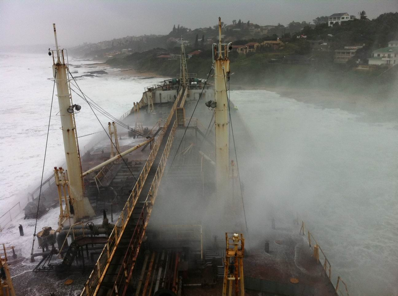
I was in Durban last week so I took the opportunity to visit Sheffield Beach and see the casualty on the rocks. What a sight! It makes a beautiful exhibit for those wanting to see what a ship looks like above and below the water line. And it is still attracting attention as well as visitors to the beach.

On the rocks at Sheffield Beach in Durban, South Africa.

The residents may not be all that stoked, but the car guards are beaming from ear to ear at the traffic turnaround in the area.

The vessel also drew the attention of the producers of Carte Blanche recently, but I must admit to being somewhat disappointed at their coverage of the incident. Apart from some deliberate editing that had a SAMSA official stating that there was no pollution from the vessel while they showed footage of small oil slick at the site – there really was nothing clever about their broadcast.

In fact, it made me reflect on some of the maritime-related press conferences that I have been to where the reporters from the daily newspapers arrive with the story already written in their heads and wait for any small quote that relates to this angle. It’s a technique that oftentimes ensures that they miss the actual story as it impacts on the maritime industry – and has me sighing when I read the story in the paper the next day.

Anyway – back to Sheffield Beach.

According to sources the plan is to try to refloat the vessel at the end of the month at high tide. Some say that this is an ambitious plan and point to the two options:

  • Refloating the vessel
  • Cutting up the vessel

It’s obvious which option would be the preferred one considering the benefits of selling the vessel as is for its scrap value. Cutting the vessel will be expensive and, given the inaccessibility of the beach, a difficult undertaking.

But there’s another question that’s been haunting me. Comparing this incident to that of the Seli 1, it is interesting that the government seems at ease with footing the salvage bill in Durban, but not in Cape Town.

Some suggest that the vessel on Sheffield beach poses more of a risk to the public, but I point to recent SAMSA directives warning ocean-users to stay clear of the Seli 1 and even some emails from residents in the area reporting coal washing up on the Blouberg beach just two weeks ago.

Well – we’ll be covering the salvage and towage sector in the next issue of Maritime Review Southern Africa so if you would like to provide some input on these two incidents, please do not hesitate to get in touch.

“Curiouser and curiouser”

One cannot help but feel a certain affiliation to poor Alice (in Wonderland) when one reads the latest statement from the South African Maritime Safety Authority (SAMSA) regarding the beaching of the MT Phoenix off Durban. With hints at a deliberate beaching; the possibility of a mystery stowaway still hiding onboard; uncertainty as to the true identity of the owners and even that the vessel was scrapped in India last year – the situation is certainly becoming “curiouser and curiouser”.

Describing the attempts undertaken by the Smit Amandla to reconnect a tow – the SAMSA statement intimates that the casualty was less than cooperative and that the crew seemed inexperienced in the basic actions required to stabilise the vessel’s position.

“It would not be the first time that an unscrupulous ship owner was prepared to sacrifice a vessel in attempt to realise the insured value,” SAMSA states.

I am not sure, however, how this relates to the fact that Lloyds Casualty Intelligence can find no record of the vessel, but reports that a vessel of “the same type, size and name” was scrapped in India in November 2010. Curiouser and curiouser indeed.

That there is uncertainty about the vessel’s owners is a little confusing. In a previous statements SAMSA is clear about their communication with the owners. Who were they communicating with if there is now doubt as to who actually owns the vessel?

And then – just to add a little more human drama to the situation – it is suspected that a stowaway may still be hiding on the vessel. Alerted by missing medical supplies, the salvage crew believe that there is still another person on the vessel and the South African Police Services will search the vessel shortly.

On a more positive note, operations to remove the pollutants from the vessel seem to be progressing and it is expected that the remainder of the fuel will be removed by tomorrow. In addition the vessel’s bow is being strengthened and preparations are being made to reconnect her to the Smit Amandla.

Oh – and just to make things a little more interesting – the Smit Amandla was called to stand-by as another tug towing a bulk carrier requested assistance off the Durban coast.  With main engine problems the Mahaweli faced gale force south westerly winds with eight metre swells. Fortunately she regained her engine power and was ordered to clear the coast.

It certainly seems that the Salvage Season has started in South Africa!


Is Durban getting her own Seli 1?

With no P&I Club cover and very little hull insurance, the MT Phoenix is currently resident at Salt Rock north of Durban. Are we looking at another Seli 1 scenario? The South African Maritime Safety Authority (SAMSA) has issued a statement saying that the owners of the tanker (which was on its way to the breakers) are “currently not responding to any communication” – a situation that should leave the vessel’s new neighbours with some real concerns.

It’s a situation that has prompted some in the industry to call for South Africa to seriously consider the benefits of appointing someone within the relevant government departments with similar jurisdiction to that of the UK’s SOSREP (Secretary of State Representative) for Maritime Salvage and Intervention.The position (and its almost unilateral powers) has gained respect in maritime circles following a number of high profile incidents off the UK coast.

The popular thinking in this regard is that, if South Africa had such a person with the requisite jurisdiction, the MT Phoenix would now be sitting safely in the port of Durban undergoing repairs before being sold at auction under the ruling which SAMSA was granted by the High Court on 22 July.

A SOSREP, you see, can override all decisions and make a call that should (theoretically) prove to be in the best interests of the environment and the safety of all concerned. He can force a port to act as a Port of Refuge in such situations where the risks of bringing the vessel into a safe haven are weighed against the risks of keeping her off port limits.

But with the lack of required insurance in place, the vessel anchored off port limits and, according to industry sources, attempted to undertake repairs at anchor. With no time to move her further out to sea or a mandate to force her into the port ahead of the storm, it is a sad consequence that she is now beached and vulnerable to further weather conditions.

It is a position that will make her hard to salvage and thus unlikely capable of recouping the expense that she is about to incur. And so the fact that “purchasers for the vessel have been identified” may prove irrelevant.

Fortunately the crew have been removed, but even their story is not without poignancy. Due to be repatriated, they will allegedly not be able to claim their wages as their remuneration was based on the successful delivery of the tanker to the scrappers!

Ranking safety at sea

Outliers by Malcolm Gladwell is a fascinating read and the section on aviation safety must surely have some bearing on the marine industry too.

In discussing a spurt of incidents attributed to one specific airline, Gladwell highlights a concept called the “Power Distance Index” (PDI).

“Power Distance is concerned with attitudes towards hierarchy, specifically with how much a particular culture values and respects authority,” he writes explaining that cultures with a high PDI will pay particular heed to levels of hierarchy and individuals will interact with each other strictly according to those hierarchies.

How this translates to behaviour in the cockpit (and arguably on the bridge of a ship) is simple. The captain is in command and his (or her) decisions should not be questioned if you are of a lower rank. Now, as rank and command are integral to the aviation and marine world, one would be forgiven for assuming that this is the correct order of business.

In his book, however, Gladwell uncovers the dangers of a high PDI culture. In investigating the series of accidents and listening to the black box recordings of cockpit communication – it was discovered that the WAY in which the lower ranks communicated with the captain had direct bearing on the actual incident.

The Korean crew (with a high PDI cultural background) understood that the hierarchy within the cockpit needed to be respected. And so, even when they saw their superiors making a dubious decision, they felt they could not undermine their authority by bringing direct attention to it.

And so the black box transcripts document their attempts to hint at potentially disastrous decisions. They simply were unable to voice a different opinion – and the captain at this stage was just too tired to pick up on the hints.

According to Gladwell it was this single discovery that marked a significant turnaround in aviation safety. Airlines began to concentrate on creating a new culture in the cockpit that allowed for the co-pilot to question authority and a specific set of prompts was created that ensured that neither the captain nor the other crew felt they were overstepping the mark.

In a very interesting footnote Gladwell lists the five highest rating PDI countries and the five lowest rating PDI countries:

Highest PDI’s:

  1. Brazil
  2. South Korea
  3. Morocco
  4. Mexico
  5. Philippines

Lowest PDI’s:

  1. United States
  2. Ireland
  3. South Africa
  4. Australia
  5. New Zealand

Remember that in this case it is better to be listed in the lowest PDI rankings. Surely this bodes well for SAMSA’s vision of creating a nation of seafarers?


It’s a dry – dock!

One of the attractions of the V&A Waterfront is that it is a working harbour. It’s the perfect way for the maritime industry to showcase itself to the general public. Usually, however, when I visit the waterfront I am struck more by the ability of the general public to ignore the “maritimeness” than by their willingness to want to engage with it.

Today as I walked passed the Robinson dry dock I was therefore pleased to see a young couple leaning over the guardrail checking out the two fishing vessels receiving attention. I could not help overhearing a snippet of their conversation:

“It’s a drydock,” he said to his girlfriend.

“A what,” she asked.

“A dry … dock,” he said even as she was turning her back and refocusing on the more commercial spoils of the Waterfront.

Yes – it’s a drydock. It’s a drydock that represents an industry in waiting. The ship repair industry, having submitted proposals for the concessioning of the ship repair facilities around the country, still awaits the outcome of this bid process.

There seems to be some speculation around what is holding up the process. Some say that more negotiations are likely to follow around the financial aspects of the proposals, while others point to Robinson drydock and the Cape Town synchrolift as being the stumbling block.

But the industry is getting impatient and one industry player was bold enough to say that if Transnet is unwilling to make a decision in this regard, then the industry needs to go to the Minister of Public Enterprise for a mandate to make this happen.

It is believed that a vibrant and rejuvenated ship repair sector will have a positive spin-off on job creation. But SATAWU has publicly opposed the move.

“We also remain opposed to the privatisation of the dry docks which should be retained under state ownership as part of the promotion and growth of a vibrant maritime sector,” SATAWU announced in their reaction to Transnet’s financial results.

Given the need to undertake a degree of much-needed maintenance in most of the facilities and given the industry’s desire to move forward – it’s a decision that needs to be taken sooner than later. And one cannot help but speculate that the maintenance required as well as the subsequent drive by the sector to bring more business to the facilities would be of benefit to the workforce.

It’s time to nominate a seafarer

Now in their second year the SAMSA Seafarer of the Year Awards celebrate the role of South African Seafarers in the country’s economy as well as their contribution to safe seas, prevention of pollution at sea and job creation.

Understanding that over 90 percent of our local trade is carried by the shipping industry; that fishing is one of the most dangerous jobs in the world; that oil companies are drilling further and further offshore and that incidents do occur at sea that require human intervention – it is clear that the men and women who choose a career at sea do so facing many challenges.

The SAMSA Seafarer of the Year Awards are designed to honour the choices that our seafarers make everytime that they go to sea. These awards, nominated by peers and employers, offer recognition of the challenging working environments and often the dangers that they face.

Culminating in a gala dinner and entertainment evening in Maritime Month (October 2011), the SAMSA Seafarer of the Year Awards go beyond thanking those that excel at sea – they aim to raise the profile of seafarers and the maritime industry as a whole in a country that is reliant on their contribution.

The inaugural awards in 2010 drew a high level of nominations from the industry and gave me a rare opportunity to interview some exceptional individuals. I am once again looking forward to engaging with those that remain the backbone of the industry.

I was also humbled by those that took the time to nominate their peers. Oftentimes we get so caught up in our own lives and issues, but  acknowledging others is such a simple way to give back to those that deserve the recognition.

Our partners in this initiative also need recognition. The South African Maritime Safety Authority (SAMSA) has once again put their weight behind the awards as the title sponsor. Smit Amandla Marine and Grindrod Limited (as employers of a great many South African seafarers) prove once again that they understand the importance of their own crew. Sea Harvest – one of our top fishing companies also partners us for the second year as does Business Partners.

Entries are now open and members of the South African maritime community can download the nomination form from our website (www.maritimesa.co.za) or nominate directly online. Click on the SAMSA Seafarer of the Year logo on the home page to learn more!


Thank you for my job

Without the ships that ply the oceans I would not have a job. It is truly that simple. Today is the International Day of the Seafarer and I am saying thank you for my job because without the men and women who commit to a career at sea we would not be able to navigate the global fleet of ships that call at our ports and carry our trade. Without them the only maritime-related industry that would be booming would be that of the ship scrappers; and the ships would be queuing off the beaches of India.

Without ships we would not need harbours or cranes and gantries. We would not need navigation equipment or engines. Salvors, importers, exporters, shipping companies, ship repairers and all those who supply our vessels with equipment or products would be out of business. Many countries would be cut off from their markets and all those shops filled with the “made in China” (or any other foreign destination) items would be largely empty.

That means that many retailers and shopping centres would no longer be able to operate effectively. They would not need to advertise and would scale down operations cutting back significantly on staff.

It is not just the marine-related industries that would falter without seafarers. Would you still have your job if men and women stopped going to sea? Today is the International Day of the Seafarer – acknowledge their impact on the world by tweeting and facebooking your vote of thanks.

Thank you for my job!

In memory of those at sea

On the 24th June 2010 a string of events culminated in the death of a young South African cadet serving on board the Safmarine Kariba. The discovery that Akhona Geveza had allegedly jumped overboard disturbed the maritime industry deeply and sent the media into a frenzy of headlines that spoke of rampant sexual abuse of cadets at sea. The next day – on the 25th June 2010 – the vessel returned to the place where Akhona had been found to hold a memorial service and lowered a floral wreath into the sea.

For some months media speculation around the actual facts surrounding the death of Akhona continued while the Croatian authorities investigated the incident. Locally Safmarine seemed perplexed that newspaper reporters had managed to uncover an apparent legacy of sexual harassment that extended beyond the current incident; and journalists did not name their sources in these allegations. Further investigations ensued and reports that the South African Maritime Safety Authority planned to conduct their own investigations surfaced this year.

In their July issue of Navigator (an inhouse publication), Safmarine devotes three pages to Akhona Geveza and the events that surrounded her death. They trace her last day onboard the Safmarine Kariba and discuss why they do not feel that the allegations of sexual misconduct existed on their fleet of vessels.

Capt Louise Angel weighs in on the debate saying; “A ship is run like a small community; this is our home for three to six months at a time and there is always someone you can turn to onboard if you have any kind of problem, and everybody generally knows everybody’s business. Our ‘bush telegraph’ onboard is finely tuned for sources of information (aka gossip) and at no time have we heard any allegations of sexual misconduct onboard any Safmarine ships.”

One cannot expect however, that those that travel our seas are always one hundred percent happy or one hundred percent at ease. Just as we experience our ups and downs in our own daily lives on land – seafarers must surely experience theirs. That we can take day off or easily seek comfort from our family or friends is something we take for granted. That we have the option of going home after a tough day in the office and relaxing with a glass of wine (or going to the gym for that matter) is another given.

Seafarers are stuck with their colleagues 24/7 for extended periods of time – a situation that must surely lead to periods of mental discomfort. For the most part they can move forward and look ahead to a time when they come ashore, but (for whatever reasons) Akhona was not able to do so and the whole maritime industry needs to acknowledge that the support systems in place failed this young cadet.

And so it is fitting that Tomas Dyrbye, CEO of Safmarine is quoted as saying; “We deeply regret any possible lapse in our duty of care which may have played a part in this sad incident and we remain deeply remorseful that we, despite our best efforts, could not have prevented Akhona’s death.”

But the industry also has to move forward. We have to continue to attract suitable candidates to engage with a career at sea and we have to continue to honour those that do.

Tomorrow is The International Day of the Seafarer. If you are in the maritime industry – what are you doing to say thank you to these men and women who have committed to the challenges at sea? In South Africa we have teamed up with some of the progressive maritime companies including Smit Amandla Marine, Grindrod and SAMSA to publicly demonstrate our appreciation. We will be participating in Flash Mobs around the country in Cape Town, Pretoria, Durban and Mossel Bay.

What are you doing?