Riding the wave of the blue economy

Since I started reporting on the maritime sector in the mid 1990’s, the industry has been complaining about the lack of recognition it receives from government. It has been one of the biggest and most constant gripes. At the beginning of the year when the African Union announced the maritime decade, it was clear that the landlocked mindset of the continent was shifting – and the South African government’s July launch of Operation Phakisa affirms that strategic thinking is taking place to develop the “blue economy”.

With the government’s emphasis on four distinct areas there are, of course, sectors of the maritime industry currently not receiving the same level of attention. A conversation with a stakeholder, however, revealed that the full spectrum of opportunities within the blue economy is being considered. He said that more details will be announced during the course of the coming months and that a document would be released highlighting the recommendations made by industry experts at the conclusion of the Ocean Lab sessions held in Durban.

With a probable second South African Maritime Industry Conference hosted by the South African Maritime Safety Authority due to be called before the end of the year, it seems likely that Operation Phakisa will take centre stage. One is not sure, however, to what extent the outcomes of the Ocean Labs will be set in stone and to what extent they will be flexible enough to accommodate further interrogation by other stakeholders omitted from the initial deliberations.

I am choosing to remain cautiously optimistic, but am not so naive as to believe that the naming of an important sounding strategy within government will necessarily provide the panacea that the industry is waiting for. Despite adopting a “quick fix” strategy from Malaysia to churn out a blue economic policy in less than six weeks, the real work will require a lot more staying power and even some unpopular decisions.

President Jacob Zuma says that he will be monitoring the progress on an ongoing basis. Well, so will I and I hope to be able to provide updates via this blog in the future.

We also welcome any feedback from industry in this regard. Please drop me an email with your thoughts or complete the survey on Operation Phakisa by clicking here.

Operation Phakisa 3

Maritime Newsmaker of the Year 2013

Last night we hosted our annual function to thank clients for their valuable support as well as to present the Maritime Newsmaker of the Year Award. The award aims to recognise individuals, companies or organisations that have garnered media attention that depicts the maritime industry in a positive way. It recognises those who have successfully showcased the industry to a wider mass audience – and in so doing have positively marketed the industry as a potential employer or career opportunity to a new generation.

Last year something happened that took me by surprise. Suddenly the world and the media became fascinated with the maritime skills and expertise of a South African who had been hand-picked to lead one of the most publicised wreck removal projects of recent years.

Locally and internationally he suddenly became a maritime celebrity as he showcased not only his own knowledge and expertise, but assembled a team of South African individuals and companies to lift the Costa Concordia under the watchful eye of the world.

Television and print media flocked to the sight of the wreck and Nick Sloane and his team must have generated more airtime and print space for the significant talent that we have than any marketing campaign could have dreamed of doing. Notwithstanding the tragedy of the shipwreck; the ensuing story of maritime ingenuity is a good one to tell.

My hope is that many of our youth would have been awoken to the wide variety of potential careers that are open to them in the industry. Careers that are demanding but immensely rewarding.

But I guess the day I happened to pick up a GQ magazine at a guesthouse to find Nick Sloane staring back at me, was the day I really realised he had helped capture media attention for maritime news that extended beyond the normal tragic story of a shipwreck to give people a real glimpse into the salvage, diving, engineering and pollution prevention sectors that seldom get a media nod of approval.

Unfortunately Nick was still on site at the wreck and remains focused on the job at hand – and so could not join us last night to receive the award. He did, however, send this message:

“I am extremely humbled to be named such a figure and would like to accept this on behalf of all South Africans involved in the offshore and salvage industry. I believe that our seamanship and work ethics are starting to be appreciated on a global basis. I would also like to thank my wife Sandra and three children for allowing me to follow my passion. From all 330 team members on the Costa Concordia at this time thank you for thinking of us in this way. I hope that we refloat mid July and that I can get home by August.” -: NICK SLOANE

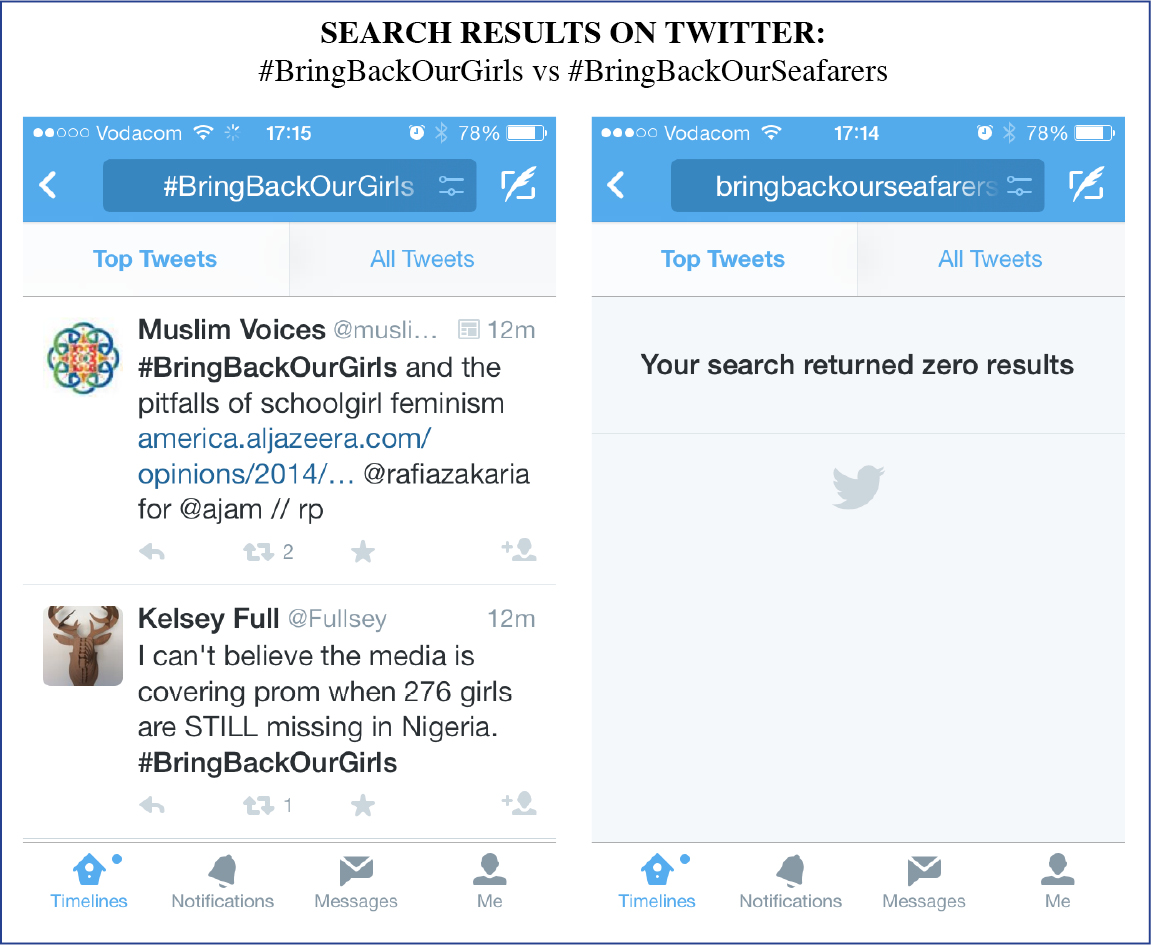
#BringBackOurSeafarers

Over the last few weeks the Bring Back Our Girls (#bringbackourgirls) campaign has ignited quite a following across the globe. Initially fueled by many people’s outrage that the media had all but ignored the story, this grew to a lambasting of international super-powers for not stepping in to assist Nigeria find the girls. Mostly the argument followed the rather simplistic course that, if this had happened to 200 white schoolgirls the media would have been all over it and that if it was a situation that jeopardised America’s access to oil then they would have sent in the troops.

This is not the place to debate either of these suppositions and certainly the plight of these girls is one of grave concern. Indeed the message to Bring Back Our Girls has gone viral and everyone is standing up in support of it: from the ANC Women’s league to individuals keen to pen, blog and tweet about it to get in on the action. Even corporates are parading employees in front of cameras and posting photos of them holding up signs with the Bring Back Our Girls message on them – some of them in the maritime industry.

So damn it – where is the #BringBackOurSeafarers campaign? Why is every shipping company, support company, port company, importer, exporter and seafarer not jumping up and down for more media coverage about the plight of 54 seafarers who are still being held hostage in deplorable conditions. According to the recently released document on the State of Maritime Piracy by Oceans Beyond Piracy these seafarers have been held in captivity for almost three years.

“Substantial work must still be done in the interest of saving the lives of the 54 high risk hostages who remain in pirate captivity almost three years after their capture. Moreover, the continued ability of pirates to hijack small vessels such as dhows and fishing vessels is a continued risk. It is important to remember that piracy is not only a threat to the free flow of goods, but also to the well-being of individual seafarers, regardless of their vessel size or nationality. It is evident that the number of hostages in captivity, while trending downward, remains of immediate relevance to counter-piracy work and should be prioritized by the maritime and international communities,” the report says. 

While I am personally doubtful of the true effectiveness of viral campaigns such as the one directed at releasing the Nigerian schoolgirls and feel they simply help us feel better about being powerless in the face of such atrocities; what if they are even slightly successful in seeing their safe return as a global eye is turned to the situation?

What if viral campaigns do prompt the appropriate action? Then the maritime industry needs to be more active in pushing the agenda. Yes we have had successful intervention at sea in the form of naval presence, armed guards and vessel hardening – but 54 seafarers are still no closer to going home. So as you spare a thought for the schoolgirls and their families – spare a thought for those seafarers and their families and consider some action. #BringBackOurSeafarers.

comparison


Tina took two hours of my time

I  wasted almost two hours of my Sunday by responding to Minister Tina Joemat-Pettersson’s invitation to a press briefing to discuss her response to the Public Protector’s report: Docked Vessels.

  • 25 minute drive to town
  • 10 minutes to park and get through parliament security
  • 10 minutes wait
  • 2 minute introduction to panel
  • 6 minutes to read press statement in English
  • 6 minutes to read press statement in Afrikaans
  • 7 minutes of largely inadequate question and answer time
  • 30 seconds of shutting books and watching the panel high tailing it out of the room
  • 10 minutes leaving parliament and returning to car
  • 25 minutes drive home

The Minister should note that should she just wish to issue a statement, that the Department of Agriculture Forestry and Fisheries’ website would probably be an appropriate place to publish a press statement. Should she wish to ensure that the journalists saw this – she could even go as far as asking her communications team to send it to their list of relevant reporters.

But to call a press conference and essentially thwart any real engagement with the journalists present is a waste of her time; the panels’ time (consisting of legal counsel and senior communications officers from the Department) and our time too.

And so what was the ultimate crux of newsworthy information at the core of her statement?

“I will be asking the North Gauteng High Court to declare that the Report including the findings and recommendations, are reviewed, corrected and/or set aside.”

Any real questions from the floor were shut down and many left unanswered such as:

  • Has she discussed the report with the president?
  • Should the report, in the main, found to be accurate and should she be appointed in her current position after the elections, would she step down?
  • What of the lack of patrol capacity and state of illegal fishing currently continuing in our waters?

I look forward to reading what the reporters from the dailies write in tomorrow’s paper and will continue to follow the progress of this story as it now proceeds into our court system.


State of the Maritime Industry Address

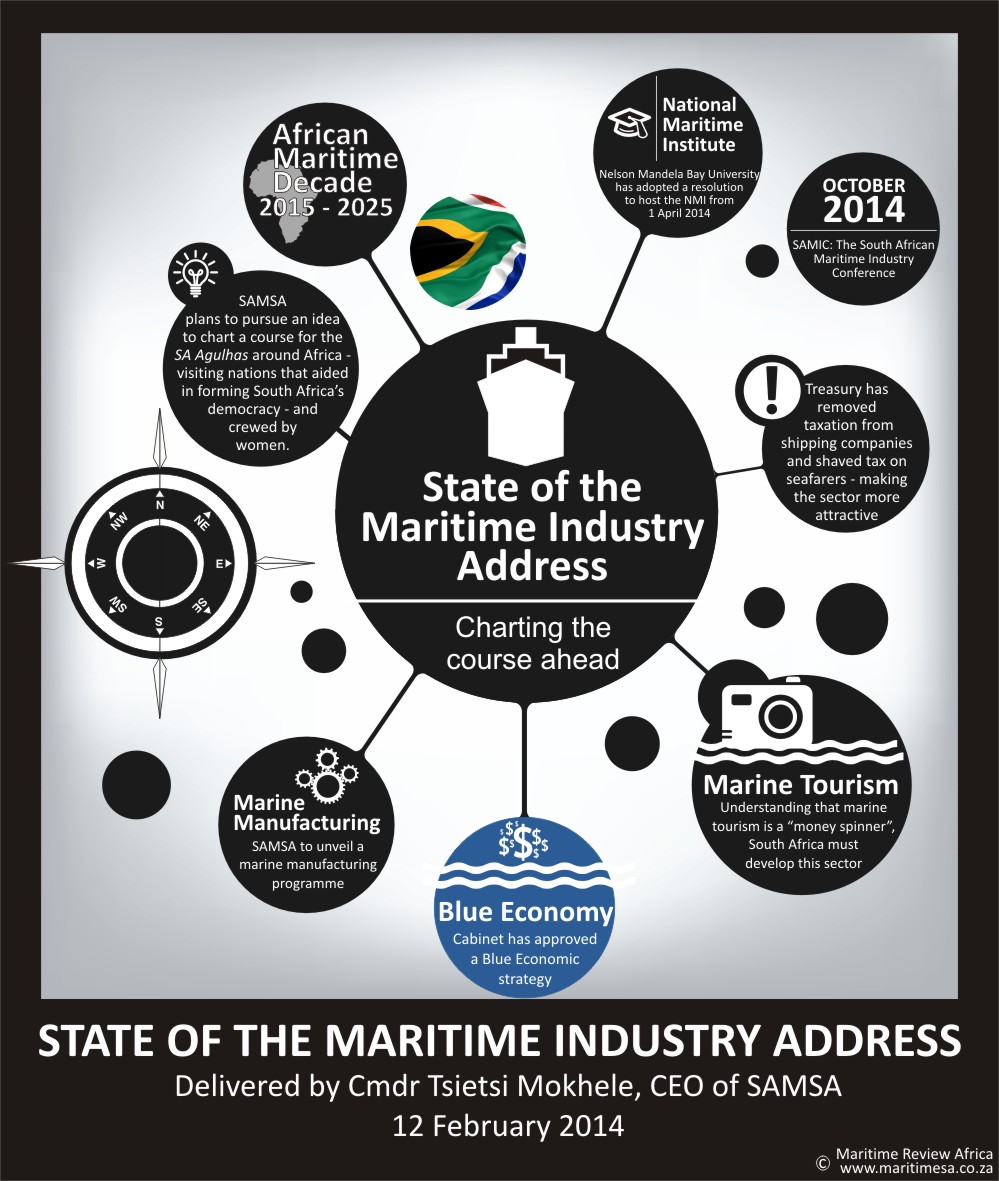
I am not going to comment on the State of the Nation Address (SONA) made last week by President Jacob Zuma except to say I did hear him mention the maritime industry as he acknowledged the importance of the fishing industry; the need to develop our ports and the focus on oil and gas for the development of Cape Town and Saldanha Bay. I am, however, going to comment on a speech made the night before SONA by Commander Tsietsi Mokhele, CEO of the South African Maritime Safety Authority (SAMSA).

Anyone who has ever listened to the CEO speak will know that he is constantly pushing the South African maritime agenda – and it seems that, while there is still much to be done, a lot of groundwork has been covered.

State of Maritime Industry

Here are a few highlights of his speech:

TREASURY TICKS OFF TAXATION: Mokhele highlighted the decision by South African Treasury last year to remove all forms of taxation on shipping. “I never thought in my living days that I would see South Africa Treasury moving on shipping tax when we have waited and worked so hard on the tonnage tax,” he said adding that although the industry was willing to accept a nominal tax, this gesture to help develop the industry was welcomed. Treasury has shaved tax contributions of seafarers; removed taxation on the sale of assets; and paved the way for shipping companies to trade in any international currency.

“I never thought in my living days that I would see South Africa Treasury moving on shipping tax when we have waited and worked so hard on the tonnage tax.”

THE BLUE ECONOMIC STRATEGY: In a similarly positive light, Mokhele reported that Cabinet had approved The Blue Economic Strategy for the country. “It talks to helping improve the lives of our people by taking and leveraging the assets of the industry; the expertise that is there. It is a strategy about development; it is a strategy about progress – and about giving the economy an upliftment,” he said. 

THE AFRICAN MARITIME DECADE: Coupled to the approval of the African Integrated Maritime Strategy (AIMS) 2050 made by the African Union Commission at the end of January was the announcement that 2015 to 2025 would be dedicated to the maritime industry.

“It means that the maritime sector has arrived where it needed to be. It has become an asset of of our people, politically endorsed, industry recognised opportunities and communities are involved,” said Mokhele.

NATIONAL MARITIME INSTITUTE: Having completed a feasibility study to assess the impact of establishing a National Maritime Institute, SAMSA has successfully concluded a deal with the Nelson Mandela Metropolitan University. On November 12 last year, the University passed a resolution to accept the custodianship of the National Maritime Institute. According to Mokhele, the Institute will be operational from April 1 this year and will coordinate efforts in maritime education. “We are not displacing the existing infrastructure, but providing cohesion in the development of programmes that are geared to the development of technology and innovation,” he said. 

MARINE TOURISM STRATEGY: Understanding that 80 percent of the United States of America’s tourism revenue originates from marine tourism, Mokhele’s announcement that SAMSA would unveil a Maritime Tourism Strategy during the course of the year, makes sense as a strategy to open the maritime sector to new entrants.

“Water programmes sell. They sell real estate, they sell activities, they sell everything – and therefore our marine strategy is going to be inclusive of the tourism strategy that we are going to unveil before the end of this year.”

MARINE MANUFACTURING STRATEGY: Another strategy scheduled to be unveiled during the course of the year is one that speaks to the marine manufacturing sector. Mokhele spoke about the need to develop the capabilities of the ship repair and ultimately the shipbuilding sectors.  Alluding to the potential of gearing up for the offshore oil and gas industry, Mokhele said “South Africa has to gear themselves up to become the hub service centre for the gas industry that is emerging on the east, but also to play a part on the existing oil and gas industry that is already established on the west of the continent.”

CELEBRATING SOUTH AFRICA’S 20 YEARS OF DEMOCRACY: Perhaps the most ambitious plans that Mokhele revealed were those relating to a planned cruise around the African continent. He aims to see an all-female crew navigate the SA Agulhas to visit nations in Africa that supported the liberation of South Africa. The cruise aims to also set up a fund for the development of women in Africa’s maritime sectors. SAMSA will approach industry to help sponsor this initiative.

SAMIC IS BACK ON THE CALENDAR: If you remember the landmark conference initiated by SAMSA in 2012, you may be pleased to hear that it is scheduled to return to the calendar in October this year. It will be a good opportunity to report back on resolutions taken at the last edition and decide whether the industry, government and other stakeholders have stepped up to the plate to see real development of the industry.

While these topics remain the highlights of Tsietsi Mokhele’s speech, he also spoke of the success of the cadetship programme; the ambitions to see ships return to the ships registry as well as the interest from various shipping companies to source South African seafarers to crew their fleets.

Yes, he told a good story, but we still all need to roll up our sleeves and get back to work. It makes no sense to endlessly debate the merits of a report back if we are not prepared to go back to our desks – irrespective of our views – and make things happen.

Link

Identifying maritime leaders

Having attended an interesting workshop on maritime leadership as part of the Third International Conference on Strategic Theory; we have decided to try and identify our current and future maritime leaders by asking you to let us know who you feel is championing the maritime agenda in South Africa.

maritime leaders

July/August Editorial Comment

MY EDITOR’S COMMENT FROM THE LATEST ISSUE OF MARITIME REVIEW:
Servest cover designThe recent grounding of the Kiani Satu grabbed media headlines towards the beginning of August. Many of the news reports were to be expected: highlighting details of leaking oil; initial unsuccessful refloating attempts; lack of availability of the patrol vessels as well as comments from concerned environmentalists and citizens. There were those, however, who seemed to use the floundering vessel as a platform to try refloat issues that have long been scuppered by factual evidence. 

Take the media report that focused on comments made by the Chairperson of the Fisheries Portfolio Committee, Lulu Johnson for example.  Mr Johnson chose to lay blame for the lack of readiness of the DAFF patrol vessels at the door of Smit Amandla Marine.

I’ve heard him say it before and he was quoted again saying; “They (Smit Amandla Marine) have got away with murder”.  It is rather a simplistic summation that makes little sense against the almost two-year drama that now surrounds the  cancellation of the vessel management tender; the transfer of the vessels into and then out of the SA Navy – and the current contract which aims to get the vessels operational again.

Documents and reports exist in the public domain clearly disputing this “fact” that Johnson is so determined to  try to qualify. His argument that Smit Amandla Marine handed over a fleet of unseaworthy vessels has even been disputed by the Department of Agriculture, Forestry and Fisheries (DAFF) themselves.

So, Mr Johnson, here are some facts for you to consider. At the time of the vessel handover from Smit, independent third party marine surveyors were contracted to verify the condition and inventories of the vessels. In addition, DAFF was provided with a full risk assessment, which raised a number of concerns the company had.

They specifically emphasised the risks associated with the Africana and DAFF was warned about the consequences of laying the vessels up “inappropriately”. At the time of the handover, the vessels were seaworthy and all statutory certificates were valid.

It would, however, be accurate to note that the vessel is old and that, as admitted by Smit Amandla Marine at the time, she did require some key maintenance work including a main engine overhaul, pipe work, hydraulic and steel work as well as an overhaul of the onboard electronic systems.

That these projects were not carried out is not due to mismanagement by the previous vessel management service provider, but rather due to budgetary constraints of the Department.

Ironically while Mr Johnson was pontificating and accusing the company of murderous actions; the self same company was out at sea in their well-maintained workhorse – the Smit Amandla (previously the John Ross) which is, incidentally, even older than the Africana and still going strong. Called out to the scene of the stricken Kiani Satu under the DOT casualty response contract; the Smit Amandla entered into a Lloyd’s Open Forum (LOF) and shortly thereafter invoked the SCOPIC clause.

What followed was a tremendous effort by authorities, salvors and volunteers to minimise the damage to the coast and to wildlife.

Just over a week later, the vessel was refloated and towed away from the coast.

What Mr Johsnon’s portfolio committee did successfully do was re-awaken media attention to the fact that the DAFF vessels are still not operational. At a joint press conference with Damen in May to announce the contract to affect emergency measures to get the vessels back at sea, Greta Apelgren-Narkedien noted that a period of six months was needed.

Since then the vessel management tender has been announced and the Department has yet to reveal the successful bidder. Factoring in the six months from May – perhaps we can anticipate that this announcement will come sooner rather than later to ensure that the vessels have a new home to go to when eventually certified seaworthy.

Given the controversy that dogged the previous announcement, however, there must certainly be a great deal of pressure for DAFF to get it right with no room for litigation.

The media, the current bidders and the Fisheries Portfolio Committee will be waiting to scrutinise the results.

For Shaheen Moolla, however, the portfolio committee does not have the teeth of a true watchdog – and he seems to describe them as a tame puppy when it comes to their oversight duties. You can read his concerns in this regard on page 8 of this issue.

Perhaps that’s why he has taken it upon himself to act in the capacity of the barking dog next door as he aims to make his neighbours  aware that DAFF’s house is not in order.

We said it last issue, and I’ll say it again: the last few months of this year will vindicate either DAFF or their detractors as deadlines and timelines begin to catch up with them.

Let us know what you think!

 TO SEE IF YOU QUALIFY FOR A FREE SUBSCRIPTION TO THE MAGAZINE – click here

WARNING: Women at Work!

As I prepare to put my feet up for Women’s Day tomorrow and scroll through the many newsfeeds I follow on social networks, I am suddenly reminded that the “thing to do” in media is to couple content planning to calendar events such as this. So let’s take a moment to reflect on the feminine demographic in the maritime industry.

When I started reporting on the industry way back in the mid 1990’s there were not many ladies at sea and few holding positions of any real maritime significance ashore. I remember visiting a Captain on his ship and being subjected to a bout of misplaced chivalry as he opened the doors while I had to squeeze passed his sizeable belly in the narrow passages to enter first. I remember interviewing a Managing Director of a reputable maritime company and being told at the end of an hour: “I’m sorry I did not get your name – I was too busy looking at your breasts”. And I remember meeting with a potential freelance writer for the magazine, who was himself an old salt, and him casually remarking “I’ve never worked with anyone like you before” as he gave me  a very obvious once over.

Thankfully things have changed considerably since then.

The maritime industry, however,  was not unique in its chauvinistic behaviour and now, as it did then, simply continues to be a microcosm of life ashore. Certainly there has been a shift towards attracting women into seafaring positions – similar to most professions “traditionally” associated with male dominance, but I struggle to see a real demographic gender shift at board level of the majority of maritime companies.

We’re happy to send our girls to sea; we’ll even claim bragging rights when a handful of them move up the seafaring ranks – but we are yet to see real progress within top management structures.

Now, I am the first to say that women should not be appointed to simply tick a box on some score card somewhere, but surely there are ladies of significance ready to step into these positions within our industry?

Oh – and the next time you need to have a lady break a bottle of bubbly over the hull of your newbuild, don’t simply invite the wife of some important man – look for that woman of significance in the industry and give her the honour. Because there are some truly innovative, smart, courageous, talented and forward thinking women at work in this industry.

Happy Women’s Day to all in the maritime industry – whether ashore or at sea!


Will cabinet reshuffle quell maritime momentum?

As we welcome Ms Dipuo Peters as the new Minister of Transport, one has to wonder at the rationale behind President Jacob Zuma’s cabinet restructure that will see the relatively new (and now ex) Minister of Transport, Ben Dikobe Martins, shuffle off towards the Department of Energy.

Having declared 2013 Maritime Year and called for a complete review of current and proposed maritime policy to be on his desk by July this year, Mr Martins has been replaced at what could have become a landmark milestone for the industry had this backlog  been moved forward.

Speaking to the industry in March ahead of the BRICS summit, Mr Martins was persuasive about his desire to see the maritime industry shrug off its “Cinderella status” and seemed to have tasked stakeholders in the South African Maritime Safety Authority (SAMSA) as well as the Ports’ Regulator to provide a road map (or more aptly a navigational chart) to move the sector forward.

At the same gathering Martins said: “I was not here ten years ago, but it is my responsibility to solve the obstacles and challenges that are there. I am the Minister of Transport; it is my responsibility to address the challenges.”

Well – he is no longer the Minister of Transport and so I guess it is no longer his responsibility to address these challenges. That task now falls to Ms Peters. Let us hope that she reclaims this mandate and moves it forward without loss of momentum.

If not, then I suspect the industry may well be more than a little frustrated at the thought of having to resurrect the maritime sensitisation process with a new minister.

I would be interested to get some feedback from the Presidency at the thought processes behind this latest reshuffle. Why does President Zuma believe that Ms Peters will make a more effective Minister of Transport? Is he disappointed in the progress made by Mr Martins? Will the two ministers sit down and discuss their previous portfolios with each other?

Oh – and one last question. Why are some Ministers left in positions where their effectiveness is continuously questioned – because that seems more than a little fishy to me?