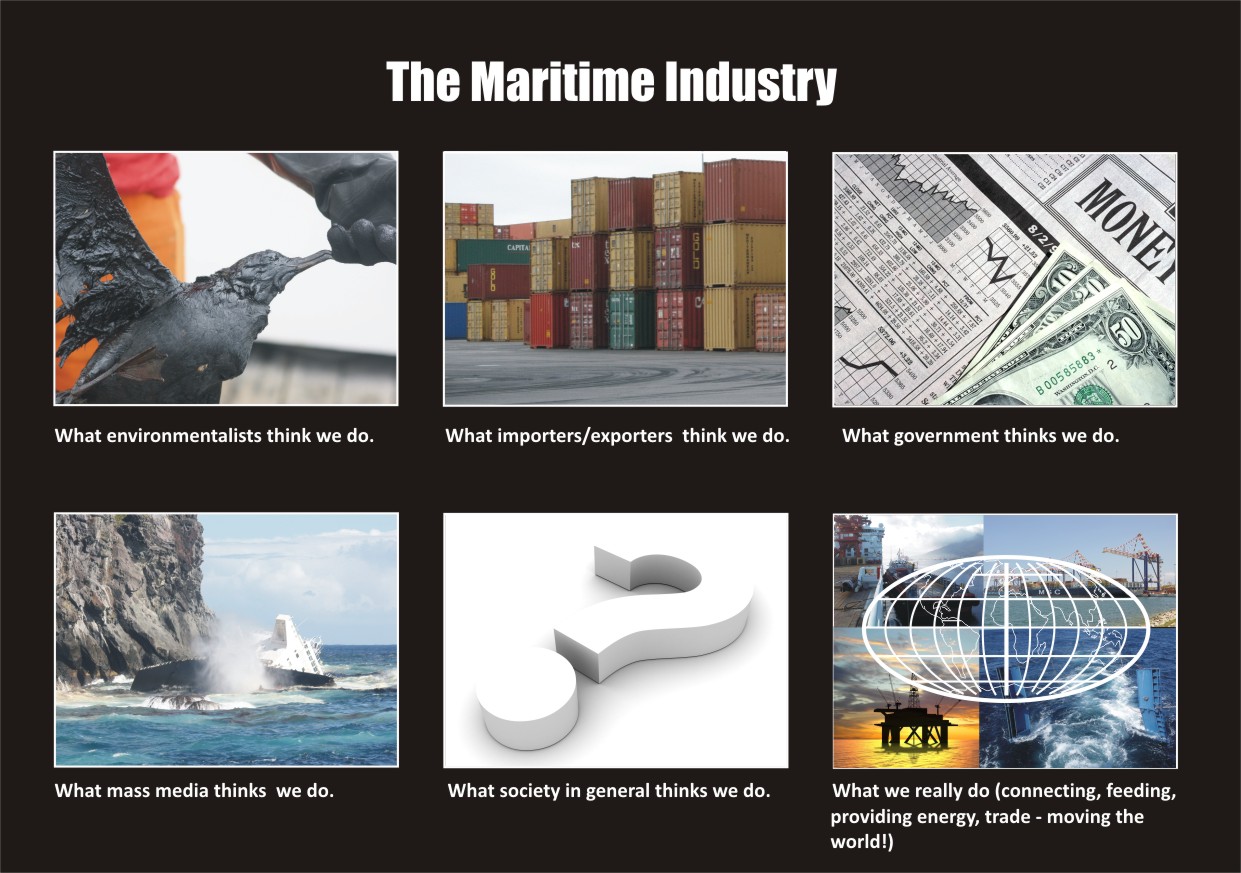
According to thedailymeme.com “Meme’s are viral and propagate around sometimes mutating as they propagate.” Many of you may have seen the widely spreading graphic (meme) that takes a type of person, a place or a profession and breaks them down into six perceptions with the last perception purporting to the the “true” perception or reality. Over January and February Facebook was literally flooded with these perception meme’s so I have created one for the maritime industry. I hope you like it:
Don’t sign a petition to save the rhino!
If you’ve ever eaten a crayfish taken illegally out of the sea, please do not sign any anti-rhino poaching petitions. If you’ve ever snuck a perlemoen out the sea or eaten one that has been, please do not sign any anti-rhino poaching petitions. If you’ve ever eaten fish in a restaurant with questionable origins or on the endangered list, please do not sign any anti-rhino poaching petitions. Hell – if you’ve ever littered on a beach, please do not sign any anti-poaching petitions.
Thousands of South Africans are getting behind the plight of the rhino and with good reason. It’s quick and easy to sign a petition or post a facebook status about how outraged you are about the massacre of these animals, but how helpful is this really?
All poaching, illegal harvesting and unregulated fishing is a consequence of market demands. It’s that simple. Without a market, there is no one to supply. The consequences are depleted oceans, deforestation, extinct species and an ailing planet.
Overfishing around the world is being driven by demanding markets willing to pay a premium to satisfy their appetite. Just how different is that to the nature of the rhino poaching problem currently being experienced in South Africa?
The solution? The solution lies in education – in educating the market that demands the product. It’s irrelevant that we in South Africa know that rhino horn is not all it’s cracked up to be – the end user of the product needs to be informed.
So why am I asking you not to sign petitions? By all means go ahead, but please do not be naive about the impact it will have – and when you do add your name to the list, give some thought to your own role in creating market demands that impact the future health of the earth and its species.
The Safmarine Way
Today I received a press release that compels a comment. Apparently Safmarine was recognised at an awards ceremony yesterday. To quote the title of the press release: “Safmarine wins coveted Containerisation International Investment in People of the Year’ award”. Surely I am not alone in finding this just a little ironic?
This award comes exactly ten days after the announcement that Safmarine’s corporate functions would be “integrated” into Maersk and certainly not outside of the memory of the closing of a certain Safmarine department based in Cape Town.
Now one does understand that the judging was done some time back, but one cannot help but think that the some 240 people likely to be affected by this latest “integration” into Maersk may well find this announcement to be a bit of a slap in the face. Especially as the press release quotes a judge saying; “The entries demonstrated just how important staff are in any organisation and what can be achieved in terms of performance and branding ….”
To his credit, Safmarine’s HR Director Con De Ruig did have the decency to allude to the recent “changes in organisational structure” when he accepted the award. “Safmarine faces its greatest test ever and will, through its people, continue to serve customers in the Safmarine Way,” he said.
While one can certainly understand that the decision to integrate Safmarine into Maersk makes complete business sense and even commend them on maintaining separate operations for so long – it surely must have been a little embarrassing to accept such an award and send out a press release of this nature so soon after announcing the Maersk integration!
Perhaps that’s just the Safmarine Way!
International Maritime Day: an opportunity lost!
Today we celebrated International Maritime Day in South Africa. It’s a great way to elevate maritime matters and showcase the potential that the various industry sectors have to offer the South African economy and employment landscape. It’s a wonderful opportunity for industry and government to come together to prove that each is serious about realising the opportunities that still exist.
So it is somewhat disappointing to sit in the airport after leaving the festivities in Richards Bay feeling a little deflated. Yesterday’s Maritime Skills Summit was a wonderful introduction to herald in this day, but today’s parade of speeches from the Department of Transport and other invited as well as uninvited speakers (with the exception of the always eloquent Tsietsi Mokhele) simply did not give the industry the attention it deserves.
And so, as I reflect on the call from some in the industry to move towards the establishment of a dedicated Ministry of Maritime Affairs, I must admit I may well get behind this call. That the Department of Transport chose to launch October as Transport month at this function is still understandable, but to allow almost the entire proceedings of International MARITIME day to be dominated by road safety issues, speed limit debates and even the seemingly impromptu advertorial for Santaco Airlines is quite unforgivable.
In retrospect I should not be surprised. At last night’s Maritime Skills Summit dinner the Department of Transport’s banner on the stage boldly advertised the Arrive Alive (road safety) campaign – and not one of their roll-up banners in the hall of the venue today related to anything vaguely maritime until the one lone banner was revealed as the Minister launched Transport Month.
Even on this banner our industry was rather side-lined as the “maritime” picture amongst the other transport-related imagery depicted a stack of containers that may well have been taken at Gauteng’s “inland port”.
Sigh – but one has to give the South African Maritime Safety Authority (SAMSA) their due. They are almost a lone drummer in the wilderness that is government and are beating a passionate rhythm for our industry.
And so surely; if we can separate Higher Education into a separate ministry that can work towards progressing the much needed change in this sphere – surely we can move maritime matters from all the disparate departments that regard them only as periphery issues into a Maritime Department that can truly advance the vision that Commander Tsietsi Mokhele is so passionately advocating.
P.S. Industry needs to show up and be counted on such days as well.
Worthy winner

Kelly Klaasen is currently a Fourth Engineer on Safmarine vessels and last year's winner of the SAMSA Seafarer of the Year Award. (Photo courtesy of Safmarine)
Yesterday we filmed an interview with the winner of last year’s SAMSA Seafarer of the Year Award and it was clear to see why our judging panel chose this petite and passionate youngster.
Kelly Klaasen in no ordinary seafarer. She’s the type of mariner that can inspire more of our young South Africans to sign up for a life at sea. While she understands the challenges; the commitment and the hard work required to move up the ranks at sea – she is also clear about the benefits and opportunities that her career choice has provided.
Getting ready to fly out to meet her next ship, Kelly will be at sea until about January next year. Yes, she will miss Christmas with her family, but she is ticking off places on the world map that she has visited (all expenses paid). She is also working her way up to Second Engineer and knows that one day when she comes ashore there will be plenty of job opportunities for her.
Chatting to her yesterday it was clear that this well-spoken and determined product of the Lawhill Maritime Centre at Simons Town High School is ready to do what it takes to make a success of her life and to promote the opportunities that the maritime industry holds.
Having set aside the monetary prize (R20 000) that goes with the award for future studies there is no doubt that, when the current top brass of the maritime industry are watching from the sidelines, she will be holding her own amongst a new generation of maritime executives.
The SAMSA Seafarer of the Year Award aims to identify and recognise excellence at sea. This year’s function will be held at the Cape Town International Convention Centre on 22 October and nominations close on 01 October.
If your business employs seafarers of any kind who have excelled over the last year, what are you waiting for? Take 20 minutes out of your day today and make sure that they get the recognition that they deserve. You can download the nomination form from our website (www.maritimesa.co.za) or simply fill in the criteria online.
Save the Sea Snail!
It’s a sad fact that the humble perlemoen (or abalone) will never attract the same kind of support for its conservation as the rhino or any other land animal. There are no facebook pages calling for your support; no mountain bike rides organised to raise funds; no rallies marching the streets to voice your outrage and certainly no celebrities getting behind the cause.
Yet the illegal harvesting of abalone along our coast is as devastating as any other poaching activity and supports a wide net of underground criminal activities.
I was discussing this with our latest team member, Nelize Ernst, the other day. Nelize is a self-confessed greenie and will be helping us launch a new section in the magazine called GREEN MARINE so we were chatting about how Freshly Ground is singing to save the rhino and the Parlotones are singing in support of the Carbon Free cause – and we mused about who would be willing to put their voice behind the plight of the perlemoen.
Nelize came up with a character that we feel would be the ideal abalone champion. She suggested Jack Parow as the best candidate and I must admit I have to agree. We can picture him standing next to a skiboat on Hawston beach singing his unique brand of South African rap about the rights of this marine mollusc.
Anyway we do have one champion for the perlemoen. The Abalone Ranger made a welcome return to the magazine in the last issue and will continue to highlight the plight of the perlemoen! Watch out for our limited edition T-shirts: SAVE THE SEA SNAIL!
Durban visitors
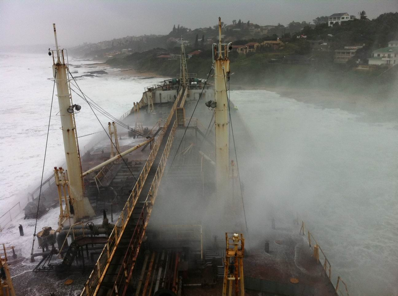
I was in Durban last week so I took the opportunity to visit Sheffield Beach and see the casualty on the rocks. What a sight! It makes a beautiful exhibit for those wanting to see what a ship looks like above and below the water line. And it is still attracting attention as well as visitors to the beach.
The residents may not be all that stoked, but the car guards are beaming from ear to ear at the traffic turnaround in the area.
The vessel also drew the attention of the producers of Carte Blanche recently, but I must admit to being somewhat disappointed at their coverage of the incident. Apart from some deliberate editing that had a SAMSA official stating that there was no pollution from the vessel while they showed footage of small oil slick at the site – there really was nothing clever about their broadcast.
In fact, it made me reflect on some of the maritime-related press conferences that I have been to where the reporters from the daily newspapers arrive with the story already written in their heads and wait for any small quote that relates to this angle. It’s a technique that oftentimes ensures that they miss the actual story as it impacts on the maritime industry – and has me sighing when I read the story in the paper the next day.
Anyway – back to Sheffield Beach.
According to sources the plan is to try to refloat the vessel at the end of the month at high tide. Some say that this is an ambitious plan and point to the two options:
- Refloating the vessel
- Cutting up the vessel
It’s obvious which option would be the preferred one considering the benefits of selling the vessel as is for its scrap value. Cutting the vessel will be expensive and, given the inaccessibility of the beach, a difficult undertaking.
But there’s another question that’s been haunting me. Comparing this incident to that of the Seli 1, it is interesting that the government seems at ease with footing the salvage bill in Durban, but not in Cape Town.
Some suggest that the vessel on Sheffield beach poses more of a risk to the public, but I point to recent SAMSA directives warning ocean-users to stay clear of the Seli 1 and even some emails from residents in the area reporting coal washing up on the Blouberg beach just two weeks ago.
Well – we’ll be covering the salvage and towage sector in the next issue of Maritime Review Southern Africa so if you would like to provide some input on these two incidents, please do not hesitate to get in touch.
“Curiouser and curiouser”
One cannot help but feel a certain affiliation to poor Alice (in Wonderland) when one reads the latest statement from the South African Maritime Safety Authority (SAMSA) regarding the beaching of the MT Phoenix off Durban. With hints at a deliberate beaching; the possibility of a mystery stowaway still hiding onboard; uncertainty as to the true identity of the owners and even that the vessel was scrapped in India last year – the situation is certainly becoming “curiouser and curiouser”.
Describing the attempts undertaken by the Smit Amandla to reconnect a tow – the SAMSA statement intimates that the casualty was less than cooperative and that the crew seemed inexperienced in the basic actions required to stabilise the vessel’s position.
“It would not be the first time that an unscrupulous ship owner was prepared to sacrifice a vessel in attempt to realise the insured value,” SAMSA states.
I am not sure, however, how this relates to the fact that Lloyds Casualty Intelligence can find no record of the vessel, but reports that a vessel of “the same type, size and name” was scrapped in India in November 2010. Curiouser and curiouser indeed.
That there is uncertainty about the vessel’s owners is a little confusing. In a previous statements SAMSA is clear about their communication with the owners. Who were they communicating with if there is now doubt as to who actually owns the vessel?
And then – just to add a little more human drama to the situation – it is suspected that a stowaway may still be hiding on the vessel. Alerted by missing medical supplies, the salvage crew believe that there is still another person on the vessel and the South African Police Services will search the vessel shortly.
On a more positive note, operations to remove the pollutants from the vessel seem to be progressing and it is expected that the remainder of the fuel will be removed by tomorrow. In addition the vessel’s bow is being strengthened and preparations are being made to reconnect her to the Smit Amandla.
Oh – and just to make things a little more interesting – the Smit Amandla was called to stand-by as another tug towing a bulk carrier requested assistance off the Durban coast. With main engine problems the Mahaweli faced gale force south westerly winds with eight metre swells. Fortunately she regained her engine power and was ordered to clear the coast.
It certainly seems that the Salvage Season has started in South Africa!
Is Durban getting her own Seli 1?
With no P&I Club cover and very little hull insurance, the MT Phoenix is currently resident at Salt Rock north of Durban. Are we looking at another Seli 1 scenario? The South African Maritime Safety Authority (SAMSA) has issued a statement saying that the owners of the tanker (which was on its way to the breakers) are “currently not responding to any communication” – a situation that should leave the vessel’s new neighbours with some real concerns.
It’s a situation that has prompted some in the industry to call for South Africa to seriously consider the benefits of appointing someone within the relevant government departments with similar jurisdiction to that of the UK’s SOSREP (Secretary of State Representative) for Maritime Salvage and Intervention.The position (and its almost unilateral powers) has gained respect in maritime circles following a number of high profile incidents off the UK coast.
The popular thinking in this regard is that, if South Africa had such a person with the requisite jurisdiction, the MT Phoenix would now be sitting safely in the port of Durban undergoing repairs before being sold at auction under the ruling which SAMSA was granted by the High Court on 22 July.
A SOSREP, you see, can override all decisions and make a call that should (theoretically) prove to be in the best interests of the environment and the safety of all concerned. He can force a port to act as a Port of Refuge in such situations where the risks of bringing the vessel into a safe haven are weighed against the risks of keeping her off port limits.
But with the lack of required insurance in place, the vessel anchored off port limits and, according to industry sources, attempted to undertake repairs at anchor. With no time to move her further out to sea or a mandate to force her into the port ahead of the storm, it is a sad consequence that she is now beached and vulnerable to further weather conditions.
It is a position that will make her hard to salvage and thus unlikely capable of recouping the expense that she is about to incur. And so the fact that “purchasers for the vessel have been identified” may prove irrelevant.
Fortunately the crew have been removed, but even their story is not without poignancy. Due to be repatriated, they will allegedly not be able to claim their wages as their remuneration was based on the successful delivery of the tanker to the scrappers!
Ranking safety at sea
Outliers by Malcolm Gladwell is a fascinating read and the section on aviation safety must surely have some bearing on the marine industry too.
In discussing a spurt of incidents attributed to one specific airline, Gladwell highlights a concept called the “Power Distance Index” (PDI).
“Power Distance is concerned with attitudes towards hierarchy, specifically with how much a particular culture values and respects authority,” he writes explaining that cultures with a high PDI will pay particular heed to levels of hierarchy and individuals will interact with each other strictly according to those hierarchies.
How this translates to behaviour in the cockpit (and arguably on the bridge of a ship) is simple. The captain is in command and his (or her) decisions should not be questioned if you are of a lower rank. Now, as rank and command are integral to the aviation and marine world, one would be forgiven for assuming that this is the correct order of business.
In his book, however, Gladwell uncovers the dangers of a high PDI culture. In investigating the series of accidents and listening to the black box recordings of cockpit communication – it was discovered that the WAY in which the lower ranks communicated with the captain had direct bearing on the actual incident.
The Korean crew (with a high PDI cultural background) understood that the hierarchy within the cockpit needed to be respected. And so, even when they saw their superiors making a dubious decision, they felt they could not undermine their authority by bringing direct attention to it.
And so the black box transcripts document their attempts to hint at potentially disastrous decisions. They simply were unable to voice a different opinion – and the captain at this stage was just too tired to pick up on the hints.
According to Gladwell it was this single discovery that marked a significant turnaround in aviation safety. Airlines began to concentrate on creating a new culture in the cockpit that allowed for the co-pilot to question authority and a specific set of prompts was created that ensured that neither the captain nor the other crew felt they were overstepping the mark.
In a very interesting footnote Gladwell lists the five highest rating PDI countries and the five lowest rating PDI countries:
Highest PDI’s:
- Brazil
- South Korea
- Morocco
- Mexico
- Philippines
Lowest PDI’s:
- United States
- Ireland
- South Africa
- Australia
- New Zealand
Remember that in this case it is better to be listed in the lowest PDI rankings. Surely this bodes well for SAMSA’s vision of creating a nation of seafarers?