Three new vessels to be launched in National Marine Week

National Marine Week kicked off in Cape Town this morning when the Minister of Environmental Affairs, Minister Edna Molewa, addressed a small audience of learners, invited guests and media. It was the first in a number of maritime-related functions in our calendar this week that includes the launch of three new vessels in Durban and Cape Town.

  • On Wednesday Sea Harvest will name their newly acquired R130 million vessel, the Atlantic Peace where Chairman Fred Roberston and CEO Felix Ratheb will officiate the proceedings.
  • Nautic Africa launches their 35 m Sentinal on Thursday in the Cape  Town harbour and invited guests will be treated to a little spin in the multi-role crew and patrol vessels.
  • Smit Amandla Marine will launch the latest addition to their fleet in Durban on Thursday.  The Sibanye linerunner has been in production at the SA Shipyards facility and will receive a formal welcome.

That’s a lot of nautical flavour for a week that is aptly named and perhaps speaks to the pronouncements that the government is making around the blue economy. Minister Molewa touched on the importance of Operation Phakisa this morning too – and affirmed that the results of the Ocean Lab deliberations held in Durban recently will be announced shortly.

She added that the Department of Environmental Affairs has been tasked to lead the blue economy initiative and that the focus will be on sustainable economic and social development.

We are still collecting feedback from the industry on Operation Phakisa. <CLICK HERE> To complete our quick survey on the initiative.


Riding the wave of the blue economy

Since I started reporting on the maritime sector in the mid 1990’s, the industry has been complaining about the lack of recognition it receives from government. It has been one of the biggest and most constant gripes. At the beginning of the year when the African Union announced the maritime decade, it was clear that the landlocked mindset of the continent was shifting – and the South African government’s July launch of Operation Phakisa affirms that strategic thinking is taking place to develop the “blue economy”.

With the government’s emphasis on four distinct areas there are, of course, sectors of the maritime industry currently not receiving the same level of attention. A conversation with a stakeholder, however, revealed that the full spectrum of opportunities within the blue economy is being considered. He said that more details will be announced during the course of the coming months and that a document would be released highlighting the recommendations made by industry experts at the conclusion of the Ocean Lab sessions held in Durban.

With a probable second South African Maritime Industry Conference hosted by the South African Maritime Safety Authority due to be called before the end of the year, it seems likely that Operation Phakisa will take centre stage. One is not sure, however, to what extent the outcomes of the Ocean Labs will be set in stone and to what extent they will be flexible enough to accommodate further interrogation by other stakeholders omitted from the initial deliberations.

I am choosing to remain cautiously optimistic, but am not so naive as to believe that the naming of an important sounding strategy within government will necessarily provide the panacea that the industry is waiting for. Despite adopting a “quick fix” strategy from Malaysia to churn out a blue economic policy in less than six weeks, the real work will require a lot more staying power and even some unpopular decisions.

President Jacob Zuma says that he will be monitoring the progress on an ongoing basis. Well, so will I and I hope to be able to provide updates via this blog in the future.

We also welcome any feedback from industry in this regard. Please drop me an email with your thoughts or complete the survey on Operation Phakisa by clicking here.

Operation Phakisa 3

Maritime Newsmaker of the Year 2013

Last night we hosted our annual function to thank clients for their valuable support as well as to present the Maritime Newsmaker of the Year Award. The award aims to recognise individuals, companies or organisations that have garnered media attention that depicts the maritime industry in a positive way. It recognises those who have successfully showcased the industry to a wider mass audience – and in so doing have positively marketed the industry as a potential employer or career opportunity to a new generation.

Last year something happened that took me by surprise. Suddenly the world and the media became fascinated with the maritime skills and expertise of a South African who had been hand-picked to lead one of the most publicised wreck removal projects of recent years.

Locally and internationally he suddenly became a maritime celebrity as he showcased not only his own knowledge and expertise, but assembled a team of South African individuals and companies to lift the Costa Concordia under the watchful eye of the world.

Television and print media flocked to the sight of the wreck and Nick Sloane and his team must have generated more airtime and print space for the significant talent that we have than any marketing campaign could have dreamed of doing. Notwithstanding the tragedy of the shipwreck; the ensuing story of maritime ingenuity is a good one to tell.

My hope is that many of our youth would have been awoken to the wide variety of potential careers that are open to them in the industry. Careers that are demanding but immensely rewarding.

But I guess the day I happened to pick up a GQ magazine at a guesthouse to find Nick Sloane staring back at me, was the day I really realised he had helped capture media attention for maritime news that extended beyond the normal tragic story of a shipwreck to give people a real glimpse into the salvage, diving, engineering and pollution prevention sectors that seldom get a media nod of approval.

Unfortunately Nick was still on site at the wreck and remains focused on the job at hand – and so could not join us last night to receive the award. He did, however, send this message:

“I am extremely humbled to be named such a figure and would like to accept this on behalf of all South Africans involved in the offshore and salvage industry. I believe that our seamanship and work ethics are starting to be appreciated on a global basis. I would also like to thank my wife Sandra and three children for allowing me to follow my passion. From all 330 team members on the Costa Concordia at this time thank you for thinking of us in this way. I hope that we refloat mid July and that I can get home by August.” -: NICK SLOANE

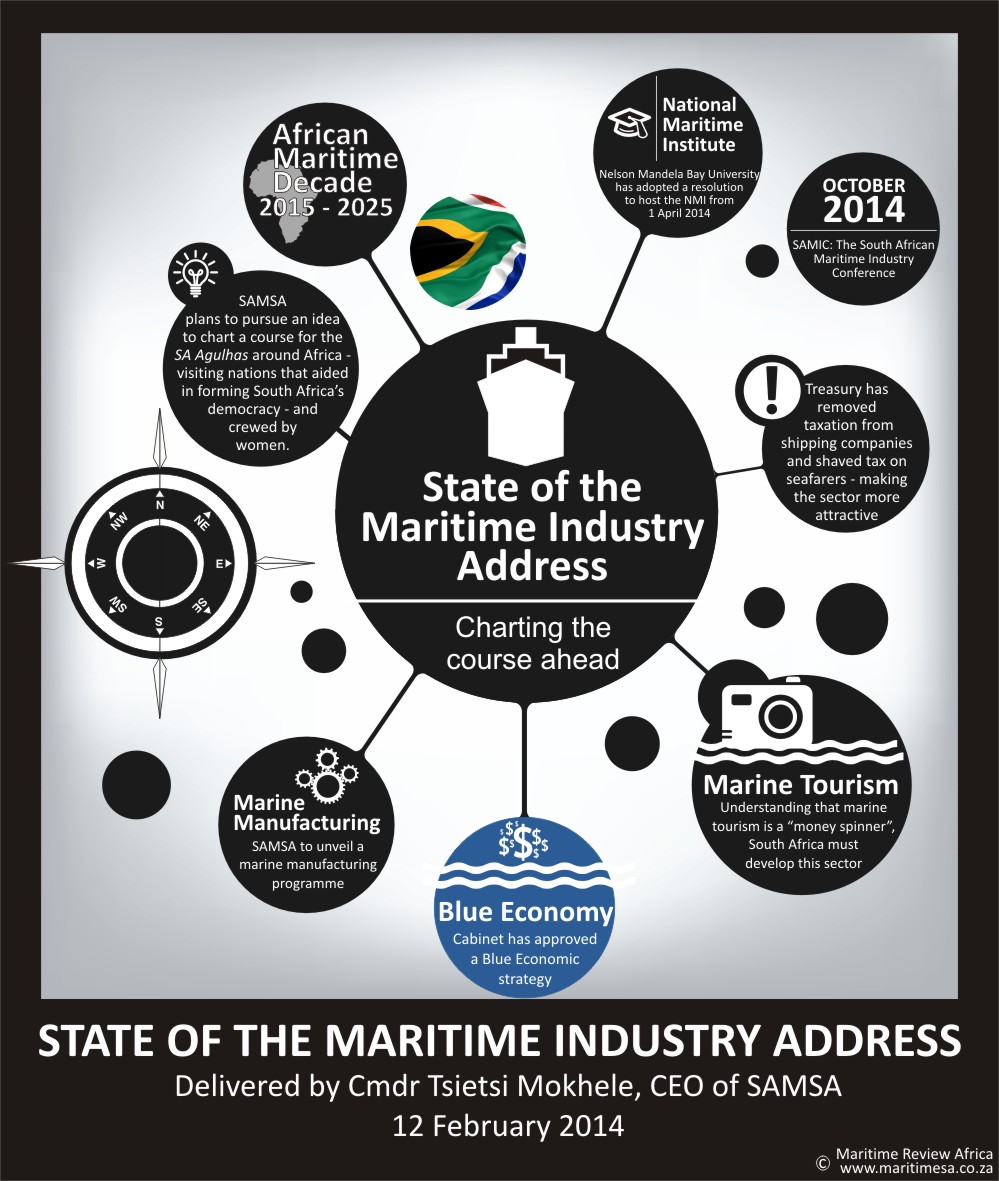
State of the Maritime Industry Address

I am not going to comment on the State of the Nation Address (SONA) made last week by President Jacob Zuma except to say I did hear him mention the maritime industry as he acknowledged the importance of the fishing industry; the need to develop our ports and the focus on oil and gas for the development of Cape Town and Saldanha Bay. I am, however, going to comment on a speech made the night before SONA by Commander Tsietsi Mokhele, CEO of the South African Maritime Safety Authority (SAMSA).

Anyone who has ever listened to the CEO speak will know that he is constantly pushing the South African maritime agenda – and it seems that, while there is still much to be done, a lot of groundwork has been covered.

State of Maritime Industry

Here are a few highlights of his speech:

TREASURY TICKS OFF TAXATION: Mokhele highlighted the decision by South African Treasury last year to remove all forms of taxation on shipping. “I never thought in my living days that I would see South Africa Treasury moving on shipping tax when we have waited and worked so hard on the tonnage tax,” he said adding that although the industry was willing to accept a nominal tax, this gesture to help develop the industry was welcomed. Treasury has shaved tax contributions of seafarers; removed taxation on the sale of assets; and paved the way for shipping companies to trade in any international currency.

“I never thought in my living days that I would see South Africa Treasury moving on shipping tax when we have waited and worked so hard on the tonnage tax.”

THE BLUE ECONOMIC STRATEGY: In a similarly positive light, Mokhele reported that Cabinet had approved The Blue Economic Strategy for the country. “It talks to helping improve the lives of our people by taking and leveraging the assets of the industry; the expertise that is there. It is a strategy about development; it is a strategy about progress – and about giving the economy an upliftment,” he said. 

THE AFRICAN MARITIME DECADE: Coupled to the approval of the African Integrated Maritime Strategy (AIMS) 2050 made by the African Union Commission at the end of January was the announcement that 2015 to 2025 would be dedicated to the maritime industry.

“It means that the maritime sector has arrived where it needed to be. It has become an asset of of our people, politically endorsed, industry recognised opportunities and communities are involved,” said Mokhele.

NATIONAL MARITIME INSTITUTE: Having completed a feasibility study to assess the impact of establishing a National Maritime Institute, SAMSA has successfully concluded a deal with the Nelson Mandela Metropolitan University. On November 12 last year, the University passed a resolution to accept the custodianship of the National Maritime Institute. According to Mokhele, the Institute will be operational from April 1 this year and will coordinate efforts in maritime education. “We are not displacing the existing infrastructure, but providing cohesion in the development of programmes that are geared to the development of technology and innovation,” he said. 

MARINE TOURISM STRATEGY: Understanding that 80 percent of the United States of America’s tourism revenue originates from marine tourism, Mokhele’s announcement that SAMSA would unveil a Maritime Tourism Strategy during the course of the year, makes sense as a strategy to open the maritime sector to new entrants.

“Water programmes sell. They sell real estate, they sell activities, they sell everything – and therefore our marine strategy is going to be inclusive of the tourism strategy that we are going to unveil before the end of this year.”

MARINE MANUFACTURING STRATEGY: Another strategy scheduled to be unveiled during the course of the year is one that speaks to the marine manufacturing sector. Mokhele spoke about the need to develop the capabilities of the ship repair and ultimately the shipbuilding sectors.  Alluding to the potential of gearing up for the offshore oil and gas industry, Mokhele said “South Africa has to gear themselves up to become the hub service centre for the gas industry that is emerging on the east, but also to play a part on the existing oil and gas industry that is already established on the west of the continent.”

CELEBRATING SOUTH AFRICA’S 20 YEARS OF DEMOCRACY: Perhaps the most ambitious plans that Mokhele revealed were those relating to a planned cruise around the African continent. He aims to see an all-female crew navigate the SA Agulhas to visit nations in Africa that supported the liberation of South Africa. The cruise aims to also set up a fund for the development of women in Africa’s maritime sectors. SAMSA will approach industry to help sponsor this initiative.

SAMIC IS BACK ON THE CALENDAR: If you remember the landmark conference initiated by SAMSA in 2012, you may be pleased to hear that it is scheduled to return to the calendar in October this year. It will be a good opportunity to report back on resolutions taken at the last edition and decide whether the industry, government and other stakeholders have stepped up to the plate to see real development of the industry.

While these topics remain the highlights of Tsietsi Mokhele’s speech, he also spoke of the success of the cadetship programme; the ambitions to see ships return to the ships registry as well as the interest from various shipping companies to source South African seafarers to crew their fleets.

Yes, he told a good story, but we still all need to roll up our sleeves and get back to work. It makes no sense to endlessly debate the merits of a report back if we are not prepared to go back to our desks – irrespective of our views – and make things happen.

World Maritime Day

Today is World Maritime Day today. This day, set aside for the last week of September each year, offers a day to reflect on how the maritime industry has influenced our lives over the past year and also offers an opportunity for organisations, companies and individuals to actively do something to acknowledge the people involved in an industry that so many take for granted.

This year South Africa is recognising the day with various events around the country. Transport Deputy Minister, Honourable Sindisiwe Chikunga will host the World Maritime Day Career Expo and Exhibition in Kimberley in the Northern Cape. The celebrations are being held under the theme: “Sustainable Development: International Maritime Organisation’s contribution beyond Rio+20.”
The event is being attended by school children from previously disadvantaged communities who will be given the chance to display their knowledge of the maritime sector through educational displays and exhibitions.

Schools around the Northern Cape will participate in a competition involving: ship designing, essay writing, drama and art competition.

The South African Maritime Safety Authority (SAMSA), the Department of Environmental Affairs, Transnet National Ports Authority (TNPA), Transnet Port Terminals (TPT), Grindrod Shipping Company, Smit Amandla Marine and various other key maritime stakeholders will engage with the learners, providing information surrounding various activities within the maritime industry.

The day will be closed with a gala dinner.

The South Africa Navy is also acknowledging the day and participating in the celebrations.

World Maritime Day in South Africa also serves as a platform to create awareness around the career opportunities available within the maritime industry. It’s just a bit of a pity that the industry seems to rely on the usual suspects (see the list above) to promote their sector. Where is everyone else? We should all be involved in these initiatives.

Make a note in your diaries because in September 2014 Maritime Review will challenge the entire industry to come to the party!

WARNING: Women at Work!

As I prepare to put my feet up for Women’s Day tomorrow and scroll through the many newsfeeds I follow on social networks, I am suddenly reminded that the “thing to do” in media is to couple content planning to calendar events such as this. So let’s take a moment to reflect on the feminine demographic in the maritime industry.

When I started reporting on the industry way back in the mid 1990’s there were not many ladies at sea and few holding positions of any real maritime significance ashore. I remember visiting a Captain on his ship and being subjected to a bout of misplaced chivalry as he opened the doors while I had to squeeze passed his sizeable belly in the narrow passages to enter first. I remember interviewing a Managing Director of a reputable maritime company and being told at the end of an hour: “I’m sorry I did not get your name – I was too busy looking at your breasts”. And I remember meeting with a potential freelance writer for the magazine, who was himself an old salt, and him casually remarking “I’ve never worked with anyone like you before” as he gave me  a very obvious once over.

Thankfully things have changed considerably since then.

The maritime industry, however,  was not unique in its chauvinistic behaviour and now, as it did then, simply continues to be a microcosm of life ashore. Certainly there has been a shift towards attracting women into seafaring positions – similar to most professions “traditionally” associated with male dominance, but I struggle to see a real demographic gender shift at board level of the majority of maritime companies.

We’re happy to send our girls to sea; we’ll even claim bragging rights when a handful of them move up the seafaring ranks – but we are yet to see real progress within top management structures.

Now, I am the first to say that women should not be appointed to simply tick a box on some score card somewhere, but surely there are ladies of significance ready to step into these positions within our industry?

Oh – and the next time you need to have a lady break a bottle of bubbly over the hull of your newbuild, don’t simply invite the wife of some important man – look for that woman of significance in the industry and give her the honour. Because there are some truly innovative, smart, courageous, talented and forward thinking women at work in this industry.

Happy Women’s Day to all in the maritime industry – whether ashore or at sea!


Five things you can do to promote the maritime industry

I like lists. And I especially like lists that are quick and easy to accomplish. So here are five things that you, as a maritime professional, can quickly and easily do to promote awareness of our industry amongst the general population.

  1. Post a maritime-related photo or status update on your Facebook wall that would be of interest to your friends and that paints the industry in a positive light.
  2. Invite your friends or family ship-spotting. In most port towns there is generally a vantage point that also makes a good picnic spot from where you can see ships. (Take a pair of binoculars to make it more exciting.)
  3. Speak to the career counselor at your nearest High School about the opportunities in the maritime sector for their learners. (I believe the South African Maritime Safety Authority (SAMSA) is producing a book on maritime careers – so perhaps this will be available for distribution soon.)
  4. Get involved in the International Day of the Seafarer campaign run annually by the International Maritime Organisation on 25th June 2013. (Click here for more information)
  5. Encourage your business to share their good news with the media.

BUT WAIT – HERE’S A BONUS POINT:

6. Share this post with other members of the maritime industry and let’s get the message out there!

2013 is Maritime Year: but shhh, its a secret!

Last week at the Maritime Trade Forum ahead of the BRICS Summit in Durban, I learned that the Minister of Transport had declared 2013, Maritime Year in South Africa. Riad Khan of the Port Regulator stated this quite clearly while welcoming delegates to these maritime discussions and I silently chastised myself for not knowing such an important development in the industry.

Wow – that’s a real milestone for the relationship between the maritime industry and the Department of Transport, which is more vocal in its directives aimed at land-based transport modes. I was buoyed by the announcement and felt sure that I would be able to find out what the Department was doing to promote this sector within the country and amongst our citizens.

Since learning this news last week I have asked a number of other members of the industry what they know about this development only to find that I was not the only one in the dark.

So I visited the Department’s website feeling sure I would see some sort of 2013 Maritime Year banner emblazoned across the screen. No. No banner.

So I looked under the press announcements, press releases and speeches. No. No such message there either.

So I took the link to the South African Maritime Safety Authority (SAMSA), the Department’s official maritime agency, to see if I could find more information there. No. No information there. And the same dismal non-message on the website belonging to the Port Regulator.

So I went back to the Department of Transport’s website to take a closer look at their maritime intentions because Minister Dikobe Ben Martins did make it clear in his speech at the Maritime Trade Forum that he was expecting high level engagement with the industry and that a coherent maritime strategy needed to be presented to him by July.

Surely such pronouncements would be borne out on their site? No. None of the speeches listed on the site relate to his public appearances in the maritime domain. It is as if he is embarrassed to admit engaging with us on some level; as if by admitting his engagement with the maritime industry, he is somehow ignoring the carnage on our road during peak holidays.

In fact if you click on MARITIME in the website menu bar – the persistent banner advert promoting road safety follows you there too.

In a last ditch effort to uncover their maritime mantra for 2013, I clicked on the link to their Facebook page. That provided no further assistance – especially as the last post on their page is dated June 2012. And most of the posts on the page relate to (yes you guessed it) road traffic.

So ladies and gentlemen of the maritime industry 2013 is Maritime Year, but please don’t tell anyone – it’s a secret.

Full diary: warning – event ahead!

The maritime industry seems to have suddenly woken up and started some vigourous planning for the next couple of weeks. While some events have been a long time in the offing – others seem to have simply sprung up on the calendar.

THE BOSBERAAD

Last week the National Department of Transport (NDoT) surprised maritime stakeholders with an invitation to a Maritime Bosberaad in Pretoria. Hosted jointly by the NDoT, the South African Maritime Safety Authority (SAMSA) and the Ports Regulator – it seems that the last minute invitation may have influenced the actual attendance register on the day.

It’s a pity really since the Minister of Transport was due to provide the keynote address. Sadly, with only a day’s notice, I did not make it up to Pretoria and will have to rely on the industry for some feedback. I would be especially interested to know what the ANC Youth League’s contribution amounted to.

CRUISING ALONG

Then the rather active and community-spirited maritime sectors in Durban took the initiative to host a Maritime Conference on the MSC Sinfonia. Featuring a rather modest price-tag of only R5000 (all inclusive), this certainly sounds as if a real effort was made to make it as inclusive as possible.

HEAD’S UP FOR THE HIGH SEAS

We’ve been watching the establishment of the Global Ocean Commission since its launch last month and were particularly interested to learn that, not only is Trevor Manuel a Co-chair of the Commission, but South Africa (Cape Town) is hosting their inaugural meeting.

Some follow-up revealed that they would be in Cape Town this week, but that media would not be accommodated at any sessions and nothing had been planned to include us. So – once again it was with surprise that an invitation to a press briefing landed in our inbox late yesterday requesting our presence at a briefing this morning.

The lack of availability of the local press eventually saw this moved to a later date – and one that will take into account the work undertaken during this week by the international heads scheduled to participate.

(Follow our tweets on this topic on @GreenMarineSA – we will use the #GlobalOcean)

BREAKING THE CONTACT FAST

Heavily criticised for not engaging enough with the top levels of the fishing industry, Minister of Agriculture, Forestry and Fisheries, Tina Joemat-Pettersson, is scheduled to share breakfast with CEO’s from this sector tomorrow morning.

I will attend the press briefing DAFF has scheduled following this gathering to hear first hand how the relationship has been strengthened.

(Follow our tweets on this topic on @MaritimeSA – we will use the #DAFFFast)

CEMENTING THE MARITIME BRICS AGENDA

I must admit I have been waiting for a long time for the local South African maritime industry to start talking meaningfully around this topic and am pleased that the initiative has been taken to break-away from next week’s BRICS sessions in this regard.

With a full calendar and a host of public holidays to contend with, organisers elected to host this on a Sunday and I hope that the date does not deter too many stakeholders.

Once again the Minister of Transport, Ben Dikobe Martins, is on the schedule and panel discussions should provide for a lively platform if they are accurately populated.

(Follow our tweets on this topic on @MaritimeSA – we will use the #maritimeBRICS)

MEETING TO DISCUSS AFRICAN MARITIME ECONOMY

The African maritime agenda is key to most conferences and events this year and the Nautical Institute (Southern African Branch) is meeting in association with a number of other key local professional associations to discuss this.

So with an Easter breather between this event and the BRICS sessions; the maritime industry will reassemble in Cape Town to debate the challenges facing the African Maritime economy.

(Follow our tweets on this topic on @MaritimeSA – we will use the #NauticalInstituteSA)

R&R ON THE GOLF COURSE

After all these cerebral outings, however, some sectors of the maritime industry are blocking out a Friday to chase a little white ball around in Stellenbosch. We’ll be there to sponsor one of the holes, take a few photos and relax with you after a hectic couple of weeks.

(Follow our tweets on this topic on @MaritimeSA – we will use the #MaritimeGolfDay)

GET YOUR EVENT ON THE RADAR

So if you are planning anything else in the maritime industry – put it on our radar and we’ll make sure that it becomes more than just a blip

All hands on deck!

Scrubbing the decks of the Lord Nelson.

Scrubbing the decks of the Lord Nelson.

I recently had the opportunity to lend a hand. I joined a group of volunteers on board the Lord Nelson in the port of Cape Town where all hands on deck was literally the mantra of the day.

It all started when I received a number of press releases from Norton Rose that highlighted their involvement with the Jubilee Sailing Trust and, specifically, their connection to the tallship, the Lord Nelson.

Intrigued by the uniqueness of the vessel’s mandate to offer sailing opportunities to both able-bodied and disabled sailors alike, I jumped at the chance to experience the true ethos of the vessel first hand and soon found myself signing up for a day of hard labour.

Perhaps not making the best of first impressions, I arrived a little late only to find that my fellow volunteers were already hard at work and looking in control of things. Greeted by four fellow deckhands in red Norton Rose shirts, I soon discovered that the notion of working on a vessel in Cape Town’s harbour was appealing enough for the staff at Norton Rose to vie for the opportunity via an office competition

Tina Costas, Jeremy Brown and Jonathan Levine of Norton Rose were joined by Gavin Maggott from the QuadPara Association of South Africa (QASA) who, by the end of the day, had confirmed that maneuvering around the vessel in a wheelchair was more than feasible.

It’s clear from the moment you step on board that the vessel has been modified to accommodate wheelchairs and those with physical disabilities. Dedicated wheelchair lifts ensure that all crewmembers can access all areas of the boat and wheelchair tie downs are strategically placed to secure those that require it should the sailing get rough.

With provision made for blind, deaf and physically challenged crewmembers, it’s clear that being disabled on the Lord Nelson should not be a disadvantage.

But back to my day of labour.

Pairing up with Jeremy – we were put to work checking the life jackets and immersion suits on the port and starboard aft stations. With all lights and gear checked and accounted for, we were being ushered on to our next tasks by first mate, John West.

Down below I found Jonathan towing a vacuum cleaner and finishing off the main staircase with a dustpan and brush. I also encountered the doc, Steve Ogden, who was preparing the bunks to welcome new arrivals for the next sailing leg later that day so I stepped in to help him.

Somehow, however, I found myself sometime later in latex gloves, toilet brush in hand, cleaning the small bathrooms on the starboard side. These too have been modified to accommodate disabled crewmembers.

After a break for lunch enjoyed on the deck in the sun, I teamed up with Tina (who had been hard at work polishing the brass with Jeremy and Gavin) and Jonathan to scrub the decks. Armed with hoses, hard brooms, buckets and some soap powder – the hours soon clocked up as curious passersby stopped on the quayside to watch our progress.

Wet and tired, we proudly surveyed our handiwork before catching up with Gavin and Jeremy. Despite the sheer volume of deck that we had scrubbed and the time it had taken – it seems we somehow got off lightly as the other two had spent the afternoon cleaning fans and other equipment below deck!

It was a group effort and the Lord Nelson was ready to receive her guests for a scheduled cocktail party that night. But it took a diverse group of volunteers willing to flex their muscles, get dirty, surrender their time and put a common goal ahead of their own for a day.

We need to find more time for days like this and we need to make the effort to ensure that our industry provides access to all.

Take a look at our Facebook All Hands on Deck gallery for photos from the day! <click here>