Access denied: flirting with the maritime economy?

There’s a general movement that is gaining traction in the maritime sectors that aims to boost the industry’s contribution to job creation and the GDP. The Blue Economy is on everyone’s lips and national, regional, continental and even international strategies are being developed to see our oceans contribute meaningfully to our human desire to produce and prosper.

With so much attention it should, therefore, not be surprising to see a whole new set of eyes flirting with the possibility of developing a long term relationship with the ocean sector. It’s time to give them a dance ticket and allow them onto the dance floor.

At the South African Maritime Industry Conference (SAMIC) organised some three years ago by the South African Maritime Safety Authority (SAMSA), there were people from every sector and plenty who saw themselves as merely standing on the side line hoping for an opportunity to show their moves.

Paul Maclons, Managing Director of Smit Amandla Marine, was unequivocal in his statement during one of the panel discussions at the conference: that the solution for a full and inclusive dance floor was not in promoting the practice of cutting in on existing dancers – but rather on extending the party and mixing it up from the DJ’s box. Well, okay Paul did not mention anything about dancing or DJ’s, but his message was clear – we need to expand the industry to accommodate newcomers.

The truth is though that the industry is expanding and there are more opportunities, but equally the economic reality of a capital-intensive international industry is seeing more consolidation and joint ventures as existing companies seek relationships with other established partners that can offer them the opportunity to extend their own dance cards.

Does that mean that there is no opportunity for newcomers? Are they destined always to be wallflowers?

The quick answer to that has to be NO! There are some newcomers to the industry aiming to show off their signature moves on the dance floor. Our job is not to stop mid beat and point or jeer. Our job is to make sure that there is space for them even if their rhythm is a little different to ours. Our job is to learn a little from the new beat.

This year’s SAMSA Maritime Industry Awards aims to recognise the new dancers on our floor. If you’ve recently launched or know of a company that has launched into our space – please take the time to nominate. It takes courage to start something in any industry and especially into one so entrusted to the “old guard”.

http://www.maritimeawards.co.za  


What is a Maritime Maestro?

Maritime Maestros have salt in their veins. They are committed to the industry in a way that goes beyond the scope of a 9 to 5 job description. They give passionately and devote their energies to develop the future of the industry as a whole. They lead the industry and often pioneer new paths – they are Maritime Maestros.

Two years ago we recognised Okke Grapow as a Maritime Maestro at the 2012/13 SAMSA Maritime Industry Awards. He was living out his maritime family heritage that had been passed down to him from his father and subsequently onto his own children. His dedication to offer himself beyond the confines of a 9 to 5 servant to the industry certainly benefitted the development of the South African maritime industry – and today he continues to inspire others.

This year we are once again appealing to the industry to get out of their comfort zones and to start to recognise the impact that their peers, colleagues and even competitors are making in the industry. Nominations are open for the 2014/15 SAMSA Maritime Industry Awards. Read more about the various categories and start nominating today!

http://www.maritimeawards.co.za


Missing out on a celebration

Not much hype seems to have been generated around the official start of the African Maritime Decade which is due to kick off tomorrow. The only nod in this direction seems to be happening at the African Union’s headquarters in Addis Ababa where a “two-day” meeting got underway today.

Today’s schedule in Ethiopia was to include a meeting of the AU Strategic Task Force on the 2050 AIM-Strategy. What should have been an ideal platform to review and debate the strategy, however, was cancelled at the beginning of July.

The schedule for the day therefore now only starts at 5pm and includes a panel discussion followed by an official dinner at 7:30pm.

Tomorrow will see the official launch of the Decade of Africa Seas and Oceans and the Celebration of the African Day of Seas and Oceans – essentially wrapping up an event that has sought to bring together a wide variety of stakeholders from across the continent by 1:30 pm tomorrow.

On a country-by-country basis nothing seems to be planned.

Have you read the Minister’s speech?

Have you read the Minister’s speech? That’s the question being most asked this month at maritime functions and it refers to Minister of Transport, Dipuo Peters’ discourse at the South African Maritime Safety Authority’s (SAMSA) AGM at the end of September where she called for “immediate action from the (SAMSA) Board in order to resolve the appalling state of affairs at SAMSA”.

What usually follows the opening question in these chats amongst maritime colleagues are the knowing nods and ensuing discussion on the schism that we all believe to exist between the Department of Transport and its subsidiary body – as if this could be the explanation as to why the minister was so severe in her deliberations.

This leads into a conversation on the three pillars of SAMSA’s mandate and how many seem to believe that it is clear that the Authority has taken to heart the third point: to promote South Africa’s maritime interests as its over-arching purpose – perhaps to the detriment of the first two tenets of its existence which relate to the preservation of life, environment and property at sea.

It is an interesting dilemma for the industry. We’ve lauded the Authority, and particularly its CEO Commander Tsietsi Mokhele, for his foresight and passion to champion the maritime cause. We’ve watched him weave the maritime thread into the government conversation. And, as we begin to see a level of recognition across a number of government departments, we are told take stock of an entity that requires some oversight.

One cannot fain surprise that expenditure on conferences and advertisements ballooned from R12m in 2012 to R54 million in 2013. Most conference organisers and many publications have viewed the Authority as an unofficial Lotto pay-out as they cashed in their rate cards and sponsorship tiers. SAMSA has been visual at most events on the calendar including one hosted by us – the Maritime Industry Awards.

Was this a waste of resources? I dare to say that a little discernment could have been applied, but that some of the television slots highlighting the cadets on the SA Agulhas were well timed and could have contributed to a broader maritime awareness amongst our youth. So too do career and job summits, but a rubber stamp of approval associated with the sponsorship and exhibition stands of just about every maritime exhibition and conference could have been undertaken with some introspection.

What the industry has been waiting for is a follow-up to the successful and refreshingly different South African Maritime Industry Conference (SAMIC). Organised by the Authority, the conference has the ability to knock many conferences off the calendar by providing one unified thought tank for the industry.

Envisioned to fill a gap left by the demise of the National Maritime Conference of the 1990’s organised by industry for industry – SAMIC was well positioned to meet the needs of an industry ready and willing to move forward. It seems a pity, however, that this conference, anticipated to take place before the end of 2014, may now never take its rightful place on the calendar.

But this is not the only reason the minister pegs the Authority to be “in serious trouble”. Citing plummeting cash flows (a 350 percent decline), irregular expenditure (R28.8 million), fruitless and wasteful expenditure (R1.1 million), a total asset decline of 96 percent and the cost escalation associated to the SA Agulhas of 31 percent – Peters did not mince her words when she asked that “immediate actions be taken” to make the entity viable and able to deliver on its legislative mandate.

The SA Agulhas may lie at the heart of many of SAMSA’s reported woes, but most in the industry will agree that the Authority’s sheer determination to create a dedicated training vessel for their cadetship programme should not go unapplauded. It was never going to be an easy or cheap endeavour – something that is clearly realised by the Authority. Their Annual Report highlights the need for projects such as the cadetship programme and the SA Agulhas to be funded externally.

“Projects will therefore be funded only to the extent to which project funding is available and the organisation’s core revenue will not be used. The SA Agulhas and the cadetship projects, which contributed significantly to the deficits will soon no longer be funded by SAMSA,” it states in the report.

But perhaps what is most alarming and does not come across clearly in the visually alluring Annual Report is the “lack of reliability of reported information”. The Annual Report provides performance targets that are generally reported as being met or at least mostly met, but the Auditor General raises concerns that these targets are “not specific, measurable or time bound”.

In addition, what is not evident in the Annual Report, but is highlighted in the Minister’s speech is anomalies of data – or data spike for the fourth quarter of the reported year. For instance the tally of inspections of both local and foreign going vessels catapults rather unrealistically in the fourth quarter – calling into question the validity of what is presented.

Similarly, although a 100 percent target of audited training institutions is reported at year-end, according to the speech, data allegedly reveals that no audits were carried out within the first three quarters of the year.

“The fact that the auditors could not validate the performance results and that the third quarter results of some KPI’s seem to be far apart from the fourth quarter results, call for an objective independent performance audit of the 2013/2014 performance information,” she says.

With much more fodder to chew on in both the Annual Report as well as Minister Peters’ speech, it would be unfair to try and unpack the issues here. And as transport month draws to a close and we mull the pronouncements of Operation Phakisa, perhaps our closing issue of Maritime Review Africa for the year will delve a little deeper into the state of South Africa as a maritime nation on the continent.

If you have anything to say on this topic, we welcome your input both on and off the record.

THE ABOVE ARTICLE APPEARS AS THE EDITOR’S COLUMN IN THE SEPT/OCTOBER ISSUE OF MARITIME REVIEW
You can read the full magazine HERE

New entrants should be accommodated in blue economy

Respondents to our Operation Phakisa survey were unanimous in their view that the maritime industry has the capacity to cater for new entrants with 71 percent deeming it “realistic” and a further 29 percent seeing it as “very realistic”.  Just under 30 percent, however, believe that it is unrealistic to expect the maritime industry to create one million jobs and for the blue economy to reach R1.7 billion by 2033.

The South African presidency is due to announce the outcome of deliberations held under the auspices of the Ocean Labs in Durban this week at an open day. Targets and activities committed to by stakeholders will be made public and it will be interesting to see if expectations can be met.

Most of our survey respondents, who mostly represent industry stalwarts of ten or more years, agree that involvement from government is “very important” (71 percent), but view government catalysts during their tenure to be “unsatisfactory” (71 percent).

We are still accepting responses to the survey <CLICK HERE TO PARTICIPATE> and will bring you news from Durban and the Phakisa Open Day in the next issue of Maritime Review Africa.


Shark boy inspires DEA Minister

Sharing the platform at yesterday’s launch of National Marine Week, Achmat Hassiem – aka shark boy – stole much of the limelight as he motivated learners to pursue their dreams. But he also managed to capture the attention of the Minister of Environmental Affairs, Edna Molewa, who attempted to persuade him to share his motivation with public servants and inspire them in their work.

Achmat survived a harrowing shark attack in 2006. The incident resulted in the loss of one of his lower legs, but failed to see him lose his spirit to pursue his dream of representing South Africa on the international sporting stage. He went on to compete in the Para Olympics and in 2012 won a bronze medal in the pool. He currently holds a number of world records in swimming – and champions the conservation of sharks when he speaks to audiences around the world.

The learners at the function clung to every word of his story as he described, in detail, the terrifying experience of coming face to face with a 4.7 m shark. Tall, muscular, fit and clearly ambitious and driven to succeed, Achmat was also clear in his message that life is to be lived and enjoyed.

Before delivering her keynote address, Minister Molewa spent a number of minutes addressing the shark-boy as he became known in swimming circles. She asked him to leave the international audiences and concentrate on delivering his message to the public servants of South Africa.

It’s clear that she feels our administrators could benefit from his message – and who would not agree that public servants get a little shot of enthusiasm to help them cope with the rigours of their daily work. Achmat certainly helped me aim to peal away a layer of complacency!


Riding the wave of the blue economy

Since I started reporting on the maritime sector in the mid 1990’s, the industry has been complaining about the lack of recognition it receives from government. It has been one of the biggest and most constant gripes. At the beginning of the year when the African Union announced the maritime decade, it was clear that the landlocked mindset of the continent was shifting – and the South African government’s July launch of Operation Phakisa affirms that strategic thinking is taking place to develop the “blue economy”.

With the government’s emphasis on four distinct areas there are, of course, sectors of the maritime industry currently not receiving the same level of attention. A conversation with a stakeholder, however, revealed that the full spectrum of opportunities within the blue economy is being considered. He said that more details will be announced during the course of the coming months and that a document would be released highlighting the recommendations made by industry experts at the conclusion of the Ocean Lab sessions held in Durban.

With a probable second South African Maritime Industry Conference hosted by the South African Maritime Safety Authority due to be called before the end of the year, it seems likely that Operation Phakisa will take centre stage. One is not sure, however, to what extent the outcomes of the Ocean Labs will be set in stone and to what extent they will be flexible enough to accommodate further interrogation by other stakeholders omitted from the initial deliberations.

I am choosing to remain cautiously optimistic, but am not so naive as to believe that the naming of an important sounding strategy within government will necessarily provide the panacea that the industry is waiting for. Despite adopting a “quick fix” strategy from Malaysia to churn out a blue economic policy in less than six weeks, the real work will require a lot more staying power and even some unpopular decisions.

President Jacob Zuma says that he will be monitoring the progress on an ongoing basis. Well, so will I and I hope to be able to provide updates via this blog in the future.

We also welcome any feedback from industry in this regard. Please drop me an email with your thoughts or complete the survey on Operation Phakisa by clicking here.

Operation Phakisa 3

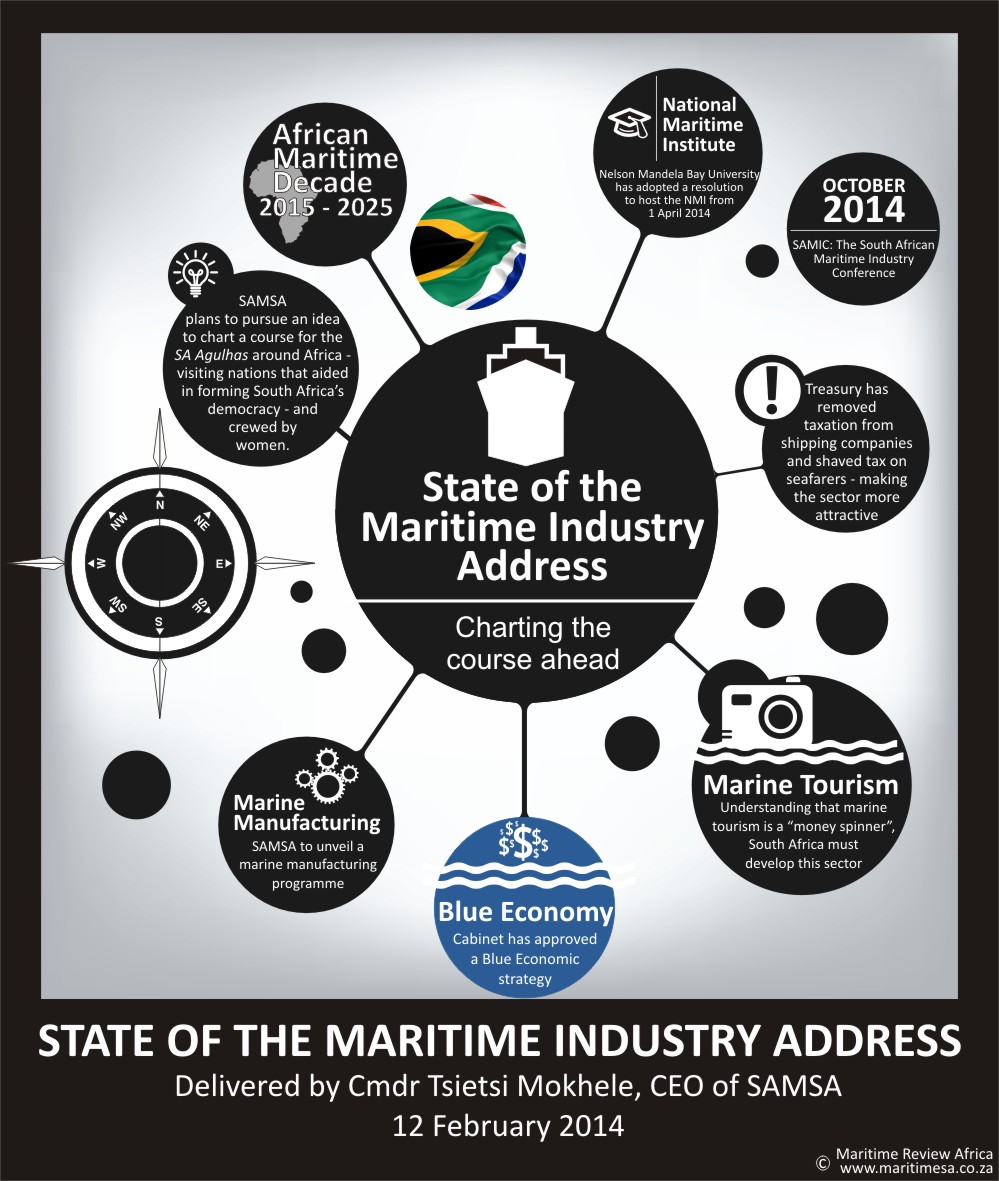
State of the Maritime Industry Address

I am not going to comment on the State of the Nation Address (SONA) made last week by President Jacob Zuma except to say I did hear him mention the maritime industry as he acknowledged the importance of the fishing industry; the need to develop our ports and the focus on oil and gas for the development of Cape Town and Saldanha Bay. I am, however, going to comment on a speech made the night before SONA by Commander Tsietsi Mokhele, CEO of the South African Maritime Safety Authority (SAMSA).

Anyone who has ever listened to the CEO speak will know that he is constantly pushing the South African maritime agenda – and it seems that, while there is still much to be done, a lot of groundwork has been covered.

State of Maritime Industry

Here are a few highlights of his speech:

TREASURY TICKS OFF TAXATION: Mokhele highlighted the decision by South African Treasury last year to remove all forms of taxation on shipping. “I never thought in my living days that I would see South Africa Treasury moving on shipping tax when we have waited and worked so hard on the tonnage tax,” he said adding that although the industry was willing to accept a nominal tax, this gesture to help develop the industry was welcomed. Treasury has shaved tax contributions of seafarers; removed taxation on the sale of assets; and paved the way for shipping companies to trade in any international currency.

“I never thought in my living days that I would see South Africa Treasury moving on shipping tax when we have waited and worked so hard on the tonnage tax.”

THE BLUE ECONOMIC STRATEGY: In a similarly positive light, Mokhele reported that Cabinet had approved The Blue Economic Strategy for the country. “It talks to helping improve the lives of our people by taking and leveraging the assets of the industry; the expertise that is there. It is a strategy about development; it is a strategy about progress – and about giving the economy an upliftment,” he said. 

THE AFRICAN MARITIME DECADE: Coupled to the approval of the African Integrated Maritime Strategy (AIMS) 2050 made by the African Union Commission at the end of January was the announcement that 2015 to 2025 would be dedicated to the maritime industry.

“It means that the maritime sector has arrived where it needed to be. It has become an asset of of our people, politically endorsed, industry recognised opportunities and communities are involved,” said Mokhele.

NATIONAL MARITIME INSTITUTE: Having completed a feasibility study to assess the impact of establishing a National Maritime Institute, SAMSA has successfully concluded a deal with the Nelson Mandela Metropolitan University. On November 12 last year, the University passed a resolution to accept the custodianship of the National Maritime Institute. According to Mokhele, the Institute will be operational from April 1 this year and will coordinate efforts in maritime education. “We are not displacing the existing infrastructure, but providing cohesion in the development of programmes that are geared to the development of technology and innovation,” he said. 

MARINE TOURISM STRATEGY: Understanding that 80 percent of the United States of America’s tourism revenue originates from marine tourism, Mokhele’s announcement that SAMSA would unveil a Maritime Tourism Strategy during the course of the year, makes sense as a strategy to open the maritime sector to new entrants.

“Water programmes sell. They sell real estate, they sell activities, they sell everything – and therefore our marine strategy is going to be inclusive of the tourism strategy that we are going to unveil before the end of this year.”

MARINE MANUFACTURING STRATEGY: Another strategy scheduled to be unveiled during the course of the year is one that speaks to the marine manufacturing sector. Mokhele spoke about the need to develop the capabilities of the ship repair and ultimately the shipbuilding sectors.  Alluding to the potential of gearing up for the offshore oil and gas industry, Mokhele said “South Africa has to gear themselves up to become the hub service centre for the gas industry that is emerging on the east, but also to play a part on the existing oil and gas industry that is already established on the west of the continent.”

CELEBRATING SOUTH AFRICA’S 20 YEARS OF DEMOCRACY: Perhaps the most ambitious plans that Mokhele revealed were those relating to a planned cruise around the African continent. He aims to see an all-female crew navigate the SA Agulhas to visit nations in Africa that supported the liberation of South Africa. The cruise aims to also set up a fund for the development of women in Africa’s maritime sectors. SAMSA will approach industry to help sponsor this initiative.

SAMIC IS BACK ON THE CALENDAR: If you remember the landmark conference initiated by SAMSA in 2012, you may be pleased to hear that it is scheduled to return to the calendar in October this year. It will be a good opportunity to report back on resolutions taken at the last edition and decide whether the industry, government and other stakeholders have stepped up to the plate to see real development of the industry.

While these topics remain the highlights of Tsietsi Mokhele’s speech, he also spoke of the success of the cadetship programme; the ambitions to see ships return to the ships registry as well as the interest from various shipping companies to source South African seafarers to crew their fleets.

Yes, he told a good story, but we still all need to roll up our sleeves and get back to work. It makes no sense to endlessly debate the merits of a report back if we are not prepared to go back to our desks – irrespective of our views – and make things happen.

Will cabinet reshuffle quell maritime momentum?

As we welcome Ms Dipuo Peters as the new Minister of Transport, one has to wonder at the rationale behind President Jacob Zuma’s cabinet restructure that will see the relatively new (and now ex) Minister of Transport, Ben Dikobe Martins, shuffle off towards the Department of Energy.

Having declared 2013 Maritime Year and called for a complete review of current and proposed maritime policy to be on his desk by July this year, Mr Martins has been replaced at what could have become a landmark milestone for the industry had this backlog  been moved forward.

Speaking to the industry in March ahead of the BRICS summit, Mr Martins was persuasive about his desire to see the maritime industry shrug off its “Cinderella status” and seemed to have tasked stakeholders in the South African Maritime Safety Authority (SAMSA) as well as the Ports’ Regulator to provide a road map (or more aptly a navigational chart) to move the sector forward.

At the same gathering Martins said: “I was not here ten years ago, but it is my responsibility to solve the obstacles and challenges that are there. I am the Minister of Transport; it is my responsibility to address the challenges.”

Well – he is no longer the Minister of Transport and so I guess it is no longer his responsibility to address these challenges. That task now falls to Ms Peters. Let us hope that she reclaims this mandate and moves it forward without loss of momentum.

If not, then I suspect the industry may well be more than a little frustrated at the thought of having to resurrect the maritime sensitisation process with a new minister.

I would be interested to get some feedback from the Presidency at the thought processes behind this latest reshuffle. Why does President Zuma believe that Ms Peters will make a more effective Minister of Transport? Is he disappointed in the progress made by Mr Martins? Will the two ministers sit down and discuss their previous portfolios with each other?

Oh – and one last question. Why are some Ministers left in positions where their effectiveness is continuously questioned – because that seems more than a little fishy to me?

2013 is Maritime Year: but shhh, its a secret!

Last week at the Maritime Trade Forum ahead of the BRICS Summit in Durban, I learned that the Minister of Transport had declared 2013, Maritime Year in South Africa. Riad Khan of the Port Regulator stated this quite clearly while welcoming delegates to these maritime discussions and I silently chastised myself for not knowing such an important development in the industry.

Wow – that’s a real milestone for the relationship between the maritime industry and the Department of Transport, which is more vocal in its directives aimed at land-based transport modes. I was buoyed by the announcement and felt sure that I would be able to find out what the Department was doing to promote this sector within the country and amongst our citizens.

Since learning this news last week I have asked a number of other members of the industry what they know about this development only to find that I was not the only one in the dark.

So I visited the Department’s website feeling sure I would see some sort of 2013 Maritime Year banner emblazoned across the screen. No. No banner.

So I looked under the press announcements, press releases and speeches. No. No such message there either.

So I took the link to the South African Maritime Safety Authority (SAMSA), the Department’s official maritime agency, to see if I could find more information there. No. No information there. And the same dismal non-message on the website belonging to the Port Regulator.

So I went back to the Department of Transport’s website to take a closer look at their maritime intentions because Minister Dikobe Ben Martins did make it clear in his speech at the Maritime Trade Forum that he was expecting high level engagement with the industry and that a coherent maritime strategy needed to be presented to him by July.

Surely such pronouncements would be borne out on their site? No. None of the speeches listed on the site relate to his public appearances in the maritime domain. It is as if he is embarrassed to admit engaging with us on some level; as if by admitting his engagement with the maritime industry, he is somehow ignoring the carnage on our road during peak holidays.

In fact if you click on MARITIME in the website menu bar – the persistent banner advert promoting road safety follows you there too.

In a last ditch effort to uncover their maritime mantra for 2013, I clicked on the link to their Facebook page. That provided no further assistance – especially as the last post on their page is dated June 2012. And most of the posts on the page relate to (yes you guessed it) road traffic.

So ladies and gentlemen of the maritime industry 2013 is Maritime Year, but please don’t tell anyone – it’s a secret.