It’s a dry – dock!

One of the attractions of the V&A Waterfront is that it is a working harbour. It’s the perfect way for the maritime industry to showcase itself to the general public. Usually, however, when I visit the waterfront I am struck more by the ability of the general public to ignore the “maritimeness” than by their willingness to want to engage with it.

Today as I walked passed the Robinson dry dock I was therefore pleased to see a young couple leaning over the guardrail checking out the two fishing vessels receiving attention. I could not help overhearing a snippet of their conversation:

“It’s a drydock,” he said to his girlfriend.

“A what,” she asked.

“A dry … dock,” he said even as she was turning her back and refocusing on the more commercial spoils of the Waterfront.

Yes – it’s a drydock. It’s a drydock that represents an industry in waiting. The ship repair industry, having submitted proposals for the concessioning of the ship repair facilities around the country, still awaits the outcome of this bid process.

There seems to be some speculation around what is holding up the process. Some say that more negotiations are likely to follow around the financial aspects of the proposals, while others point to Robinson drydock and the Cape Town synchrolift as being the stumbling block.

But the industry is getting impatient and one industry player was bold enough to say that if Transnet is unwilling to make a decision in this regard, then the industry needs to go to the Minister of Public Enterprise for a mandate to make this happen.

It is believed that a vibrant and rejuvenated ship repair sector will have a positive spin-off on job creation. But SATAWU has publicly opposed the move.

“We also remain opposed to the privatisation of the dry docks which should be retained under state ownership as part of the promotion and growth of a vibrant maritime sector,” SATAWU announced in their reaction to Transnet’s financial results.

Given the need to undertake a degree of much-needed maintenance in most of the facilities and given the industry’s desire to move forward – it’s a decision that needs to be taken sooner than later. And one cannot help but speculate that the maintenance required as well as the subsequent drive by the sector to bring more business to the facilities would be of benefit to the workforce.

It’s time to nominate a seafarer

Now in their second year the SAMSA Seafarer of the Year Awards celebrate the role of South African Seafarers in the country’s economy as well as their contribution to safe seas, prevention of pollution at sea and job creation.

Understanding that over 90 percent of our local trade is carried by the shipping industry; that fishing is one of the most dangerous jobs in the world; that oil companies are drilling further and further offshore and that incidents do occur at sea that require human intervention – it is clear that the men and women who choose a career at sea do so facing many challenges.

The SAMSA Seafarer of the Year Awards are designed to honour the choices that our seafarers make everytime that they go to sea. These awards, nominated by peers and employers, offer recognition of the challenging working environments and often the dangers that they face.

Culminating in a gala dinner and entertainment evening in Maritime Month (October 2011), the SAMSA Seafarer of the Year Awards go beyond thanking those that excel at sea – they aim to raise the profile of seafarers and the maritime industry as a whole in a country that is reliant on their contribution.

The inaugural awards in 2010 drew a high level of nominations from the industry and gave me a rare opportunity to interview some exceptional individuals. I am once again looking forward to engaging with those that remain the backbone of the industry.

I was also humbled by those that took the time to nominate their peers. Oftentimes we get so caught up in our own lives and issues, but  acknowledging others is such a simple way to give back to those that deserve the recognition.

Our partners in this initiative also need recognition. The South African Maritime Safety Authority (SAMSA) has once again put their weight behind the awards as the title sponsor. Smit Amandla Marine and Grindrod Limited (as employers of a great many South African seafarers) prove once again that they understand the importance of their own crew. Sea Harvest – one of our top fishing companies also partners us for the second year as does Business Partners.

Entries are now open and members of the South African maritime community can download the nomination form from our website (www.maritimesa.co.za) or nominate directly online. Click on the SAMSA Seafarer of the Year logo on the home page to learn more!


Thank you for my job

Without the ships that ply the oceans I would not have a job. It is truly that simple. Today is the International Day of the Seafarer and I am saying thank you for my job because without the men and women who commit to a career at sea we would not be able to navigate the global fleet of ships that call at our ports and carry our trade. Without them the only maritime-related industry that would be booming would be that of the ship scrappers; and the ships would be queuing off the beaches of India.

Without ships we would not need harbours or cranes and gantries. We would not need navigation equipment or engines. Salvors, importers, exporters, shipping companies, ship repairers and all those who supply our vessels with equipment or products would be out of business. Many countries would be cut off from their markets and all those shops filled with the “made in China” (or any other foreign destination) items would be largely empty.

That means that many retailers and shopping centres would no longer be able to operate effectively. They would not need to advertise and would scale down operations cutting back significantly on staff.

It is not just the marine-related industries that would falter without seafarers. Would you still have your job if men and women stopped going to sea? Today is the International Day of the Seafarer – acknowledge their impact on the world by tweeting and facebooking your vote of thanks.

Thank you for my job!

In memory of those at sea

On the 24th June 2010 a string of events culminated in the death of a young South African cadet serving on board the Safmarine Kariba. The discovery that Akhona Geveza had allegedly jumped overboard disturbed the maritime industry deeply and sent the media into a frenzy of headlines that spoke of rampant sexual abuse of cadets at sea. The next day – on the 25th June 2010 – the vessel returned to the place where Akhona had been found to hold a memorial service and lowered a floral wreath into the sea.

For some months media speculation around the actual facts surrounding the death of Akhona continued while the Croatian authorities investigated the incident. Locally Safmarine seemed perplexed that newspaper reporters had managed to uncover an apparent legacy of sexual harassment that extended beyond the current incident; and journalists did not name their sources in these allegations. Further investigations ensued and reports that the South African Maritime Safety Authority planned to conduct their own investigations surfaced this year.

In their July issue of Navigator (an inhouse publication), Safmarine devotes three pages to Akhona Geveza and the events that surrounded her death. They trace her last day onboard the Safmarine Kariba and discuss why they do not feel that the allegations of sexual misconduct existed on their fleet of vessels.

Capt Louise Angel weighs in on the debate saying; “A ship is run like a small community; this is our home for three to six months at a time and there is always someone you can turn to onboard if you have any kind of problem, and everybody generally knows everybody’s business. Our ‘bush telegraph’ onboard is finely tuned for sources of information (aka gossip) and at no time have we heard any allegations of sexual misconduct onboard any Safmarine ships.”

One cannot expect however, that those that travel our seas are always one hundred percent happy or one hundred percent at ease. Just as we experience our ups and downs in our own daily lives on land – seafarers must surely experience theirs. That we can take day off or easily seek comfort from our family or friends is something we take for granted. That we have the option of going home after a tough day in the office and relaxing with a glass of wine (or going to the gym for that matter) is another given.

Seafarers are stuck with their colleagues 24/7 for extended periods of time – a situation that must surely lead to periods of mental discomfort. For the most part they can move forward and look ahead to a time when they come ashore, but (for whatever reasons) Akhona was not able to do so and the whole maritime industry needs to acknowledge that the support systems in place failed this young cadet.

And so it is fitting that Tomas Dyrbye, CEO of Safmarine is quoted as saying; “We deeply regret any possible lapse in our duty of care which may have played a part in this sad incident and we remain deeply remorseful that we, despite our best efforts, could not have prevented Akhona’s death.”

But the industry also has to move forward. We have to continue to attract suitable candidates to engage with a career at sea and we have to continue to honour those that do.

Tomorrow is The International Day of the Seafarer. If you are in the maritime industry – what are you doing to say thank you to these men and women who have committed to the challenges at sea? In South Africa we have teamed up with some of the progressive maritime companies including Smit Amandla Marine, Grindrod and SAMSA to publicly demonstrate our appreciation. We will be participating in Flash Mobs around the country in Cape Town, Pretoria, Durban and Mossel Bay.

What are you doing?

Experience life at sea!

If life is about collecting a series of experiences that enrich your existence and perhaps even set you apart from those that are content to live their lives from their couches, then the maritime industry surely delivers more than most!

This morning I attended a presentation at the Department of Forestry and Fisheries where two young fisheries inspectors spoke of their six-week trip on board the Ocean Protector at the invitation of their Australian counterparts. It was plain to see that Asheem Khan and Andri van Niekerk had absorbed every possible aspect of the sea patrol that took them from Australia to  Heard Island, St Paul Island and Amsterdam Island before returning to Fremantle in Australia.

By all accounts they were exposed to a wealth of experiences while at sea that saw them engaging with potential illegal fishing vessels, practicing boardings, testing out their dry-suits, firearm training as well as fitness training. They visited the islands, noted the sea life and most importantly cemented relationships with the Australian and French inspectors and seafarers operating in these waters.

The South African duo also came back with their own recommendations for our local department to consider, but it was clear that the actual experience of being involved in this co-operative patrol will stay with them beyond the implementation of any of these possible recommendations and that the world that most of us do not get to see far from our shores offers so much to those who are willing to embrace an exhilarating life.

You can read more about their actual trip in the forthcoming issue of Maritime Review Southern Africa which will be in the post mid-June.

Get ready to flash your support for seafarers!

In exactly a month’s time – on the 25th June 2011 – the shipping sector will acknowledge the role of seafarers as they celebrate the International Day of the Seafarer. For the public at large, however, the day will probably go largely unnoticed. Most will not spare a thought for the men and women who go to sea to navigate the produce, the appliances, the toys, the luxuries and the necessities of daily living to their doorsteps. Most will not understand the sacrifices and the challenges that seafarers make and overcome to ensure that 90 percent of all goods in our shopping malls are available to us.

The International Maritime Organisation understands this situation and has challenged the maritime community to help promote the very vital work undertaken by those at sea. They are encouraging bloggers, companies and individuals to write and talk about the contribution made by all seafarers and have even created a package to assist those wanting to participate.

Here in South Africa – I thought we could try something a little different. We at Maritime Southern Africa are initiating [with our friends in the maritime industry] the SA Seafarer Flash Mob!

The idea is to create Flash Mobs in all our port cities as well as in Gauteng in places that show the impact of international trade. For example in Cape Town – the V&A Waterfront is an ideal location as it neighbours the port and vividly showcases international trade that the retailers rely on to stock their stores.

The group will seemingly appear out of the general public and activate attention by: Putting on a lifejacket and saluting at attention while a designated person (or the whole group) sings the South African National Anthem. As the Anthem draws to an end, the group will once again remove their lifejackets and merge into the general public.

The “incident” will be video recorded and photographed to document our efforts to acknowledge the contribution made by seafarers.

JOIN ON FACEBOOK!

We have created a Facebook page for South African Seafarers and listed the Flash Mob under the events section to make it easy for people to sign up and become involved. Simply click on the link above and join the conversation.

We already have team leaders in Cape Town and Durban, but will welcome candidates from other areas who would like to spearhead a Flash Mob in their own region. Groups can be any size and do not have to consist of people in the industry!

I look forward to engaging with the industry in this initiative!


A vote of thanks to our seafarers

As we all prepare to vote tomorrow, it’s quite ironic that just over a month ago I wrote about how 18 young cadets had been challenged to “save South Africa’s democracy”. At the time I quoted the CEO of SAMSA, Tsietsi Mokhele who emphasised the role that our seafarers have in moving our economy forward and entrenching our democracy.

Their important contribution to our economy means that they are oftentimes far from home. It means that they miss birthdays, anniversaries, public holidays and of course tomorrow they will miss the opportunity to vote.

While there are structures in place for those who cannot attend a polling station tomorrow to cast their vote earlier – there do not seem to be mechanisms in place for those at sea to have their say in the future of their own government.

These are not South Africans who have chosen to work abroad or who have emigrated, leaving behind the potholes, the crime, the debates about open toilets or service delivery. These are citizens who do still live in the cities, the suburbs and the provinces that will have their leadership structures challenged tomorrow.

Don’t waste your voice – make sure you honour those that are unable to do so and make your vote count.

Mother’s advice

In honour of Mothers’ Day on Sunday I will dedicate this post to some good advice that I am sure many mothers have served up – and relate it to a current predicament in the Cape Town Container Terminal.

I remember being advised to “admit when you are wrong and apologise before correcting the mistake” by my mother way back when I was still squabbling with my sister. In those days my sister and I could not move forward without one or the other realising their mistake and rectifying the situation through a simple acknowledgment thereof.

So it is disappointing to return from a morning in the company of Transnet’s Executive Board to celebrate the milestones being made in the expansion of the Cape Town Container Terminal without so much as a nod in the direction of the decision to convert the terminal to RTG’s (Rubber Tyred Gantries).

Well, actually that’s not entirely accurate. Both Willie van Dyk and  Brian Molefe referred to the decision in their presentations to the Minister of Public Enterprises, customers and the media. What they failed to point out was the mounting criticism of the decision to deploy wind-sensitive equipment in a port plagued by the South Easter during the summer months – some of the busiest months for the port.

We covered this issue in depth in the last issue of the magazine which cited a number of sources that clearly indicate that the blanket denial by Transnet that the RTG’s may not be the most suitable equipment in Cape Town, is beyond comprehension.

Leaving the function this morning I chatted to a representative from one of the big shipping lines using the port. He pointed out that we lost 200 hours to wind during this critical period this year as compared to only 90 hours over the same period last year. Transnet points out that we’ve had more wind and therefore shifts the blame to mother nature, but some still believe that this indeed the mother of all mistakes.

And so many still hope that this mistake will be acknowledged and some action taken because a newly expanded port with significantly improved capacity is useless without the operational infrastructure to take full advantage of it.

A bonus for safety?

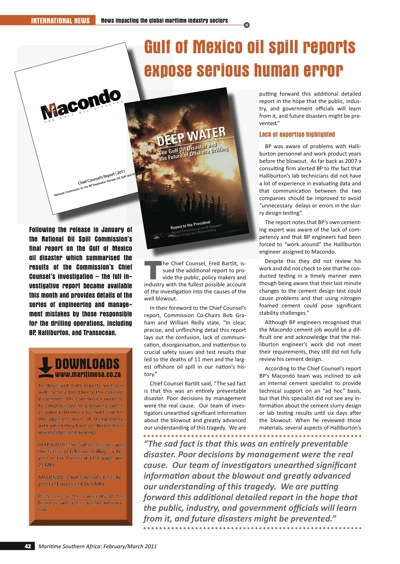
Maritime Southern Africa (Feb/March issue) highlights findings of Gulf of Mexico reports

In a press release issued by Transocean the senior management is lauded for “voluntarily donating the safety bonuses that were awarded to them for 2010 to the Deepwater Horizon Memorial Fund”. If you read the findings of the reports on the Gulf of Mexico disaster you will certainly understand that Transocean was in no way exempt from blame in this incident that resulted in the death of 11 workers and a hideous amount of oil pollution.

So the question must surely be: how can the company justify awarding safety bonuses in the same year?  It’s as bad as multi-nationals issuing performance bonuses on the back of massive retrenchments!

Surely a better PR exercise would simply have been to donate the same amount directly from the balance sheet to the Deepwater Horizon Memorial Fund? By highlighting that the money is from safety bonuses seems to send out the message that the company actually believes their safety status was good for 2010.

Once again I point out that 11 people died in the disaster; that the impact of the oil pollution is still being felt and that human error has been fingered as a major factor!

A bonus for safety? I think not!