Weekly Press Review – 13 July 2012

Professor John Hare, Professor of Shipping Law at the University of Cape Town has been extremely vocal in the press this week. Firstly expressing his displeasure at what he regards as various ministers snubbing the ‘sleeping giant’ that is the South African maritime industry and then publishing an open letter to the Hon Minister of Transport, voicing his concern about the danger that South Africa faces from a financial and environmental perspective should there be an oil spill along our coast line.

Professor Hare is a well respected figure in the maritime industry and let us hope that his opinions are respected and heeded by the powers that be. This industry needs more people who are willing to stick their necks out and say what needs to be said and, even more importantly, do what needs to be done – and perhaps the South African Maritime Industry Conference hosted by SAMSA last week is the catalyst that prompted the good professor to alert the media.

The beautiful SA Agulhas II made the news again as she set sail for the ice sheets of Antarctica and is expected to reach her destination on July 20.

The trip is primarily aimed at testing the new ships capabilities, particularly through the thick pack ice and also to test the new scientific and maritime equipment on board. These tests will be carried out by the team on board representing a number of universities and research institutions.

Ashley Johnson of the Department of Environmental Affairs and chief scientist on the voyage said that the ship had undergone some ice trials in the northern hemisphere, but only through ice that had already thinned. The testing would now be through the thicker Winter ice.

She added, ‘The old vessel was designed more to ferry people to the ice and the islands, but this one has much better laboratory facilities and instruments.’

We wish them a successful voyage and look forward to their safe return.
Conference Call rocks maritime sector

There are conferences aplenty in South Africa and Africa that plug into the maritime domain, but this week’s South African Maritime Industry Conference (SAMIC) hosted by SAMSA can truly be heralded as one that should repower the engines of the maritime industry in the country.

I sat there for the entire conference. I did not miss a minute of it. I ensured that every break-away group had a representative from the magazine in it – and we will publish a thorough and comprehensive report back of SAMIC in the next issue.

For those of you who did not attend and had to rely on newspaper reports of the highlights and headlines relating to the conference, please take comfort in the fact that the news that made it to daily newspapers relating to lack of legislation to bolster a ship registry; loss of bunker only opportunities or our lack of pollution fighting capabilities, should not be seen to represent the the entire focus of the conference. These are all headlines that spotlighted the industry during the SAMIC week and, while I am certainly not dismissing the importance of these facts, we as an industry know we are committed to addressing them, but we should also be able to walk away from the conference knowing that we did more than just air our dirty laundry.

And certainly, while we wont ignore the very real work that needs to be done to address those rather negative headlines; lets reflect on the positives that the conference highlighted:

  • Three Cabinet Ministers stood on the jetty in the V&A Waterfront on a dark cold winter’s morning to watch the SA Agulhas training ship depart with 32 cadets on board. That’s three Ministers who now have  more of a personal glimpse about what the industry can offer to young South Africans.
  • The new Minister of Transport, Ben Dikobe Martins, seemed well briefed and sounded committed to prioritising maritime matters in the Department of Transport.
  • Ruth Bhengu, Chairperson of the Portfolio Committee on Transport invited the industry to “knock on my door” to unblock policy and legislation before parliament.
  • Bridgette Gasa, National Planning Commissioner, admitted that the maritime sector had been “forgotten” in the National Development Plan and agreed to seek to correct the oversight.
  • A complete pipeline of skills development from primary to tertiary level for the maritime industry is being discussed at governmental level.
  • The Petroleum Agency reported that our offshore acreage is well marketed and fully subscribed with either exploration licenses or applications for exploration.  Increased activity in this sector is predicted in the next three to five years.
  • SAMSA launched an Industry Training Fund and raised significant funds directly at the Chairman’s Dinner on the second day of the conference.
  • CEO of SAMSA, Tsietsi Mokhele was summoned to meet with the President on Thursday and returned to alert the industry to the fact that he had proclaimed himself the governor of the Tenth Province to the presidency in an effort to convey the immense importance that the sector holds for the development of South Africa.
  • Entrepreneurs waiting to gain a foothold into the industry, stalwarts of the industry, government agents, neigbouring country officials, NGO’s and industry associations rubbed shoulders, debated, discussed and committed to a robust maritime sector.
  • The atrophy of conference delegates on the Friday afternoon was not significant!

Was SAMIC an all-encompassing solution to every problem facing the industry? Certainly not, but it was an excellent start that challenged the status-quo of conferences as a whole and the industry. We were not subjected to paper after paper, but rather given the opportunity to huddle down and shout out our opinions.

Was SAMIC totally representative of the industry? Well – no, there were a couple of industry players that perhaps should have been involved. Most notably was the absence of any representation from the Department of Agriculture, Forestry and Fisheries to engage with the fishing subsector, but there were others as well.

Was SAMIC completely unique in its topic selection? Hell – no, there were issues that have been debated at nausea for more than a decade in the industry, but there seemed to be an underlying will on a higher level than just industry frustration to move forward.

There is still a lot of work to be done. There is a lot of sensitisation to and education about the industry that still needs to happen at government level, but our new governor of the 10th province is the kind of man that has the ability to rally the troops; he has the passion to unite disparate sectors and he certainly seems to have managed to reach the ear of the president.

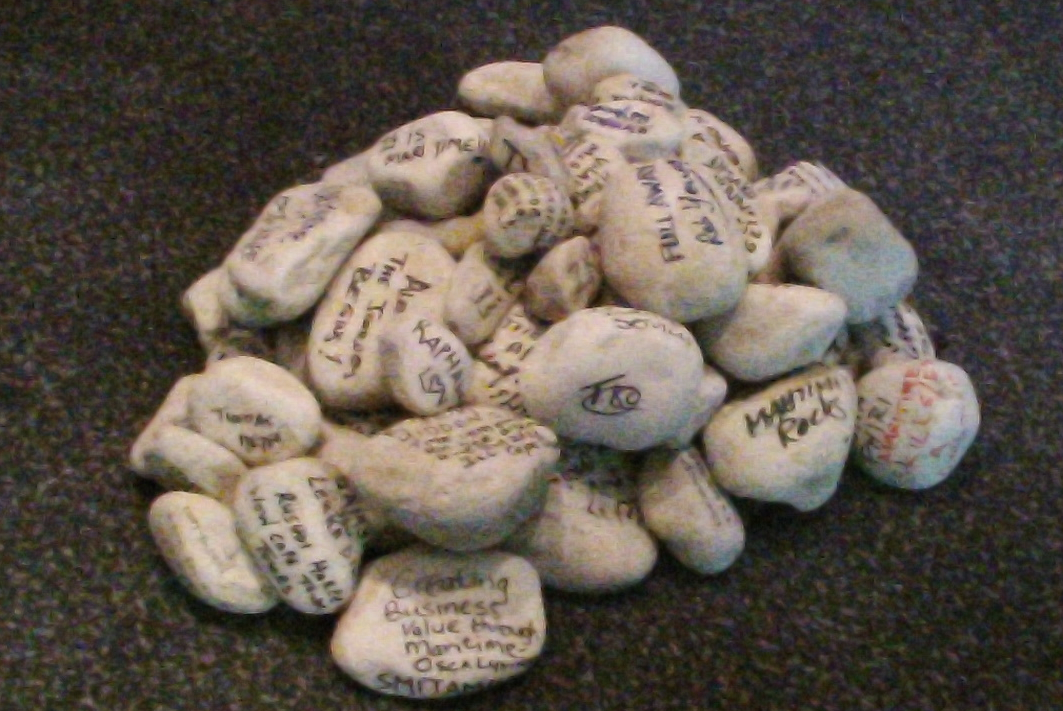
And for those of us that added our rock to the pile – let us live up to the commitment this symbolised and work to make our 10th province prosperous, influential and peaceful.

MARITIME ROCKS: Delegates at SAMIC were invited to take a rock, write their commitment on it and add it to the pile at the end of Day 2 at the conference.

Weekly Press Review – 6 July 2012

Greeted by a flotilla of yachts and showered by sea spray by two tugboats, the Mediterranean Shipping Company’s MSC Sola docked in Durban’s harbour yesterday. She made news headlines as the largest container ship to ever visit a South African port with a gross tonnage of 131 771 tons and carrying capacity of up to 11 660 containers. Prior to Transnet’s 2010 project to widen and deepen the entrance to the Durban harbour, the vessel would have been unable to enter.

The depth of the water at the Durban Container Terminal is still a problem, but Karl Socikwa, Transnet Port Terminals chief executive was reported as saying that the depth issue would be remedied, “We are optimistic that our planned investments into port infrastructure over the next few years will offer mega-ships like these the prospect of making more regular calls to South Africa.”

Of course there’s been much in the media over the last few months about Transnet’s investment strategy and it would seem that Transnet are stepping up and putting their money where their mouth is.

Plettenberg Bay was in the news this week. After awarding a tender for the development of a small boat harbour in the Pisang River and the building of multi-storey buildings on the foreshore of the coastal town of Plettenberg Bay 10 years ago, the first round of environmental impact assessments have begun and residents are up in arms.

Robbie Robinson, a retired SA National Parks CEO and local resident says that he feels that the area will lose it’s aesthetic value if the the development goes ahead.

As the planned development has taken 10 years to get this far, it would seem that local residents have a long wait and plenty of time to argue until anything concrete actually takes place.

Giving the maritime industry some favourable headlines this week, the polar supply and research ship the SA Agulhas has been relaunched as a dedicated training ship by the South African Maritime Safety Authority. SABC’s morning live team got there early and spent the morning interviewing cadets, ministers and SAMSA members before watching the vessel leave the port.

The ceremony to mark it’s departure took place on Thurday morning and coincided with an impressive SAMSA-led conference being held in Cape Town this week.

The ship will sail along the East coast with 33 cadets and three training officers on board and will return to Cape Town on August 6.

The ship is replaced by the SA Agulhas II, but what a fantastic way to create a buzz and enthusiasm around maritime training in both the youth and the industry which these cadets will hopefully one day be part of. Congratulations SAMSA.

Come out for seafarers!

This time last year we partnered with members of the maritime industry locally and attempted to bring attention to the vital work undertaken by the men and women who go to sea each day. We organised Flash Mobs in Durban, Cape Town, Pretoria and Mossel Bay to publicly acknowledge the role of seafarers.

I’ll be honest and say that getting some of the industry to buy into the concept of a Flash Mob was hard and the traditionally conservative industry tended to shy away from the idea of standing up in a public place and thanking seafarers. Yet there were those who stood up and came out.

Coming out in support of seafarers like that seemed totally alien to the industry – an industry totally reliant on their seagoing crew and I wondered: if the actual maritime industry was reluctant to stand up and thank seafarers; how on earth was the man in the street going to be able to conceptualise the need to thank them?

At the time we had grandiose ideas of what we would be doing this year to mark this day. From street parades to organising a harbour run; we were keen to expose landlubbers to the risks, challenges, duties and responsibilities of the seafarers!

But we decided to get in line with the rest of the world and embrace the social media campaign that marked last year and that again marks this year’s dedication to and celebration of seafarers.

And so this morning I got to work ready to start tweeting and blogging about the things in my life that I cannot do without that happened to be here after a journey by sea. And so as I sit at my desk and consider the contents of my office, my house and indeed my life I can’t help think that I have let down those seafarers that I was prepared to come out for last year.

I regret not organising that street parade. I regret not setting up the harbour run. And I believe we should be doing more than tweeting and blogging our thanks.

Next year – let’s take it to the streets and drive the message to the very doors of the consumers who simply cannot live without seafarers!

Weekly Press Review – 25 June 2012

Am I the only one experiencing a strange sense of deja vu as the Eihatsu Maru becomes the latest ship to be abandoned by its owners and financiers after experiencing trouble in our waters and may have to be sold in order to recoup the costs of its salvage operation – an estimated R7 million at this point (excluding harbour fees).

Dave Colly of SAMSA is obviously very unhappy about the situation as not only is there the problem of disposing of the ship if the owners are not forthcoming with any money, but also its’ cargo – 70 tons of frozen tuna. It would appear that South Africa is going to take a hit financially with the selling of the fish which, according to press reports, is regarded as ‘too tainted by scandal’ for the Japanese market.

Why are the owners of these ships allowed to get away with washing their hands of the responsibility of their vessels at the first sign of trouble or, more accurately, expense? And what can South Africa do to protect itself from continually being forced to bail out these vessels in distress?

Newspaper articles report that the Panos Earth (another vessel abandoned in our waters) has now been sold at judicial auction to a Chinese company for $2.17 million (about R22.3m), unfortunately well below what it is actually worth. Ed Greiner, the maritime lawyer who acted for salvors Smit Amandla Marine and Smit Marine SA, was quoted in the press as saying of the creditors that ‘certain people will be paid in full, certain people will be paid pro rata and certain people will not be paid at all.’ Too bad if you are in the latter catagory.

In other news, it would seem that the powers that be have finally woken up and are on track to reintroduce the lapsed system of having independent observers on board fishing vessels in an attempt to ensure that South Africa does not lose its certification with the Marine Stewardship Council, as well as its’ lucrative overseas markets.

Johan Augustyn of the Department of Agriculture, Forestry and Fisheries (DAFF) stated that ‘it was never a policy decision not to have the observer programme, it was simply a result of financial and bureaucratic problems’ and that the observer programme would hopefully be reintroduced within the year.

Surely DAFF can see that it is time to step up and get this done, and the sooner the better? South Africa’s place – and name – in the market is at stake.

A 1950’s tug boat left to rot in the harbour at the V&A Waterfront has been given a second lease on life in the unlikely form of a group of farmers from a Tractor and Engine club in Villiersdorp.

If you missed the report in the Cape Times, it seems that Keith Wetmore and his friend Andy Selfe approached the club about the possibility of saving the tug’s engines, but the club decided it would prefer to save the entire boat.

The tug, the Alwyn Vintcent, will undertake a rather long and strange journey, via Hopefield, Malmesbury, Tulbach and Worcester, to Villiersdorp and ultimately the Theewaterskloof Dam, where it is hoped that it will eventually be made into a tourist attraction.

The tug, one of the last coal-fired steam vessels, was built in Venice in 1958 and worked in Mossel Bay from 1959 – 1983. Messages from heritage enthusiasts around the world have started to pour in.

Good luck to this group of farmers from Villiersdorp and the next time you are in the area, why not pop by and spend a little time with the Alwyn Vintcent.

But perhaps, the most uplifting news from last week was the release of the South African couple who spent 20 months in the captivity of Somali pirates. Latest reports suggest that the couple, Bruno Pelizzari and Deborah Calitz, will be home in just a few short days.

Weekly Press Review – 15 June 2012

The Seli 1 is back in the news this week. After lying just off Blouberg for nearly three years, while authorities try to determine who should foot the bill for its removal, it has now been determined that the wreck is eroding the beach and threatening council infrastructure. The wreck, abandoned by its owners shortly after running aground in September 2009, has already cost the public about R24 million and now the hidden costs are starting to mount.

According to reports, all the authorities involved agree that the wreck must be removed, but no one has been able to come up with the money as yet.

The city council met with the Department of Transport, as well as other government departments, two months ago to decide the fate of the wreck. Councillor JP Smith, mayco member for safety and security, said that the meeting had been a positive one and that an application would be made to the treasury to supply the funding for its removal. Other bodies, such as Transnet, Environmental Affairs and the Ports Authority, would also be asked to contribute funding.

The city, who has also volunteered to contribute to the cause, is now awaiting feedback from the Department of Transport.

Clearly, this has been, and looks likely to continue to be, and extremely lengthy process.

Another vessel in distress in our waters …. the Cidade de Paraty also hit the headlines this week and has been given permission to be towed into False Bay after developing trouble with its generators about 45 miles offshore last week.

Dave Main of Smit Salvors was quoted in the media saying that it was unclear as to how long the repairs to the generator would take, but it would seem that it is once again SAMSA and Smit to the rescue.

In other news, a R108 million upgrade for 12 of our local harbours is on the cards, but first those responsible for the abandoned sunken vessels can expect legal action from the Department of Agriculture, Forestry and Fisheries (DAFF).

The 12 harbours to be upgraded or rehabilitated are: Hout Bay, Kalk Bay, Gordon’s Bay, Gansbaai, Arniston, Stillbaai, Saldanha Bay, St Helena Bay, Laaiplek, Lamberts Bay, Yzerfontein and Hawston. ‘The construction periods for these contracts range from six months to three years,’ said public works spokesman Thami Mchunu to the media.

Other DAFF news making the papers relates to the decision to hire diving companies to recover about 31.5 tons of perlemoen a year in order to conduct a three year research programme. The research is aimed at gathering information on the distribution and size of stocks, as well as the possibility of viable future perlemoen harvests.

They had better act quickly as there will soon be nothing left to research – thanks to our ever busy poachers.

Pretoria Comedy Club

If it wasn’t so sad, she would be funny. Problem is that the industry cannot afford to laugh at this lady. In the light of today’s announcement that the performance and evaluation system for Heads of Department in government has been amended, we recommend that the following forum is the only one that makes sense for the evaluation of the performance of the Head of the Department of Agriculture, Forestry and Fisheries.

Weekly Press Review – 8 June 2012

The press kept a pulse on the fate of the dead ship Panos Earth and reported on the decision to sell it by public auction.  The auction was ordered by the Western Cape High Court on Wednesday and a provisional sale date of June 20 has been set.

After a meeting on May 2, SAMSA came to the conclusion that the owner had ‘completely abdicated its responsibilty for the vessel and crew.’  Money apparently ran out weeks ago with the result that the repair costs of approximately $1.8 million were not able to be met.  Other creditors include Smit Amandla Marine and Smit Marine South Africa who are owed an estimated $3 million for services rendered to the vessel.

The remaining five crew members have also received no pay and have been living in appalling conditions while awaiting the fate of their ship.  Court papers revealed that there was no proper sanitation on board, as well as no electricity in the crew’s cabins and very limited food and water.

The money from the sale will be put into a fund and the funds will be allocated to creditors by a court allocated advocate.  Alan Gold, the maritime lawyer acting for the crew has said that he will put in a claim for their outstanding wages.

It would appear that a difficult  and costly situation has been dealt with in a swift and professional manner and that all parties will eventually get what they deserve.  Congratulations to all those involved.

Weekly Press Review – 1 June 2012

The Department of Agriculture, Forestry and Fisheries just cannot make any good news headlines. News that DAFF has yet to sign or renew a contract for onboard observers for the hake trawling industry means that the sector is at risk of loosing its Marine Stewardship Council certification.

The press picked up on the fact that the contract expired at the end of 2011 and that no new contract has been awarded.

The absence of these observers could result in the loss of Marine Stewardship Council certification, which in turn could result in the loss of up to 5000 jobs in the hake fishing industry, as well as lucrative international markets – about R5 billion in economic value, generated through exports.

And, to make matters worse, the anchovy fisheries also appear to be in trouble.  Their scientific survey, due to have taken place in May, has not happened.  This survey is essential.  If the quotas are not set correctly, they will be set at very conservative levels.  Experts fear that this could cost the anchovy industry up to R200 million.

What is happening here?  Where is our minister?  Is there no one willing to step up and accept responsibility for this impending economic disaster and come up with a solution, albeit a temporary one?

Anyone remember the Panos Earth?  It would seem that the ‘marooned’ ship Panos Earth, now under arrest by the sheriff of Simon’s Town court, was mostly forgotten by the press last week, but the ship’s plight was very much on the minds of the crew members still stuck onboard.

Eleven of the remaining crew left the ship on Saturday and flew home to South America on Sunday.  As they were ferried from the ship to the Simon’s Town harbour, they held a makeshift sign saying “Thank you South Africa and Smit Company.’  For some it was the first time that they had set foot on dry land in over four months.

Five crew members as well as a Smit Amandla Marine crew remain onboard.
According to reports, the ship has broken generators caused by taking on dirty fuel.  The repair costs are estimated at R4.2 million.  There is no money.  Smit spokeswoman, Clare Gomes has been quoted in the media saying that they are hoping for a judicial sale within the next few weeks.

Perhaps it was the Panos Earth that prompted the media to take a look at the wreck still sitting in Table Bay and report on the fact that she is likely to see another winter through in her current position.

It’s a position that South Africa needs to address as we head once again towards salvage season and a seemingly increasing number of vessels sail without sufficient insurance to meet salvage costs should the situation arise.

Weekly Press Review – 25 May 2012

In January, due to safety concerns, Home Affairs banned cruise liners from docking at Jetty Two of the V&A Waterfront.

Making headlines this week was news of plans to develop a proper cruise terminal. Now, after two years of lobbying, plans are finally underway for a cruise liner terminal at Table Bay Harbour.  Transnet has called for submissions of interest in the funding, construction and operation of such a terminal.

According to Guy Lundy, head of the business think tank Accelerate Cape Town, at present Cape Town does not even feature on the plans of international cruise liners, but the building of such a facility would go a long way to attracting operators to the shores of South Africa and particularly Cape Town.

Obviously, this is only the first step in a very long process, but if it comes to fruition it will open the doors of a large tourism trade which can only benefit the maritime industry, as well as Cape Town as a whole.

Also mentioned in the news this week was the arrival of the French helicopter carrier, Dixmude and the frigate Georges Leygues. The ships took part in exercises with the South African Navy and were a very impressive sight both arriving and leaving Cape Town harbour.

It is nice to see Cape Town harbour so busy.  A new terminal would certainly not go amiss, so let us hope that the process runs more smoothly than some of the other “opportunities” provided by Transnet in the past.