Is Durban getting her own Seli 1?

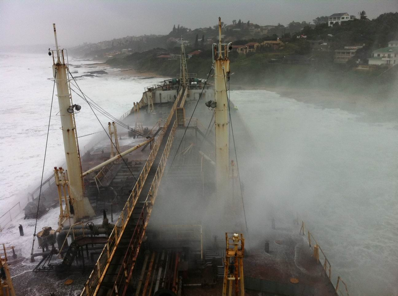
With no P&I Club cover and very little hull insurance, the MT Phoenix is currently resident at Salt Rock north of Durban. Are we looking at another Seli 1 scenario? The South African Maritime Safety Authority (SAMSA) has issued a statement saying that the owners of the tanker (which was on its way to the breakers) are “currently not responding to any communication” – a situation that should leave the vessel’s new neighbours with some real concerns.

It’s a situation that has prompted some in the industry to call for South Africa to seriously consider the benefits of appointing someone within the relevant government departments with similar jurisdiction to that of the UK’s SOSREP (Secretary of State Representative) for Maritime Salvage and Intervention.The position (and its almost unilateral powers) has gained respect in maritime circles following a number of high profile incidents off the UK coast.

The popular thinking in this regard is that, if South Africa had such a person with the requisite jurisdiction, the MT Phoenix would now be sitting safely in the port of Durban undergoing repairs before being sold at auction under the ruling which SAMSA was granted by the High Court on 22 July.

A SOSREP, you see, can override all decisions and make a call that should (theoretically) prove to be in the best interests of the environment and the safety of all concerned. He can force a port to act as a Port of Refuge in such situations where the risks of bringing the vessel into a safe haven are weighed against the risks of keeping her off port limits.

But with the lack of required insurance in place, the vessel anchored off port limits and, according to industry sources, attempted to undertake repairs at anchor. With no time to move her further out to sea or a mandate to force her into the port ahead of the storm, it is a sad consequence that she is now beached and vulnerable to further weather conditions.

It is a position that will make her hard to salvage and thus unlikely capable of recouping the expense that she is about to incur. And so the fact that “purchasers for the vessel have been identified” may prove irrelevant.

Fortunately the crew have been removed, but even their story is not without poignancy. Due to be repatriated, they will allegedly not be able to claim their wages as their remuneration was based on the successful delivery of the tanker to the scrappers!

Ranking safety at sea

Outliers by Malcolm Gladwell is a fascinating read and the section on aviation safety must surely have some bearing on the marine industry too.

In discussing a spurt of incidents attributed to one specific airline, Gladwell highlights a concept called the “Power Distance Index” (PDI).

“Power Distance is concerned with attitudes towards hierarchy, specifically with how much a particular culture values and respects authority,” he writes explaining that cultures with a high PDI will pay particular heed to levels of hierarchy and individuals will interact with each other strictly according to those hierarchies.

How this translates to behaviour in the cockpit (and arguably on the bridge of a ship) is simple. The captain is in command and his (or her) decisions should not be questioned if you are of a lower rank. Now, as rank and command are integral to the aviation and marine world, one would be forgiven for assuming that this is the correct order of business.

In his book, however, Gladwell uncovers the dangers of a high PDI culture. In investigating the series of accidents and listening to the black box recordings of cockpit communication – it was discovered that the WAY in which the lower ranks communicated with the captain had direct bearing on the actual incident.

The Korean crew (with a high PDI cultural background) understood that the hierarchy within the cockpit needed to be respected. And so, even when they saw their superiors making a dubious decision, they felt they could not undermine their authority by bringing direct attention to it.

And so the black box transcripts document their attempts to hint at potentially disastrous decisions. They simply were unable to voice a different opinion – and the captain at this stage was just too tired to pick up on the hints.

According to Gladwell it was this single discovery that marked a significant turnaround in aviation safety. Airlines began to concentrate on creating a new culture in the cockpit that allowed for the co-pilot to question authority and a specific set of prompts was created that ensured that neither the captain nor the other crew felt they were overstepping the mark.

In a very interesting footnote Gladwell lists the five highest rating PDI countries and the five lowest rating PDI countries:

Highest PDI’s:

  1. Brazil
  2. South Korea
  3. Morocco
  4. Mexico
  5. Philippines

Lowest PDI’s:

  1. United States
  2. Ireland
  3. South Africa
  4. Australia
  5. New Zealand

Remember that in this case it is better to be listed in the lowest PDI rankings. Surely this bodes well for SAMSA’s vision of creating a nation of seafarers?


It’s time to nominate a seafarer

Now in their second year the SAMSA Seafarer of the Year Awards celebrate the role of South African Seafarers in the country’s economy as well as their contribution to safe seas, prevention of pollution at sea and job creation.

Understanding that over 90 percent of our local trade is carried by the shipping industry; that fishing is one of the most dangerous jobs in the world; that oil companies are drilling further and further offshore and that incidents do occur at sea that require human intervention – it is clear that the men and women who choose a career at sea do so facing many challenges.

The SAMSA Seafarer of the Year Awards are designed to honour the choices that our seafarers make everytime that they go to sea. These awards, nominated by peers and employers, offer recognition of the challenging working environments and often the dangers that they face.

Culminating in a gala dinner and entertainment evening in Maritime Month (October 2011), the SAMSA Seafarer of the Year Awards go beyond thanking those that excel at sea – they aim to raise the profile of seafarers and the maritime industry as a whole in a country that is reliant on their contribution.

The inaugural awards in 2010 drew a high level of nominations from the industry and gave me a rare opportunity to interview some exceptional individuals. I am once again looking forward to engaging with those that remain the backbone of the industry.

I was also humbled by those that took the time to nominate their peers. Oftentimes we get so caught up in our own lives and issues, but  acknowledging others is such a simple way to give back to those that deserve the recognition.

Our partners in this initiative also need recognition. The South African Maritime Safety Authority (SAMSA) has once again put their weight behind the awards as the title sponsor. Smit Amandla Marine and Grindrod Limited (as employers of a great many South African seafarers) prove once again that they understand the importance of their own crew. Sea Harvest – one of our top fishing companies also partners us for the second year as does Business Partners.

Entries are now open and members of the South African maritime community can download the nomination form from our website (www.maritimesa.co.za) or nominate directly online. Click on the SAMSA Seafarer of the Year logo on the home page to learn more!


Thank you for my job

Without the ships that ply the oceans I would not have a job. It is truly that simple. Today is the International Day of the Seafarer and I am saying thank you for my job because without the men and women who commit to a career at sea we would not be able to navigate the global fleet of ships that call at our ports and carry our trade. Without them the only maritime-related industry that would be booming would be that of the ship scrappers; and the ships would be queuing off the beaches of India.

Without ships we would not need harbours or cranes and gantries. We would not need navigation equipment or engines. Salvors, importers, exporters, shipping companies, ship repairers and all those who supply our vessels with equipment or products would be out of business. Many countries would be cut off from their markets and all those shops filled with the “made in China” (or any other foreign destination) items would be largely empty.

That means that many retailers and shopping centres would no longer be able to operate effectively. They would not need to advertise and would scale down operations cutting back significantly on staff.

It is not just the marine-related industries that would falter without seafarers. Would you still have your job if men and women stopped going to sea? Today is the International Day of the Seafarer – acknowledge their impact on the world by tweeting and facebooking your vote of thanks.

Thank you for my job!

In memory of those at sea

On the 24th June 2010 a string of events culminated in the death of a young South African cadet serving on board the Safmarine Kariba. The discovery that Akhona Geveza had allegedly jumped overboard disturbed the maritime industry deeply and sent the media into a frenzy of headlines that spoke of rampant sexual abuse of cadets at sea. The next day – on the 25th June 2010 – the vessel returned to the place where Akhona had been found to hold a memorial service and lowered a floral wreath into the sea.

For some months media speculation around the actual facts surrounding the death of Akhona continued while the Croatian authorities investigated the incident. Locally Safmarine seemed perplexed that newspaper reporters had managed to uncover an apparent legacy of sexual harassment that extended beyond the current incident; and journalists did not name their sources in these allegations. Further investigations ensued and reports that the South African Maritime Safety Authority planned to conduct their own investigations surfaced this year.

In their July issue of Navigator (an inhouse publication), Safmarine devotes three pages to Akhona Geveza and the events that surrounded her death. They trace her last day onboard the Safmarine Kariba and discuss why they do not feel that the allegations of sexual misconduct existed on their fleet of vessels.

Capt Louise Angel weighs in on the debate saying; “A ship is run like a small community; this is our home for three to six months at a time and there is always someone you can turn to onboard if you have any kind of problem, and everybody generally knows everybody’s business. Our ‘bush telegraph’ onboard is finely tuned for sources of information (aka gossip) and at no time have we heard any allegations of sexual misconduct onboard any Safmarine ships.”

One cannot expect however, that those that travel our seas are always one hundred percent happy or one hundred percent at ease. Just as we experience our ups and downs in our own daily lives on land – seafarers must surely experience theirs. That we can take day off or easily seek comfort from our family or friends is something we take for granted. That we have the option of going home after a tough day in the office and relaxing with a glass of wine (or going to the gym for that matter) is another given.

Seafarers are stuck with their colleagues 24/7 for extended periods of time – a situation that must surely lead to periods of mental discomfort. For the most part they can move forward and look ahead to a time when they come ashore, but (for whatever reasons) Akhona was not able to do so and the whole maritime industry needs to acknowledge that the support systems in place failed this young cadet.

And so it is fitting that Tomas Dyrbye, CEO of Safmarine is quoted as saying; “We deeply regret any possible lapse in our duty of care which may have played a part in this sad incident and we remain deeply remorseful that we, despite our best efforts, could not have prevented Akhona’s death.”

But the industry also has to move forward. We have to continue to attract suitable candidates to engage with a career at sea and we have to continue to honour those that do.

Tomorrow is The International Day of the Seafarer. If you are in the maritime industry – what are you doing to say thank you to these men and women who have committed to the challenges at sea? In South Africa we have teamed up with some of the progressive maritime companies including Smit Amandla Marine, Grindrod and SAMSA to publicly demonstrate our appreciation. We will be participating in Flash Mobs around the country in Cape Town, Pretoria, Durban and Mossel Bay.

What are you doing?

Get ready to flash your support for seafarers!

In exactly a month’s time – on the 25th June 2011 – the shipping sector will acknowledge the role of seafarers as they celebrate the International Day of the Seafarer. For the public at large, however, the day will probably go largely unnoticed. Most will not spare a thought for the men and women who go to sea to navigate the produce, the appliances, the toys, the luxuries and the necessities of daily living to their doorsteps. Most will not understand the sacrifices and the challenges that seafarers make and overcome to ensure that 90 percent of all goods in our shopping malls are available to us.

The International Maritime Organisation understands this situation and has challenged the maritime community to help promote the very vital work undertaken by those at sea. They are encouraging bloggers, companies and individuals to write and talk about the contribution made by all seafarers and have even created a package to assist those wanting to participate.

Here in South Africa – I thought we could try something a little different. We at Maritime Southern Africa are initiating [with our friends in the maritime industry] the SA Seafarer Flash Mob!

The idea is to create Flash Mobs in all our port cities as well as in Gauteng in places that show the impact of international trade. For example in Cape Town – the V&A Waterfront is an ideal location as it neighbours the port and vividly showcases international trade that the retailers rely on to stock their stores.

The group will seemingly appear out of the general public and activate attention by: Putting on a lifejacket and saluting at attention while a designated person (or the whole group) sings the South African National Anthem. As the Anthem draws to an end, the group will once again remove their lifejackets and merge into the general public.

The “incident” will be video recorded and photographed to document our efforts to acknowledge the contribution made by seafarers.

JOIN ON FACEBOOK!

We have created a Facebook page for South African Seafarers and listed the Flash Mob under the events section to make it easy for people to sign up and become involved. Simply click on the link above and join the conversation.

We already have team leaders in Cape Town and Durban, but will welcome candidates from other areas who would like to spearhead a Flash Mob in their own region. Groups can be any size and do not have to consist of people in the industry!

I look forward to engaging with the industry in this initiative!


A vote of thanks to our seafarers

As we all prepare to vote tomorrow, it’s quite ironic that just over a month ago I wrote about how 18 young cadets had been challenged to “save South Africa’s democracy”. At the time I quoted the CEO of SAMSA, Tsietsi Mokhele who emphasised the role that our seafarers have in moving our economy forward and entrenching our democracy.

Their important contribution to our economy means that they are oftentimes far from home. It means that they miss birthdays, anniversaries, public holidays and of course tomorrow they will miss the opportunity to vote.

While there are structures in place for those who cannot attend a polling station tomorrow to cast their vote earlier – there do not seem to be mechanisms in place for those at sea to have their say in the future of their own government.

These are not South Africans who have chosen to work abroad or who have emigrated, leaving behind the potholes, the crime, the debates about open toilets or service delivery. These are citizens who do still live in the cities, the suburbs and the provinces that will have their leadership structures challenged tomorrow.

Don’t waste your voice – make sure you honour those that are unable to do so and make your vote count.

Saving South Africa’s democracy!

Yesterday, the 4th April 2011, eighteen young South Africans signed up to save the country’s democracy! Forgive for a moment the hyperbole and let me explain:

Yesterday 18 students were officially welcomed as the first entrants into the SAMSA (South African Maritime Safety Authority) Cadet Programme in Simons Town. Seated in a lecture hall at the South African Maritime Training Academy (SAMTRA), each of them received a warm hand shake from the CEO of SAMSA, Commander Tsietsi Mokhele and were motivated by his call to action.

The commander was not only aiming to welcome these new recruits; he was lighting a fire under each of them in the hope that they would realise the very unique and important position that they are in. For him they are not just 18 lucky youngsters who have been given an opportunity to complete their maritime training with sea time; they represent the future potential of some 35 000 future South African seafarers.

If successful the SAMSA Cadet Programme, which aims to place 140 cadets by the end of the year, will expand to place 480 cadets at sea by the end of 2012. But that’s not all. Mokhele sees the programme expanding by 50 percent year on year with the eventual aim of placing 2000 cadets at sea EVERY year.

So how does this scheme hope to save South Africa’s democracy? Well as the Commander points out: the maritime industry is not about ships – it’s about the world’s economy. “Your country needs you more than you know,” he said. “Without the maritime industry there will be no trade. Without trade we cannot improve the standards of living of our people and without improved standards of living there will be no future for our democracy. This is not about ships – this is about the future of our country!”

And so 18 youngsters signed up for more than just a career at sea!

For more information about the SAMSA Cadet Programme get the March/April 2011 issue of Maritime Southern Africa.

Piracy puts us on the big screen

Is it unfair to say that Tom Hanks is the next to actually stand to benefit from the scourge of piracy off the Somali coast? Breaking news from Hollywood at the beginning of the week names the actor as the chosen lead in a film depicting the true-life drama that played out on board the Maersk Alabama when it was captured by pirates. The film is to be based on the book by Captain Richard Phillips who was in charge of the vessel at the time.

Tom Hanks is an actor who can demand up to $30 million per movie plus profit participation which, in the case of Forest Gump, saw him walk away with $70 million. That’s not a bad pay check – higher in fact than most pirates’ ransoms!

In the 15 years that I have been reporting on the maritime industry for specialist publications – piracy has been the topic that I have received the most calls from the daily newspapers for information on. It’s unfortunate that this is the reality that has catapulted the world of shipping into the headlines and it does nothing for the industry’s very real need to attract youngsters into a career at sea.

Indeed most feature films depicting aspects of the maritime world revolve around disaster. That many are based on true stories does not bode well for the image of the industry, but then where would the drama be in plain sailing?

And so while legal, emergency and medical vocations are glamourised in shows such as ER, Gray’s Anatomy, LA Law and so forth – surely a case can be made for a series that follows the lives of a crew across the globe. It’s a perfect set-up for a show that relies on the need to focus on the relationships between a small group of people who interact on a daily basis. Yes, certainly there will be incidents that will do nothing to attract new seafarers – but on the whole it may go a long way towards promoting the industry by exposing more people to the fact that there are other options for them outside of being a doctor, a lawyer, a policeman or a firefighter.