Weekly Press Review – 31 August 2012

It has been quite a busy week in the maritime industry and various stories have made it into the press.

The Cubal, a 285 metre long LNG tanker, is at anchor in False Bay for repairs to its engine. The ship, designed to transport liquefied natural gas (LNG), is one of the most valuable visitors to anchor in our bay with a price tag of around $202 million.

According to reports, the vessel was given permission to anchor at False Bay by the South African Maritime Safety Authority (SAMSA) and regional manager, Dave Colly said that it would not be a long stay as the engines required only minor repairs.

On the policing front, thanks to the efforts of officials of the Department of Agriculture, Forestry and Fisheries (DAFF) 22 suspects are to appear in courts in both Cape Town and Hermanus this week.

News of the most recent arrest, details four men being arrested for abalone poaching on Robben Island on Friday. DAFF spokesman, Lionel Adendorf described how the arrest turned violent and his team was forced to fire at the engines of the rubber duck used by the poachers who, in attempting to avoid arrest, ‘rammed’ the Fisheries Protection vessel. 416 units of abalone were found on the rubber duck.

By all accounts it would seem that policing our waters continues to be a challenging and dangerous task.

There is more discussion and unhappiness surrounding the quota system in the press this week as a group of women from Meermin Visserye seek the assistance of the Department of Agriculture, Forestry and Fisheries to cancel an agreement with Compass Fishing Enterprises to fish on their behalf.

The women, who have a 15-year quota worth approximately R1.5 million to fish anchovies and pilchards, allege that they have not been able to capitalise on the full income generated by their quota due to issues with Ricky Donaggi, director of Compass Fishing, and his company; and have asked the department to withdraw all fishing permits issued to Compass Fishing to fish on their behalf.

Lionel Adendorf, spokesman for the Fisheries Department said that the department was committed to carrying out the wishes of the shareholders.

Let us hope that the real issues are addressed in this story and that the women can earn a living from the ocean in accordance with the quotas they control.

Finally some good news: South Africa has joined only a handful of countries, namely: Canada, Norway and Australia, in successfully integrating women into their submarine unit. Up until a few years ago any position aboard a submarine was regarded as ‘too dangerous and scary for women’, but now the SA Navy has successfully integrated 14 fully qualified women submariners: two chefs, one communicator, five mechanical engineers, artisans and a radio operator.

That’s a good story to end off women’s month on.

Weekly Press Review – 24 August 2012

The hate-hate relationship between Department of Agriculture, Forestry and Fisheries Minister Tina Joemat-Pettersson and DA fisheries spokesman Pieter van Dalen has once again be covered in the press this week; with the names of Duncan Hindle, the Minister’s special adviser and Shaheen Moolla of Feike also being thrown into the mix.

All the name calling and petty arguing has somewhat detracted from the fact that the long awaited public protector’s report on the marine patrol tender has been delayed. This is apparently due to the fact that the inquiry has been extended.

Although the delay is disappointing, as it is important to get answers and some kind of closure to the issues, it is also well worth waiting for the results of the enquiry so that all discussion and debate can at least be FACT BASED and not just finger pointing and name calling like badly behaved childern on a playground.

After a long and extremely respectable silence, Smit Amandla Marine has chosen this week to speak. In a statement Smit, widely regarded as the ‘whistle-blower’, has been subjected to months of ‘slanderous unsubstantiated claims about our integrity and business practices.’

Smit has now gone on record stating that they are not a fishing company and nor are they being investigated by the Hawks or any other state authority regarding their management of the Fisheries Department’s research and patrol vessels.

They have gone even further by offering their full co-operation and assistance with any investigation into their business operations – past or present.

This magazine is in the process of organising an actual face-to-face debate between Minister Tina Joemat Pettersson and Pieter van Dalen which will allow the two the opportunity to answer the really important questions in a controlled environment and hopefully get some real answers.

After many years of legal wrangling, the name Arnold Bengis is back in the news this week. After being accused of poaching large quantities of SA rock lobster and Patagonia toothfish, importing them illegally into the US and then selling them at a huge profit, a US judge has ordered Bengis and his son, who was also involved, to pay a record $54.9 million (R450m) in restitution to South Africa.

Marius Diemont, legal representative for SA, said this is ‘ a significant precedent that shows that authorities will go to great lengths to bring people who deal in illegal fish to justice.’

The case against Hout Bay Fishing, headed by Bengis, which started in 2001, is still to be finalised.

Weekly Press Review – 17 August 2012

The ever controversial tender for the operation of patrol boats to protect South Africa’s marine resources is back in the press this week. With only a week to go before the release of the Public Protector’s report into alleged corruption relating to the tender, there is more mud being slung around in the public domain.

Secretary-General of the WCBBC, Mntuwekhaya Cishe, stated that the chamber had asked that the irregular tender originally awarded to Smit Amandla Marine, dating back to 2005, be included in the investigation.

To add to the controversy, according to Tina Joemat-Petersson’s spokeswoman, Palesa Mokomele, the Hawks and the Asset Forfeiture Unit are also conducting an investigation into corruption in the Fisheries branch.

Surely, as a group, all these players need to work together to weed out those who clearly do not have our country’s oceans interests at heart as quickly (and quietly) as possible?

Our navy is in trouble again facing an inquiry into the incident which caused the SAS Queen Modjadji to ‘nosedive’ onto the sea bed during a training exercise off the coast between Port Elizabeth and Durban – and may have to explain itself to Parliament.

Reports seem to suggest that Parliament is beginning to question whether the large amounts of funding that the navy receives are being spent wisely.

In other news – Greenpeace activist, Peter Wilcox, captains the new Rainbow Warrior III which is on a six-day stay in the Table Bay Harbour. The yacht, which is in the harbour for routine maintenance is being billed as the most environmentally friendly vessel ever built.

She is heading for the Indian Ocean where she will kick off a campaign against illegal fishing by means of research and documentation of illegal fishing activities in the area.

Weekly Press Review – 10 August 2012

John Hare has once again raised some interesting questions this week with an article published in the Cape Times entitled: ‘Cape should be Africa’s corner cafe.’

In it he raises the question of why up to 80% of ships that pass the Cape each year do not stop? This despite the fact that maritime South Africa is in an extremely fortunate position with regard to geographical location, port facilities and expertise, communications, commercial and legal infrastructure etc, etc, etc.

He then goes on to give SAMSA credit for attempting to drive the maritime industry forward, but states that it is a huge task with many issues to overcome.

His general message is that all those in the maritime industry need to contribute to making our coast a ‘must-stop’ destination by supporting the efforts that SAMSA has made thus far, encouraging education in the maritime sphere and seeing how and where we can all assist in taking a giant step forward together.

Leaving PE on the SA Agulhas II

Nelize Ernst and I joined the SA Agulhas II at the end of her “shakedown cruise” to experience first-hand how the new vessel is handling and accommodating her research crew.

Leaving Port Elizabeth by moonlight.

Leaving Port Elizabeth harbour last night under the guidance of the (almost) full moon was nothing less than spectacular as the vessel was guided through the harbour mouth by the harbour tugs. The pilot was soon hopping across from the SA Agulhas and we were left to head out to sea on a perfect winter’s night.

You can refer to our May/June issue of the magazine for all the real technical aspects of the ship and her specifications, so I am going to concentrate on our experience here.

Having already explored most areas of the vessel when she docked in Cape Town in May, we left many of the other new guests to clamber around the ship while we settled in and aimed to find a few areas that we had not yet discovered.

Did you know that the vessel has a sauna on board – a gift from the Finnish builders? It’s obviously quite small, but perfectly designed to work aboard a ship. As a neighbour to the small gym, these facilities do give crew and researchers the opportunity to get some exercise. And after already eyeing the menus on offer for each meal – they may very well need to use them on a long cruise.

The monkey island provided a welcome surprise too. Fully enclosed, the area is far from the usually windy, cold vantage spot on most other vessels. Comfortable chairs, a work top area and vistas of views behind floor to ceiling windows make the SA Agulhas II’s monkey island a pleasant place to spot birds and sea life.

But with the bar about to open in the Miriam Makeba lounge and a short opportunity to get to socialise with some of the other people on board, we hurried down to enjoy the stylish comfort of the lounge area. Although all commercial vessels are required to be dry ships, the SA Agulhas II does carry a complement of passengers and therefore does offer a short period when the bar is open and serving (very reasonably priced drinks).

The actual crew (in this case from Smit Amandla Marine), of course, do not drink!

The accommodation itself is comfortable and practical.  We did manage sneak a peak at the rather spacious Captain’s quarters before retiring to our four-berth cabin. But our cabin packs a punch in terms of what it delivers for its small size. With two bunk beds, a three-seater couch, small flat screen television, cupboard space, desk and en-suite facilities, this cabin makes some crew accommodation I have seen look positively shabby.

Tired and lulled towards sleep by the gentle rocking motion of the vessel, it was lights out, blinds down and eyes closed for us way before the bewitching hour!

Weekly Press Review – 3 August 2012

Fisheries Minister Tina Joemat-Petersson is back in the news this week, accusing officials within her department of being corrupted by poaching syndicates. She stated that attempts were being made to ‘destabilise’ her department both internally and externally and also that ‘an overall cleaning-up operation of the department’ was taking place. The investigation which led to the discovery of the corruption initially focused on perlemoen poaching only, but is now also focusing on the allocation of quotas, permits, the transfer of fishing rights and the preferential treatment that certain businesses receive from the fisheries branch.

It would appear that our poor minister once again has her hands full. Perhaps if she had done a better job running her department thus far, she wouldn’t be dealing with this particular mess – amongst many others.

According to an article published in the Cape Times this week, it would appear that not only is the concept of male chivalry at sea a thing of the past, but it was a complete myth to begin with.

After a study of 18 major maritime disasters carried out by Mikael Elinder of Uppsala University in Stockholm, with the exception of the Titanic, where the captain ordered his crew to allow women and children to leave the sinking vessel first, there is no evidence to suggest that this is in any way the norm during a maritime disaster. It would appear that it is more a case of every man for himself.

The study analysed maritime disasters as far back as 1852 and found that in most cases more men than women and children survived and, even more alarming, was the fact that the crew themselves had the greatest survival rate.

Perhaps the world at large has been too critical of the poor captain of the stricken Costa Concordia for abandoning ship before anyone else? He was only doing what anyone else would do if their ship was going down – get off.

Or rather, perhaps this is just a sad reflection of our society as a whole; that everyone is indeed only looking out for number one.

Weekly Press Review – 30 July 2012

Last week’s media coverage of abalone busts highlights that poaching is an ongoing problem in our waters. There was another small victory for the Department of Agriculture, Forestry and Fisheries along with the South African police department who raided a home in South Beach yesterday and discovered almost five tons of abalone with an estimated value of R12 million.

A 36-year-old Chinese national was arrested at the scene and another man is still at large. ‘This is probably the biggest bust for Milnerton police,’ said Capt Cyril Dicks.

Interestingly last week saw the cancellation of a scheduled conference on Illegal, Unregulated and Unreported  Fishing in Cape Town, but did see the Mother City host a CCAMLR (Commission for the Conservation of Antarctic Marine Living Resources) workshop on the subject. This did, however, not make news headlines.

Adventurer, Mike Horn, received some media attention. After traveling for nearly two decades he has decided that he would like to share some of his skills, knowledge and expertise with a younger generation. To do this he invited anyone between the ages of 15 and 20 interested in joining him on his travels to apply to the Mike Horn Expedition Centre in Switzerland. He chose 16 individuals for each leg of the journey on the yacht, The Pangaea, and he and his 16 young adventurers from around the world have just arrived in Cape Town.

Each adventurer has been trained in survival, first aid, sailing, outdoor equipment and the latest advances in technology.

Congratulations to this group of young explorers on their accomplishment and to Mike for passing on his passion to a younger generation.

‘n Salvor maak ‘n plan

Yesterday I joined a room full of delegates at Smit Amandla Marine’s Emergency Response Seminar at the Protea President Hotel in Sea Point and was struck by the innovative and challenging nature of the marine salvage industry. Our local saying “‘n Boer maak ‘n plan” (a farmer knows how to make a plan) shall forthwith be changed in my vocabulary to “‘n salvor maak ‘n plan”!

While the seminar did indeed deal with the regulatory, contractual and governmental input required to deliver a National Contingency or Response plan – the case studies presented by many salvage stalwarts highlighted the diverse skill sets required within salvage teams. They also highlighted the ability of individuals and companies to think on their feet and create solutions to problems in situ.

This is the “Macgyver” (Google that if you’re younger than 35) sector of the maritime industry. It’s risky, dangerous, challenging and, I would imagine, immensely satisfying to be involved in successful salvage projects.

I would suggest that this sector could easily become the poster child to excite and attract the youth into the maritime sectors.

Look out for the editorial on this seminar in the next issue of Maritime Review Africa.

Weekly Press Review – 20 July 2012

The big news affecting the marine industry this week related to the MSC certification. Amid concerns that certification from the Marine Stewardship Council (MSC) would be lost, negotiations between the Department of Agriculture, Forestry and Fisheries and the MSC seemed to have been resolved – at least for the following year – ensuring South African fishing companies a place in the lucrative European hake trawl fishing market. This was confirmed in a statement by both the government and the council’s programme manager, Martin Purves and reported widely in the media this week.

Shaheen Moolla, chief executive of Feike, however regards the development as merely “a band-aid over a festering wound.” It would appear that there is still a lot of work and negotiation to be done to ensure a positive and permanent resolution to this ongoing situation – and no doubt this particular issue will continue to make news in the months to come.

Ship spotting is still possible!

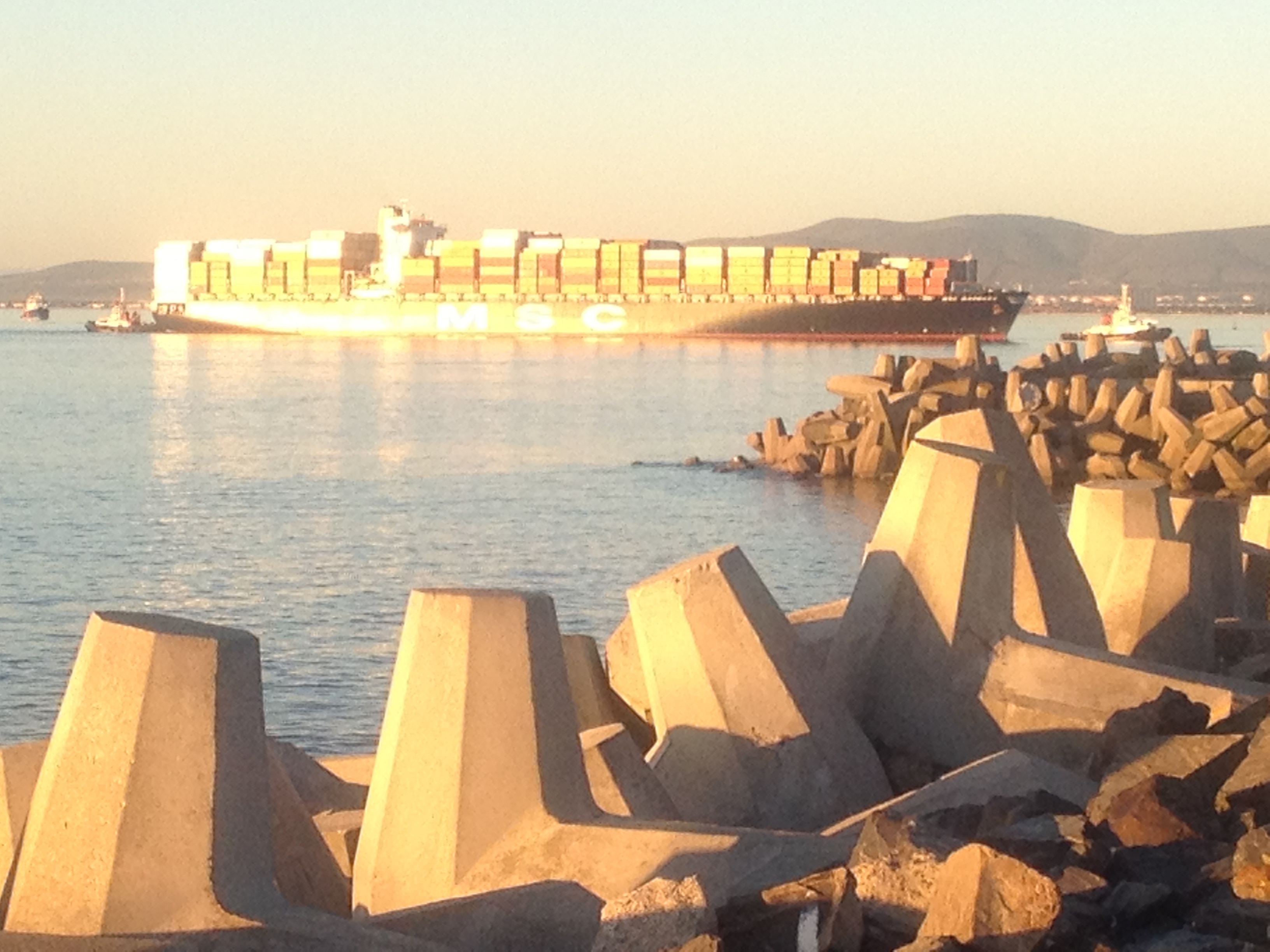
Last night I had to go to the Waterfront to attend a function at the V&A Hotel. With my mind on autopilot, I found myself on the far side of the Waterfront heading towards the Table Bay Hotel. Nonplussed, I was lured to park by the sight of the MSC Barbara being accompanied into the harbour by two tugs.

The lull in the winter weather seemed to have inspired a couple of ship spotters to the area and there were a few of us taking photos as she headed into the port.

The MSC Barbara enters Cape Town harbour.

At this point I was still under impression that I was at the correct venue for my function, so I ambled into the hotel only to find, of course, that I was meant to be on the other side of the Waterfront. A helpful employee of the hotel suggested I remain in their free parking area and just walk across, so I took advantage of the lovely evening and started the journey.

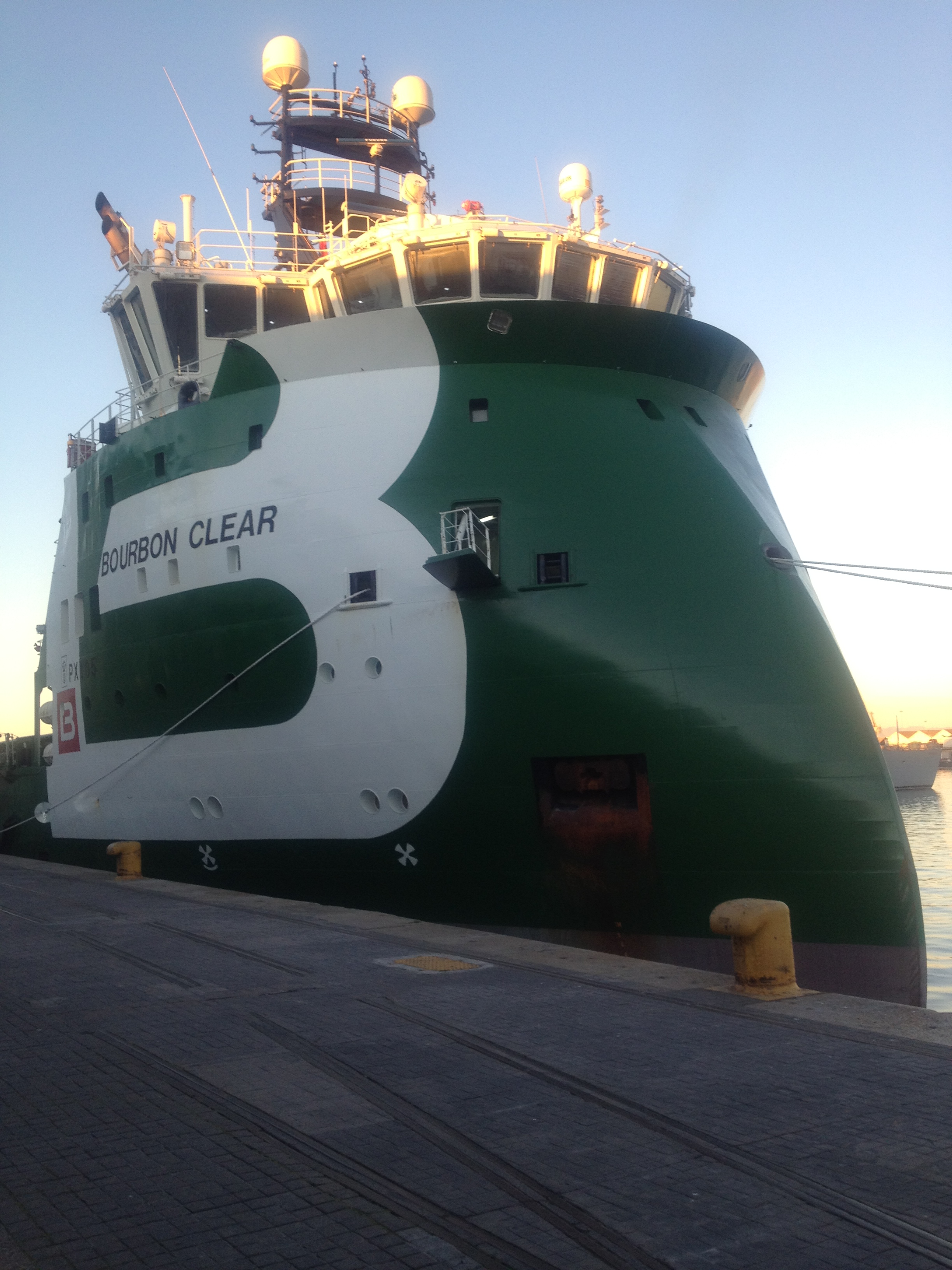
And I am glad I did. Berthed directly outside the Table Bay Hotel was the Navy Frigate, but what was really attracting some attention and cameras was the Bourbon Clear. With her distinctive bow and bright green hull, she cuts a striking figure and had more than a few people stop in their tracks.

The Bourbon Clear, a Large Platform Supply Vessel, in Cape Town harbour.

The Bourbon Clear is a Large Platform Supply Vessel designed by Ulstein Design and built by Zheijang Shipbuilding. She was delivered in 2010 to Bourbon Offshore (Norway). She is built according to Det Norske Veritas Clean Design notation and carries a Green Passport complying with IMO ship recycling recommendations.

Walking just a little further, an assortment of vessels were berthed facing the diners while just across the harbour I could easily see the fishing vessels bobbing against the I&J jetty.

The brightly lit oil rig currently occupying A-Berth and towering above the Waterfront buildings completed the maritime picture as I finally found my way to the correct venue.

We lament the fact that the ISPS code has restricted access to the harbour, but as an industry we could do more to project what is visible into the public eye. We just need to be a little more creative about showcasing our industry!