Weekly Press Review – 30 May 2014

After the dramatic governmental cabinet shuffle announced this week, there are many in the industry who breathed a sigh of relief at the news that Minister Tina Joemat-Pettersson will no longer be at the helm of the fisheries department and that that position is now in the hands of Minister Senzeni Zokwana.

Having said that, many civil society groups are dismayed at the news that Minister Joemat-Pettersson will now head up the Department of Energy.  Some feel that she should have been removed from office altogether, rather being handed control of a department that is crucial for the development of the country.

ANC spokesman Zizi Kodwa was quoted as saying that the ANC did not determine an individual’s capabilities on the basis of past experience.

A new study has revealed that bottom trawling is causing “deep-sea biological desertification.”  This type of fishing, where a net is dragged along the ocean floor, has been controversial for many years.  It is recognised as the most destructive form of fishing, primarily due to the large numbers of marine species that are caught and killed in the nets as bycatch, but also due to the damage caused to coral reefs.

The new study goes even further to say that the microscopic sea creatures living in the marine sediment are killed during trawling.

The study was conducted by Antonio Pusceddu of the Polytechnic University of Italy.

In South Africa bottom trawling is used to catch hake, sole and prawns.  The World Wildlife Fund (WWF) confirms that there are very high numbers of bycatch, including seals, seabirds, turtles, prawns and sharks.

With the ever-growing concern for our planet,  it is believed that a less destructive method of fishing needs to be given some consideration.

Two anglers, Gareth Collingwood and Gary Clouws, learnt the hard way that our marine life is full of surprises.  A day of sporting fun off the coast of Durban turned into a nightmare when a blue marlin, weighing an estimated 100kg, leapt out of the sea and skewered both men to the back section of their boat.

The incident happened at about 11am and resulted in massive damage to the boat as well as the two anglers being aided by the NSRI and taken to the local hospital.  A month later their wounds are still dressed and they are still going for regular hospital check-ups.

As for the marlin …. it got away.

Weekly Press Review – 23 May 2014

The failed 2013 fishing rights allocation process (FRAP2013) has continued to make headlines this week.  While the audit into FRAP 2013 by Harris Nupen and Molebatsi found no evidence of corruption, the audit did reveal that the process was rushed, flawed, contained “critical lapses” and was driven by the desire for “an appropriate outcome” rather than to meet the needs of the fishery.

The disaster of the 2013 fishing rights allocation process has caused much anger and frustration and has cost the country’s tax payers millions of rands, but where to now?   Let us hope that the mistakes of the last year can be put aside and the new fishing rights allocation process will be well planned, well co-ordinated, well implemented and well received.  One tall order.

Minister Tina Joemat-Pettersson herself has been quite outspoken in the press this week.  In an interview with a Cape Town newspaper she stated that, when starting with the Department of Agriculture, Forestry and Fisheries (DAFF), she had taken over a department “filled with corruption” and that she was shocked by the number of officials living well above their means, adding that she had  chosen to work for the poor.  One can only assume that after making comments along these lines it would be hard to return to work on Monday ….

She also stated that commercial perlemoen quotas needed to be looked at urgently and that changes could be expected as soon as the end of July this year.

It would seem that changes are definitely afoot at DAFF and everyone is awaiting the announcement of ministerial positions.

In other news, after two years in Table Bay harbour, the vessel, the E-Whale, has been sold to a foreign company for $61 million (R637m).  The vessel was arrested in April 2012 after various creditors alerted local authorities of large outstanding debts on the vessel.

A deposit has been made by the company purchasing the vessel and they now have five days in which to settle the outstanding balance before taking ownership.

Maritime Newsmaker of the Year 2013

Last night we hosted our annual function to thank clients for their valuable support as well as to present the Maritime Newsmaker of the Year Award. The award aims to recognise individuals, companies or organisations that have garnered media attention that depicts the maritime industry in a positive way. It recognises those who have successfully showcased the industry to a wider mass audience – and in so doing have positively marketed the industry as a potential employer or career opportunity to a new generation.

Last year something happened that took me by surprise. Suddenly the world and the media became fascinated with the maritime skills and expertise of a South African who had been hand-picked to lead one of the most publicised wreck removal projects of recent years.

Locally and internationally he suddenly became a maritime celebrity as he showcased not only his own knowledge and expertise, but assembled a team of South African individuals and companies to lift the Costa Concordia under the watchful eye of the world.

Television and print media flocked to the sight of the wreck and Nick Sloane and his team must have generated more airtime and print space for the significant talent that we have than any marketing campaign could have dreamed of doing. Notwithstanding the tragedy of the shipwreck; the ensuing story of maritime ingenuity is a good one to tell.

My hope is that many of our youth would have been awoken to the wide variety of potential careers that are open to them in the industry. Careers that are demanding but immensely rewarding.

But I guess the day I happened to pick up a GQ magazine at a guesthouse to find Nick Sloane staring back at me, was the day I really realised he had helped capture media attention for maritime news that extended beyond the normal tragic story of a shipwreck to give people a real glimpse into the salvage, diving, engineering and pollution prevention sectors that seldom get a media nod of approval.

Unfortunately Nick was still on site at the wreck and remains focused on the job at hand – and so could not join us last night to receive the award. He did, however, send this message:

“I am extremely humbled to be named such a figure and would like to accept this on behalf of all South Africans involved in the offshore and salvage industry. I believe that our seamanship and work ethics are starting to be appreciated on a global basis. I would also like to thank my wife Sandra and three children for allowing me to follow my passion. From all 330 team members on the Costa Concordia at this time thank you for thinking of us in this way. I hope that we refloat mid July and that I can get home by August.” -: NICK SLOANE

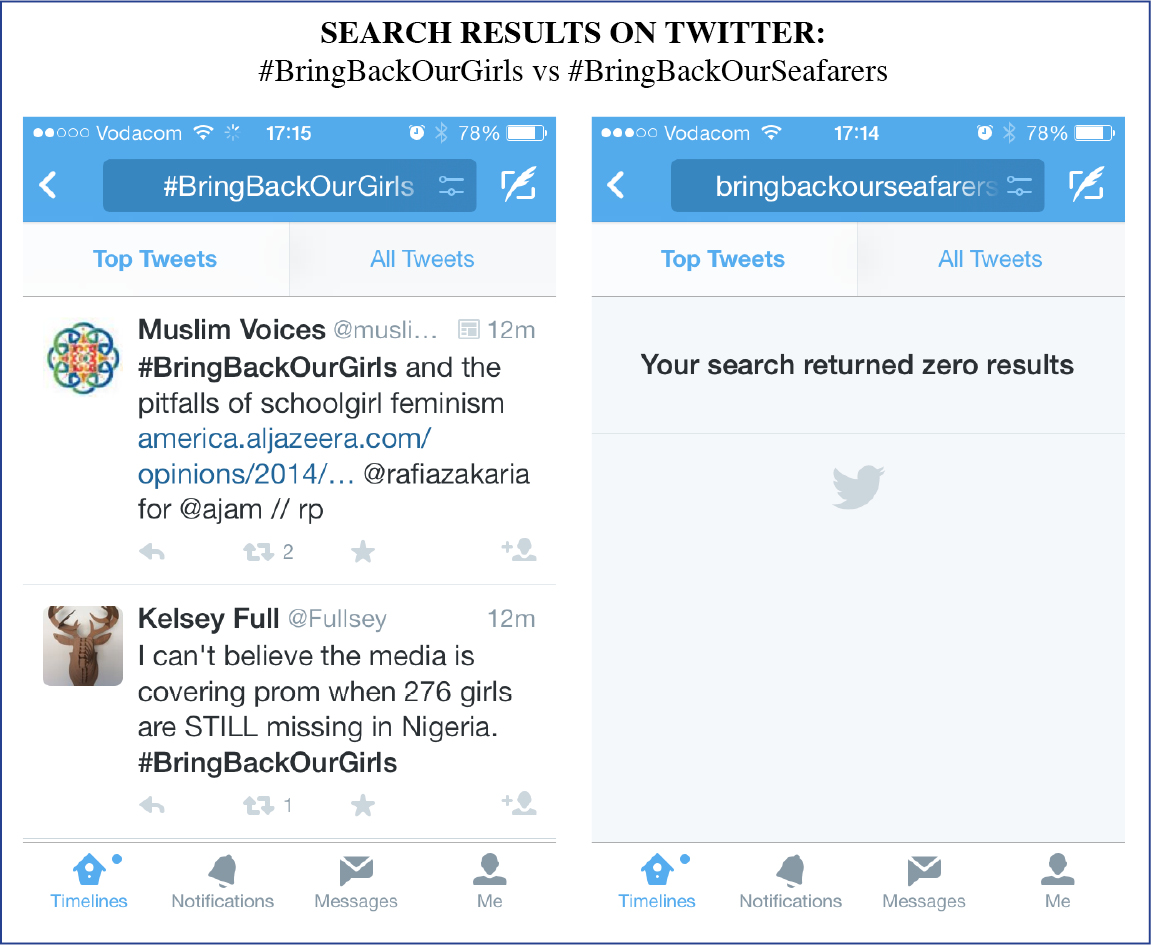
#BringBackOurSeafarers

Over the last few weeks the Bring Back Our Girls (#bringbackourgirls) campaign has ignited quite a following across the globe. Initially fueled by many people’s outrage that the media had all but ignored the story, this grew to a lambasting of international super-powers for not stepping in to assist Nigeria find the girls. Mostly the argument followed the rather simplistic course that, if this had happened to 200 white schoolgirls the media would have been all over it and that if it was a situation that jeopardised America’s access to oil then they would have sent in the troops.

This is not the place to debate either of these suppositions and certainly the plight of these girls is one of grave concern. Indeed the message to Bring Back Our Girls has gone viral and everyone is standing up in support of it: from the ANC Women’s league to individuals keen to pen, blog and tweet about it to get in on the action. Even corporates are parading employees in front of cameras and posting photos of them holding up signs with the Bring Back Our Girls message on them – some of them in the maritime industry.

So damn it – where is the #BringBackOurSeafarers campaign? Why is every shipping company, support company, port company, importer, exporter and seafarer not jumping up and down for more media coverage about the plight of 54 seafarers who are still being held hostage in deplorable conditions. According to the recently released document on the State of Maritime Piracy by Oceans Beyond Piracy these seafarers have been held in captivity for almost three years.

“Substantial work must still be done in the interest of saving the lives of the 54 high risk hostages who remain in pirate captivity almost three years after their capture. Moreover, the continued ability of pirates to hijack small vessels such as dhows and fishing vessels is a continued risk. It is important to remember that piracy is not only a threat to the free flow of goods, but also to the well-being of individual seafarers, regardless of their vessel size or nationality. It is evident that the number of hostages in captivity, while trending downward, remains of immediate relevance to counter-piracy work and should be prioritized by the maritime and international communities,” the report says. 

While I am personally doubtful of the true effectiveness of viral campaigns such as the one directed at releasing the Nigerian schoolgirls and feel they simply help us feel better about being powerless in the face of such atrocities; what if they are even slightly successful in seeing their safe return as a global eye is turned to the situation?

What if viral campaigns do prompt the appropriate action? Then the maritime industry needs to be more active in pushing the agenda. Yes we have had successful intervention at sea in the form of naval presence, armed guards and vessel hardening – but 54 seafarers are still no closer to going home. So as you spare a thought for the schoolgirls and their families – spare a thought for those seafarers and their families and consider some action. #BringBackOurSeafarers.

comparison


Weekly Press Review – 16 May 2014

It has been a long time coming, but Minister Tina Joemat-Pettersson has finally stepped up to the plate and decided to scrap the entire fishing rights allocation process of 2013 (FRAP 2013).

This comes after an independent audit found that the Fishing Department’s fishing rights allocation process was fatally flawed and would not stand up to a court challenge.

“To pre-empt further legal challenges, I intend to set aside the entire FRAP 2013 process, including all decisions and outcomes.  I have directed that the requisite legal steps be initiated for this to happen.”

This is the first time in South African history that a fishing rights allocation process has ever been scrapped.

So, it is back to the drawing board for the fisheries department.  Let us hope that a viable solution can be found as soon as possible.

The Minister is also in the news this week as she sets a deadline to receive final reports from both officials and Foodcorp, in connection with R50 million worth of fishing quotas that were allegedly awarded to two companies without due public process. Thereafter the minister will refer the issue to the public protector and the Special Investigating Unit.

Minister Joemat-Pettersson said, “I have proved throughout my term that I’m committed to clean governance and will not tolerate any decisions or transactions which undermine this.”

It will be interesting to see the results of this investigation and at whose feet the responsibility will ultimately fall.

This week the company NTP Logistics asked local authorities for permission to dock its ship, carrying material used to make nuclear fuel, in South African harbours.

The substance in question is known as yellowcake, or uranium oxide and is enriched to make fuel for nuclear power stations.  If the substance is further enriched it can be used to make nuclear weapons.

Anti-nuclear groups have objected in writing to the National Nuclear Regulator (NNR) in response to advertisements placed in Eastern Cape newspapers by the company announcing the application and calling for objections to its request to dock the ship.

It is not government policy to allow radioactive waste into South Africa.

The press has reported that nets set up at the southern corner of Fish Hoek beach in April last year as a pilot project, may become a permanent feature.

Sarah Waries, project manager of Shark Spotters says that the response from the public has been extremely positive, especially from parents of small children, all saying that they are far more comfortable swimming at the beach with their families with the nets in place.

The city was granted a research permit by DAFF and the Department of Environmental affairs to carry out the trial and it is these departments that will decide whether the nets will become a permanent feature or not.

These nets are different form those used elsewhere in the country which are designed to trap and kill sharks.  These are exclusion nets and are designed to keep sharks out, but not actually trap them

It would be a great coup for environmentalists if the nets became not only a permanent feature along the beaches at Fish Hoek, but were also implemented along the beaches of all of South Africa’s coasts.  And taking it a step further; perhaps even provide an environmentally friendly alternate to shark nets being used worldwide – especially in Australia, where a shark culling programme is being used in an attempt to protect beach goers from possible shark attacks.

Simon’s Town welcomed the SAS Spioenkop home this week amid much fanfare.  The vessel returned after a three-and-a-half month visit to the Mozambique Channel where she took part in Operation Copper – working with the Mozambican fleet against piracy.

Maritime historians from around the world will be delighted with the news of the possible findings of two well-known sunken vessels.  US marine archaeologists have announced that they believe they have discovered the remains of a sunken Civil War-era ship.  The steamship, Planter, was commandeered by a group of African-American slaves in Charleston to sail to freedom nearly 152 years ago, on May 13, 1862. The ship later sank off the South Carolina Coast.

Expeditions to find the ship began in 2010 and despite the find, due to the fact that the vessel is buried, excavation will probably be too expensive and she will remain where she is.

Equally as exciting, a ship wreck discovered off the coast of Haiti may be the remains of the Santa Maria, the flagship of Christopher Columbus from his first voyage to the America’s.

“All geographical, underwater topography and archaeological evidence strongly suggests that this wreck is Columbus’s flagship, the Santa Maria,” says Barry Clifford, a archaeological investigator from the US.

Clifford is planning a return trip to Haiti next month to meet with officials and plan the next steps to take.

Weekly Press Review – 9 May 2014

Oceana seems to be making a bit of a stink and the Hout Bay community are none too happy about it.  The company’s fishmeal plant located in Hout Bay has been emitting the smell of rotten fish over the last few weeks and residents are up in arms according to newspaper reports.

Chief executive, Francois Kuttel has admitted that some may find the smell offensive, but says that there is nothing that can be done to stop the smell.  “In instances where complaints were logged recently, it was found that the plant had been operating normally.  The regulating authority has also conducted its own investigation and our operations have been found to be compliant,” said Kuttel.

It would seem that the residents of the area do not have a leg to stand on as Mushfeeqah Croeser of the Department of Environmental Affairs and Development Planning has pointed out in the press that the plant has been in existence for more than 40 years and is a registered offensive trade.

Unfortunately for the residents of Hout Bay, they will simply have to put up with the stink …. or move.

The SA Agulhas II cruised back into Cape Town harbour this week, just in time for all those on board to cast their vote in Wednesday’s elections.  All South African’s on board were said to be delighted to be back in South Africa in time to have their say in the election process.

Weekly Press Review – 25 April 2014

Boat owners who moor their boats in the Kalk Bay harbour are very unhappy this week as security in the harbour is reportedly at an all-time low.

Newspapers reported how local boat owner, Everett Schubert, lost his boat after children playing on it somehow managed to cause the vessel to sink.  Apparently this is not the first incident of children boarding and playing on boats moored in the harbour.  Local boat owners said that the fisheries department had appointed local company, Cape Town Boating, to control security in the harbour, but the contract had ended in September last year and no other company had been employed to take over the task.

Fisheries spokesman, Lionel Adendorf has been quoted as saying that the department is only responsible for the provision and maintenance of the harbour itself, and not for protecting private fishing vessels within the harbour walls.

Having tried to gain access to the port of Cape Town myself, which is no mean feat, I am amazed that young children have such easy access to vessels in the harbour in Kalk Bay.  Beyond the safety of the vessels moored there, what about the safety of the children playing in the water?  Surely that should also be of concern to all departments involved?

Weekly Press Review – 17 April 2014

An image that would make anyone’s blood run cold, let alone those within the maritime industry, is the sight of the bow of a vessel protruding from the water as it slowly sinks beneath the waves.  That is the image that covered the front page of many newspapers around the world today as a ferry carrying 462 people sank off the coast of South Korea.

At this point there is little detail as to the cause of the accident.  The focus now is on the search and rescue operation to try to determine the fate of the almost 300 people, mostly high school students, that are still missing. There are at least 87 vessels and 18 aircraft involved in the rescue operation and navy divers are now searching for survivors inside the ship’s wreckage.

For the families of those on board there is nothing to do but wait.

In another search operation, the search for the missing Malaysian airliner continues in the Indian Ocean off Australia, and in a strange coincidence, the story of a vessel that went missing in that same ocean area in 1909 has made the news this week.

The story of the SAS Waratah shares quite a few similarities with the missing airliner.  Both went missing in the same body of water, both had a similar number of passengers on board and in both cases a large number of vessels, from various countries and at great expense, worked together to join the search.

The SAS Waratah went missing on July 17, 1909 with 211 people on board.  She was the most modern passenger ship of her time and was even more stringently built than the later Titanic.  She simply vanished and her story made headlines around the world. After 13 months the search for the missing vessel was called off and she was never recovered, neither was any flotsam.

There is a very real chance that, with the help of modern technology, one of the world’s greatest aviation mysteries could simultaneously solve one of the greatest maritime mysteries.  Stranger things have happened.

Weekly Press Review – 11 April 2014

The shark culling taking place in Australia has made the news again this week.  A new survey has revealed that despite the relatively high incidents of shark attacks along the Australian coast and the very aggressive culling campaign, Australians, on the whole, are not overly concerned about being attacked.

In a survey of 583 individuals, 87 percent felt that sharks should not be killed due to the possibility of an attack and 69 percent felt that public education would be a far better approach to preventing attacks.

University of Sydney shark expert, Christopher Neff said:  “The assumption is that the public is afraid. That when shark bites happen that they react emotionally and that they are looking for an immediate response.  My data refutes that.”

A total of 45 sharks gave been killed thus far in the largest shark culling drive in the world in Western Australia.  The state government wants to extend the culling for another three years.

Surely if this drive was in response to the terror that Australians felt at visiting their own beaches, then this survey proves that this is not necessary. Australians are not afraid and are intelligent enough to realise the risks involved when interacting with our oceans.

Is this culling drive perhaps aimed at putting the minds of visitors to Australia’s beaches at peace and ensuring the continuation of a lucrative tourism trade?

Weekly Press Review – 4 April 2014

Members of local fishing communities made headlines as they took to the streets in two separate protests this week. The first of these was staged outside the Western Cape High Court in response to allegations that a community from Buffeljachtsbaai is being forcibly removed by the Overstrand Municipality.

The second took place in Hout Bay, where protestors blocked the entrance to the harbour and called for the renewal of their fishing rights, as well as transformation within the fishing industry.

Protest leader, Emmanuel Arendse was quoted as saying, “We are living in poverty.  We want our fishing rights back.  Our people need food on their tables.  We cannot live like this.  Minister (Tina Joemat-Pettersson) must get out of office.”

Are we not all secretly calling for change within the fishing industry?  Perhaps the urgency is just felt that much more keenly by communities who rely on the industry for every meal that is or is not on their table.

Also making news this week was the announcement by Oceana that it would be paying out R289 million to the beneficiaries of its empowerment trust. The company added that the cash payout was only a quarter of the value that the empowerment fund had generated and proved that they were worthy recipients of fishing rights.

Oceana chief executive, Francois Kuttel stated:  “What we have achieved is far more than what we would have been able to achieve if these rights were given to players with less resources and experience.”

Minister of Agriculture, Forestry and Fisheries, Tina Joemat-Pettersson has previously stated that empowerment and creating value for fishing communities was an important criteria for assessment during fishing rights allocation.

With their fishing rights up for assessment next year and again in 2020, it would seem that Oceana are aiming to tick all the right boxes.