If you go down to the docks today ….

If you go down in the docks today, you’re sure of a big surprise
If you go down in the docks today, you won’t believe your eyes
For every boat that ever there was
Will be there for certain because
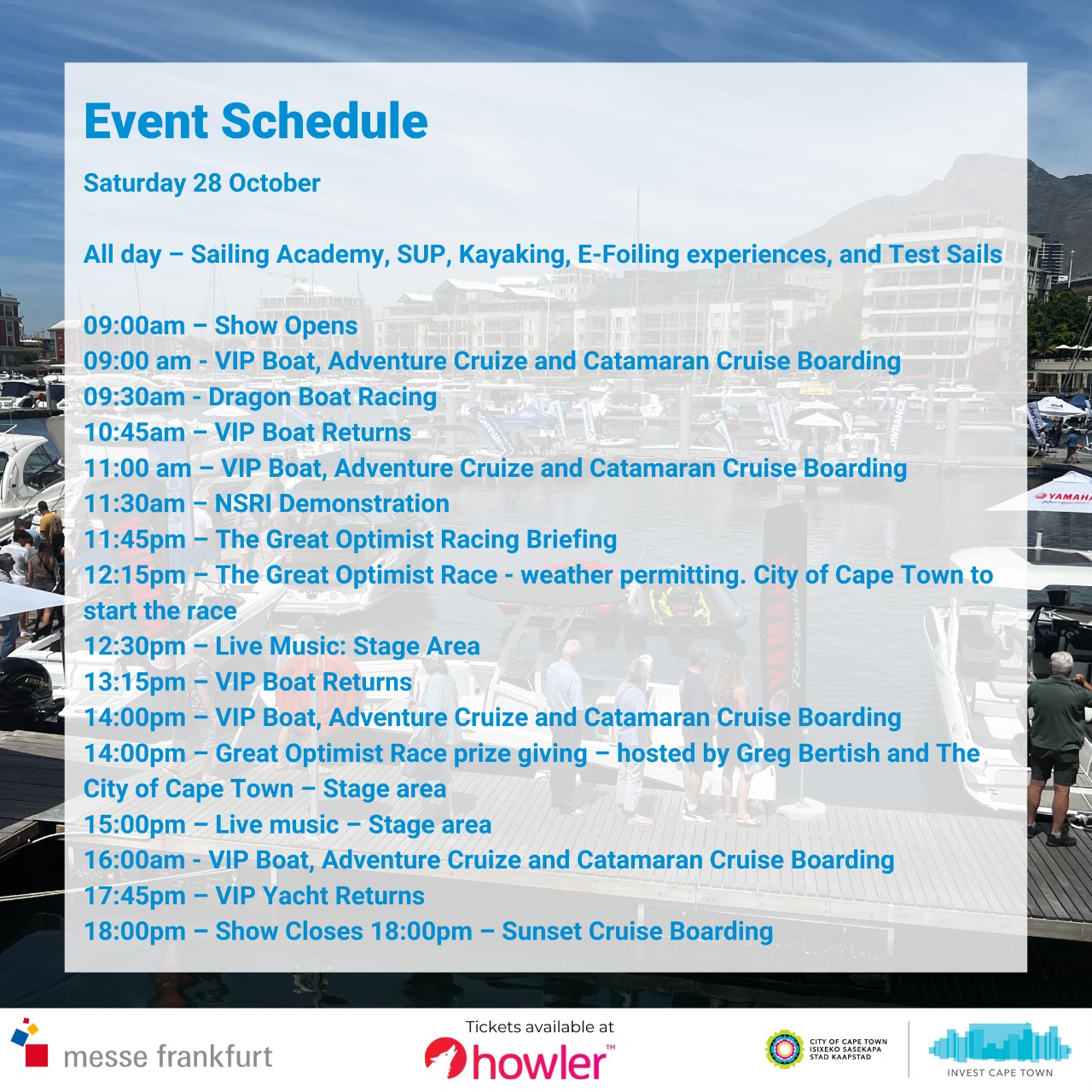
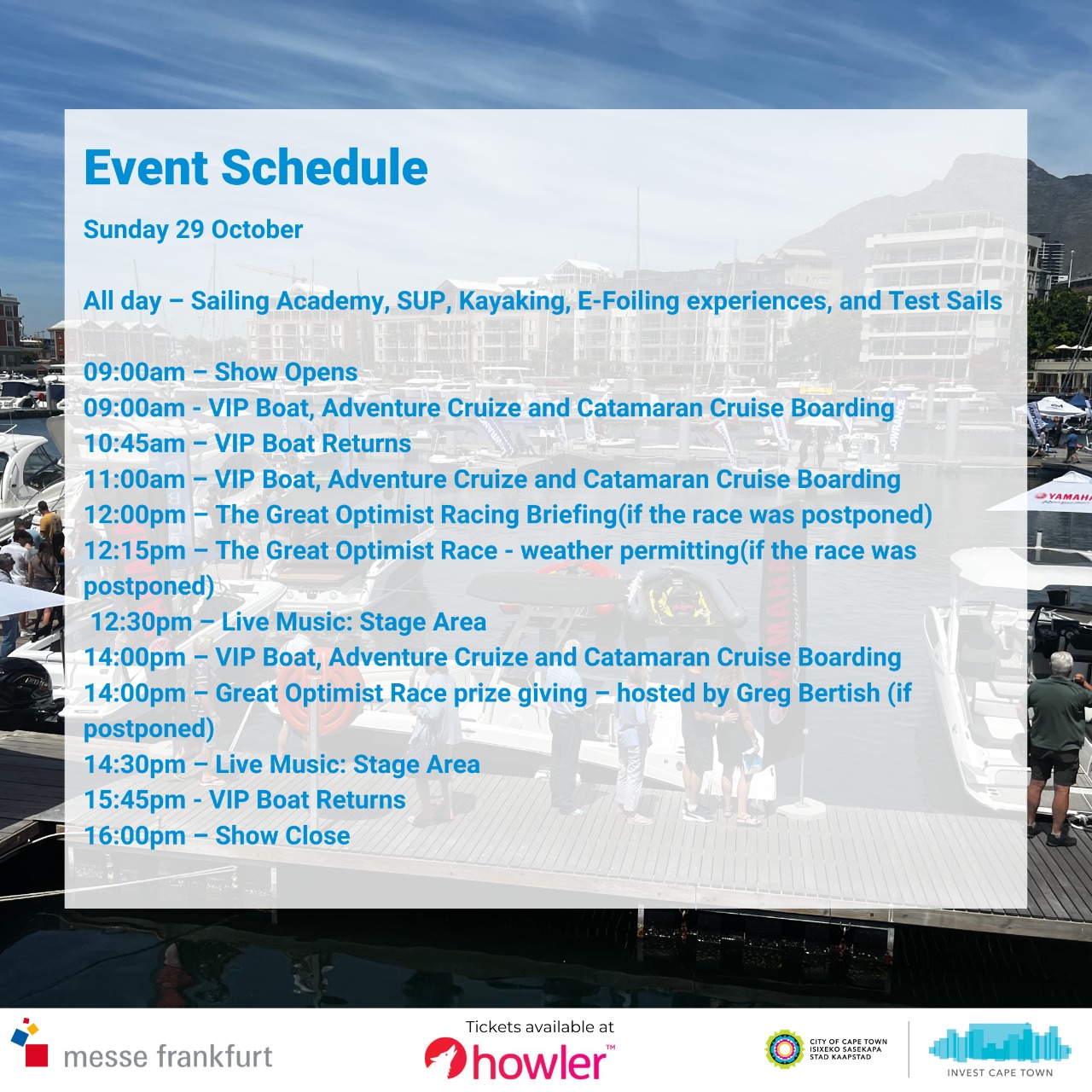
Today’s the day the waterfront hosts a boat show

boatica has loads to share
All are welcome for the next three fun filled days
Watch the action enjoy the fair
The boats and stalls will amaze

If you go down in the docks today, you’d better not go alone
It’s lovely down in the docks today, but nicer to share not on your own
For every boat that ever there was
Will be there for certain because
Today’s the day the waterfront hosts a boat show


Apologies to Henry Hall, the original writer of the Teddy Bear’s Picnic, but I immediately thought of it today when I woke up – thinking it would be apt given the excitement around the boatica show that opens in the V&A Waterfront today.

After last year’s bumper edition that launched a number of new vessels, I was sceptical that this year’s show could compete, but WOW! Last year we saw a number of newly designed catamarans test the waters and this year sailing is taking centre stage with a number of new yachts on display.

But cat enthusiasts won’t leave the show disappointed as there is at least one new cat being launched as well as many of the luxury catamarans that have put the Cape on the map as a premier destination for catamaran purchasers worldwide.

So – if you go down to the docks today, you’re in for a great surprise!

Managing your maritime message (Part 1)

Five tips for your maritime website

As a maritime journalist I often trawl maritime websites for news and insights that could spark a good story or initiate a discussion within the industry. While there are some amazing examples of professional-looking sites, there are also some very dismal ones. These inferior sites not only give the companies that they represent a bad reputation, but also impact on the overall standing of Africa’s maritime industry within the international community.

With this in mind, I thought I would provide a quick list of five tips for those in charge of managing their company’s maritime message.

ONE | LORUM IPSUM – GET RID OF PLACEHOLDER TEXT

Yes, you won’t believe how many sites have placeholder text on sections of their website where the company is still possibly curating appropriate content or has forgotten all about it. While this is moderately acceptable when you are first setting up the website, ideally any page that includes this text should not be accessible to visitors.

TWO | MENU – MANAGE YOUR MENU

That brings me to the second tip. The tabs in your menu need to make sense and open existing pages. I often visit sites where links on the menu do not work and produce error messages. Of course, this can be a result of a technical issue, but when the tab is permanently malfunctioning or simply pointing you back to the HOME page, it can be rather annoying.

Similarly, I have yet to work out why some websites (most notably government departments) use more than one menu tab to point you to the same news. This clutters your page and could easily be consolidated under one tab.

THREE | NEWS – NEWS IS NEW

Well, this is a personal bugbear. Do not include a NEWS page on your site if you do not have the capacity to update it regularly. Many companies and organisations start off with lofty ideas of ensuring that their NEWS page is constantly updated but, over time, realise that this is not a core function for anyone in the company. As a result, the items on the page are outdated and reflect poorly on the overall message that the site should be conveying.

If you are resolute about wanting a NEWS page, aim to ensure that there is someone in your organisation that has the capacity and the experience to sniff out the newsworthy stories as well as the time to keep the page updated. Alternatively, hire a PR company to do this on your behalf with targets on how many stories you want to add and when.

A caveat to this could be the creation of a BLOG page as opposed to a NEWS page. This is a far safer bet for those who may not have regular news items to share, but do want to include some company insights and updates on their website.

FOUR | DATES – WHEN DID IT HAPPEN

Perhaps even a worse sin than not keeping your NEWS page updated is not including the date on which your story was posted. When a visitor has absolutely no idea of when this great piece of news unfolded, they are less likely to share it, and I will certainly never use it as a news item on the magazine’s website.

This is such a simple thing to remember, but I am astounded by how many companies simply post news with no mention of when it happened.

FIVE | SOCIAL SHARING – BE SOCIAL

In a similar vein to the news updates, companies that link their page to a social media platform that is inactive are really not taking full advantage of what these platforms can provide. Rather shut down inactive social media platforms or investigate how you can maximise them to share your maritime message.

[Oops – I better take my own advice and ensure the magazine’s Instagram page gets a bit more attention!]

An ad-hoc approach to your maritime message is not the best way to maximise your maritime message

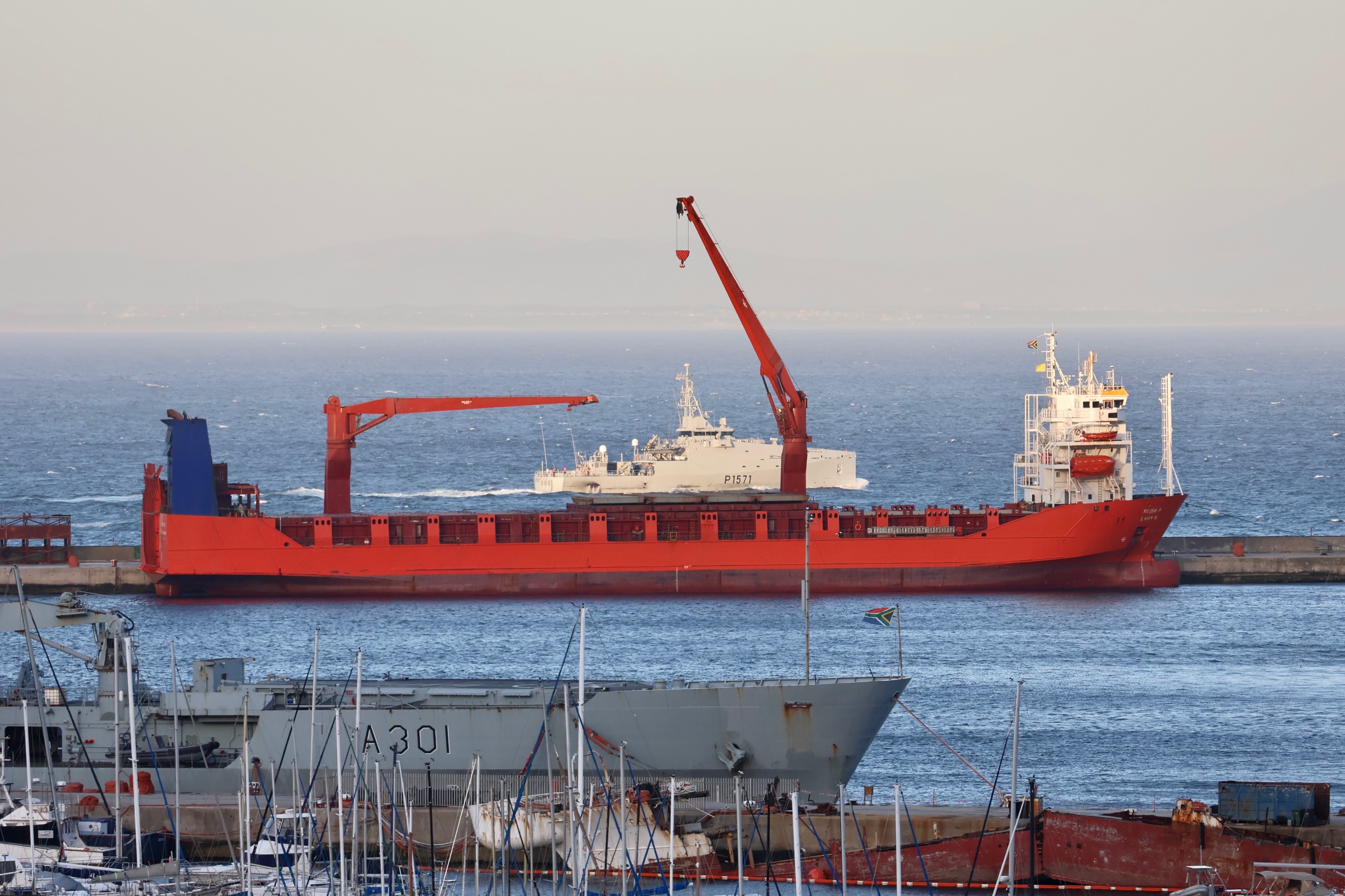
Lady R – Lady in Red

The Lady R berthed in Simon’s Town (Photo: Hugo Attfield)

Following the conclusion of the investigation into the Lady R – the vessel that attracted so much attention when she docked at the South African Navy’s base in Simon’s Town – I decided it was fitting to re-script Chris de Burgh’s iconic song Lady in Red to fit the circumstances.

The Lady R – Lady in Red

We’ve never seen a ship berthing as she did that night,
We’ve never seen one ignite such a fight,
We’ve never seen so many give a ship more than a glance,
They’re looking for info in advance, given half a chance,
And we’ve have never seen a ship so daring,
To visit the naval quay or catch so many eyes,
Have we been blind?

The Lady R came in from the sea, to the navy,
Hoping no one would see, just to come and flee,
It’s not where she should be,
We don’t know this vessel on the quayside,
No AIS like she had something to hide.

We’ve never seen a ship spark such public debate,
We never saw her freight, it was amazing,
We’ve never seen so many people get that irate,
We watched it escalate, it took our breath away,
And we’ve have never had such a feeling,
Such a feeling that the visit was about more, despite what they say;

The Lady R came in from the sea, to the navy,
Hoping no one would see, just to come and flee,
It’s not where she should be,
We don’t know this vessel on the quayside,
No AIS like she had something to hide.

An invitation

Most of us never get the opportunity to engage one-on-one with the international maritime leaders. We may meet them in passing at an event or even request a quick photo opportunity with them – but we don’t really know who they are or what makes them function the way they do within their roles.

Tomorrow I have the opportunity of engaging with Amb Nancy Karigithu – Africa’s candidate for the position of Secretary General of the International Maritime Organisation. And I am inviting everyone to join the conversation ahead of this month’s election process.

We are not only going to be discussing her ambitions for winning the election, but are really going get to know the woman who has been at the forefront of Kenya’s maritime sector for many decades. We will invite our audience to participate in the conversation and ask questions; to listen and understand the candidate on a more visceral level. Our conversation is not going only going to be about the mechanics of the maritime domain or about the bullet points of her campaign, so grab a cup of coffee tomorrow morning and join the conversation. Let’s really get to know the woman who could become the first African and first lady at the helm of the International Maritime Organisation.

JOIN THE CONVERSATION HERE

I asked ChatGPT about starting a National Shipping Line

With all the hype around ChatGPT internationally and the local debate about whether or not South Africa should start a national shipping line, I thought I would test out GPT’s intelligence and pose the question.

For those of you who may have been hiding in the engine room of a ship somewhere and have not yet heard about ChatGPT, it was launched in November last year and is designed to provide “articulate answers across many domains of knowledge” according to Wikipedia. I have heard from some individuals that they are using it to create speeches and assist in the writing of research papers.


So I decided to pose the question: Should South Africa launch a National Shipping Line?

THE ANSWER

Whether or not South Africa should launch a National Shipping Line depends on a variety of factors, including economic conditions, the country’s strategic goals, and the potential risks and benefits. Here are some factors to consider:

Pros

  • South Africa is an important trading nation and a National Shipping Line could provide the country with greater control over its shipping operations, ensuring the safety and quality of its goods, as well as setting competitive shipping rates.
  • Launching a National Shipping Line could create jobs for South African citizens and stimulate economic growth.
  • A National Shipping Line could help to reduce the country’s dependence on foreign shipping companies and increase national pride.

Cons

  • Starting a National Shipping Line can be expensive, with high start-up costs for ships, ports, and other infrastructure.
  • The shipping industry is highly competitive and volatile, with unpredictable demand and fluctuating freight rates, making it a risky investment.
  • Established shipping companies may already have a stronghold on certain routes, making it difficult for a new National Shipping Line to compete.
  • Political interference could lead to inefficiencies and potential corruption.

Overall, whether or not South Africa should launch a National Shipping Line depends on a thorough analysis of the costs, risks, and potential benefits, as well as a clear strategy for success. It may be wise for the government to consult with industry experts and stakeholders to make an informed decision.


While this all took only a few minutes to generate and the information is obviously accessible on the internet somewhere, the ChatGPT service does not indicate any of the sources of its information. For me, as a journalist, this is somewhat problematic for a number of reasons.

Firstly – it is important to know the source of information in order to make an informed decision as to whether you believe it to be accurate and factual.

And, importantly, the information that GPT digs up may be protected by copyright laws and using it may expose you to potential infringement suits.

Nevertheless, GPT may serve as a good port of call for obtaining basic information from which to launch a more indepth investigation into matters that require critical interrogation and where the nuanced data is not required.

It just does not fly with me

News this month that Cape Town’s Mayor Geordin Hill-Lewis was aiming to drive the city’s position as the Gateway to Antarctica is great – but the fact that it is being promoted as a “day trip” from the Mother City just does not fly with me.

In just five hours tourists can touch down in Queen Maud Land having joined a flight in Cape Town. Is it just me – or does this kind of defeat the object of travelling to one of the poles? It’s not supposed to be this easy. It’s not supposed to be accessible to the “instant gratification” types who will simply haul out a wallet to notch this up as an experience on their idealised bucket list.

They will not fully appreciate the distantness of this remote setting. They will not experience the icy seas and oceans that prevent many from reaching this destination. They will not be holed up on a small speck in the ocean in a daring effort to reach the ice.

While I appreciate that flights are shared between visitors and the scientific community, reducing environmental impact and supplying logistical support for scientists at research bases operated by several countries, including South Africa – it still seems at loggerheads to what getting to a remote destination should be about.

The mayor’s quote from press releases acknowledges that witnessing the “Antarctic’s pristine wilderness first-hand” is a privilege. Perhaps it’s just me, but I believe that it should be a privilege for those who are willing to set sail and earn their right to claim a footprint via an ocean expedition.

“Visiting the world’s remote seventh continent is the closest anyone will come to experiencing life on another planet,” notes the mayor without acknowledging that this is like taking the space out of space travel.  

Sadly I do see this as the way that tourism and exploration is heading – and am slightly jealous that I was not whisked down to the ice. Yes, I realise the hypocrisy in this, but fortunately I have not been tempted to test my lofty convictions.

ACCESS DENIED:

Rocking the boat

As part of a four-ball of relative novices, I was asked not to be offended by the decision not to allow us to participate in the upcoming Fairship General Botha Old Boys Bursary Fund fundraising golf day.

Having previously addressed the fact that industry golf days, by their very nature and legacy, tend to remain rather male dominated with the board of the Bursary Fund, this decision came as a bit of a surprise – given that the four ball in question happened to include four women.

We were assured, however, that the marketing efforts for the golf day had reached out to women’s golfing groups and to the ladies belonging to the Rondebosch Golf Club where the event is being hosted.

That they had to find non-maritime women for an industry golf day does not seem to have made a dent in their thinking. According to the correspondence from the Bursary Fund and the manager of the Golf Club – there was not much interest shown despite their efforts to create a more inclusive field via these channels. That the women which were targeted in these marketing endeavours do not want to sign up for a stereotypically male dominated industry golf day also seems to be beyond their understanding of some of these nuances.

As a group of lady novices keen to have some fun at a golf day aimed at raising money for the future maritime generations – a golf day with sponsored holes aimed at making the game less serious, we have been advised to rather not participate lest it destroys our potential longer-term love of the game. In fact, the club manager has already decided we would NOT enjoy ourselves. The capitalisation of the word is her emphasis and not mine. Instead – she has advised us to embark on a more structured approach that includes the expense of coaching, lessons and mentorship.

Personally – the idea of the golf day sounds a hell of a lot more fun as well as a fundamentally better introduction to the game than the latter advice.

Apparently the “suggestion” to prevent us from teeing off is “not intended to exclude anyone and hopefully not discourage the eager and brave souls from ever trying golf”. I do hope that the intention now is to ascertain whether any of the other “souls” signed up for the golf day are novices and exclude them as well.

Yes, we are certainly novices and no we do not own our own clubs, but the correspondence also makes the assumption that none of us have had any exposure to the game – a fact that neither the Bursary Fund nor the manager cared to clarify. Personally, I have been on a driving range; I have played a short round with some experienced golfers, and I have co-organised several industry golf days back in the day.

During these golf days I spent the majority of the day riding around in a golf cart, photographing and engaging with players – followed by assisting with the prize giving and engaging with the score cards.

It was through the organisation of these golf days that my reservations about hosting such events materialised. The number of women from the maritime industry that played over the course of several years could be counted on one hand. Each event turned into a male bonding fest that effectively discouraged inclusivity.

Having been asked to engage with the Bursary Fund previously about how to move their brand into the future and maintain a relevance for the next generation of maritime professionals, I voiced this exact concern, but did suggest that they at very least include a prize for the top lady player. Not even this hit the mark with their organising committee.

I was told that these events remain the easiest and best way to raise money. Yes, raising money for maritime bursaries is certainly important, but what happened to our commitment to make the industry more cognisant of creating an inclusive environment?

Given this lack of inclusivity, I am rather astounded at the nature of the correspondence received to inform us of their decision, which is inherently condescending in its nature – offering us the opportunity to come out on the day and be taken out “briefly” on a golf cart. The email also goes as far as to say: “I trust that this does not offend any of your team and that it will be taken in the positive spirit intended”.

My answer to this is quite simply: yes, it does offend, but us taking offence is almost irrelevant to the broader picture here. A more “positive spirit” could have been engendered had either the board or the club reached out and made suggestions to accommodate us rather than simply telling us to get ourselves together and try again next year.

Perhaps suggesting that we tee off last so as not to impact the field; or to split our four ball into two and look for four more experienced players to join each four ball (more four balls – more money for the fund) could have indicated a rather more positive response.

I dare say that there are many other creative suggestions that could have come to mind had they thought further than protecting “the sport that they both love” with the word no!


Interestingly, their Instagram account seems to indicate that you are welcome whether you know how to play golf or not.

Be like a bonobo

(Based on speech given at the the Imbokodo Transformation Agenda Award ceremony on 24 August 2022)

Faced with the task of delivering an uplifting and motivational maritime message, I searched the internet for some inspiration, but found nothing that really fitted the brief. So donning my journalist hat, I came up with a few titles that I thought might work: 

  • Achieving your maritime mission
  • 5 Easy ways to get ahead in your maritime career
  • Maritime gains over the last two decades
  • A collaborative approach for Maritime South Africa
  • Lift as you rise on the tide – or; 
  • Be like a Bonobo

As you can see from the title of the blog – I settled on the last topic: Be like a bonobo. 

When I was in Durban in 2019 for SAIMI’s (South African International Maritime Institute) Forward Thinking Conference, I went back to my hotel room and was fascinated by the story of the bonobos on the Discovery Channel. 

For those of you who may not know what a bonobo is – it is a primate rather closely related to the chimpanzee. In fact, the two species are almost entirely identical in terms of their genetic make-up. They are, however, vastly different in terms of their lifestyles. 

It turns out that the bonobo is a largely matriarchal society which is generally a peaceloving, chilled one where there is little aggression and where there is a genuine sense of community as well as a desire to act as a group and not as an individual. 

Interestingly, this is quite different from the chimpanzee who lives just across the river. On their side of the dividing water – they exhibit an aggressive lifestyle. The patriarchal society allows male chimps to dominate their female counterparts – often resulting in severe aggression that includes infanticide. 

The documentary showed footage of both sides of the river; cutting between the two societies to amplify the differences. The chimps were marauding, violent creatures where females were often at the mercy of the bigger, stronger males. While on the bonobos’ side of the river things appeared a little more like a hippy commune where the members languished in the sun and shared food; looked after each other’s infants and generally seemed to be living in utopia. 

The obvious question then is why and how? Why are these societies so different and how can we more emulate the bonobos?

Well it turns out that there is a very real reason for these differences. Apparently a massive drought impacted the side of the river on which the chimpanzees live in a way that resulted in food shortages as well as the need to protect scarce resources from other species such as the bigger gorilla. 

The chimpanzees needed to become more aggressive to survive. This aggression spilled over into their own community and generation after generation they passed on the scarcity trauma to their descendants – even as the drought eased and resources returned. As a result the chimpanzees became an aggressive, xenophobic society where not even its own members were safe. 

By comparison, on the other side of the river, the bonobos were not faced with these same challenges and were secure in the knowledge that enough resources were available to all. And in turn this culture of sharing was therefore inculcated amongst the community – and this became the ancestral gift passed from generation to generation. 

Now you may be wondering what on earth this has to do with the maritime industry? And that’s a good question. On the surface it has absolutely nothing to do with the maritime industry actually. 

But one of the issues that keeps popping up at maritime conferences and workshops is the lack of collaboration as companies, institutions and individuals try to protect their turf or domain in the industry. Now, I would suggest that makes us more like the chimpanzees than the bonobos. 

I do understand that the pie seems to be small, but continuously cutting it up into more and more pieces is simply going to make us more hungry to become focused on our own survival at the expense of the growth of the industry. 

The mere existence of a 3,000km coastline; the vast EEZ that the South Africa has access to as well as its position at the tip of Africa on a busy trade route between East and West, means that we should be more secure in the notion that we have the resources and opportunities to help us err towards the bonobo mindset.

Many have alluded to a number of gaps in the industry. Low hanging fruit and lost opportunities should highlight that we need to expand our vision of the maritime sector to embrace its ability to accommodate new entrants, women, youth and even the expansion of existing companies. 

We need the government to listen to industry in terms of what is required to unlock many of these opportunities. The ports need to act swiftly to a changing landscape and commit to timeous delivery of capital expenditure, licensing and partnerships while removing corruption as well as the bureaucracy that stifles growth. 

We also need industry to work collaboratively across sub sectors in a way that acknowledges synergies and breaks down silos. 

In the context of the Imbokodo Awards, the Women’s Conference and women’s month – I would suggest that we can take this desire to be like a bonobo even further. 

I would argue that we cannot attain bonobo status by narrowing our view to the very binary picture we currently have of gender roles. It is not so much about allowing women to be women in the maritime industry as it is about society allowing everyone to be themselves wherever they may land on the stereotypical feminine/masculine spectrum. 

And it certainly needs to challenge the idea that men should not adopt traditionally feminine roles just as much as it needs to address the idea that women can adopt leadership roles. It needs to be inculcated into our families where parents stop presenting different household chores to sons and daughters or where fathers automatically assume the place at the head of the table at dinner time. We can only truly be authentic when we shrug off stereotypes and allow ourselves to live in the way that feels natural to us. Not all of us are leaders; not all of us are caregivers – there is a huge spectrum of opportunity that lies between these two points. 

A glance at our bonobo society shows us that the males are not expected to be the leaders, but neither are the females. The power is not assumed by either gender – but rather shared across the troop in a way that underpins the notion that power is not a scarce commodity that naturally will result in the desire to dominate.

There are currently a number of overlapping initiatives within the industry to address the silo mentality; to improve the visibility of women and youth by unlocking opportunities; to create awareness and to expand the scope of our maritime sector within the global interest to lower carbon emissions as well as to create a greener maritime space.

We need to actively identify these overlaps and commit to addressing why we are not working together to reach these goals. 

And this is why we need to be more like the bonobo. There are no silos within the bonobo society. They are actively working as one community to ensure a sustainable future for the group as a whole. They are not intent in driving domination by any one over another and have, by default, created a society where all can thrive. 

So I leave you with this mantra: be like a bonobo – see your domain as one where you do not need to grab every opportunity; where there is space for all who surround you to acknowledge their strengths wherever they lie on the spectrum. And let us unlock the hereto locked blue economy opportunities by cutting bureaucracy, territoriality and a sense of scarcity. 

20 in 2022

It seems like it was a completely different universe that we launched the magazine in – and in some ways it was. This year marks the 20th anniversary of the magazine and its various platforms and I feel extremely proud that we not only survived the serious outfall of 2008, but have also managed to navigate the last two years of the COVID pandemic – albeit with a bit of fumbling.

We have some interesting initiatives planned to mark this milestone, but we cannot ignore the current economic and social climate that we are operating in. The last two years have brought some challenges and hard lessons, but have also given us the kick we needed to start to re-strategise how Maritime Review sees its future within the maritime Business-to-Business publishing environment.

Having left 2021 with a full blown dose of COVID’s omicron variant and entered this New Year still trying to return to health, I have a new perspective of what those who suffered through the earlier, less mild versions of the virus must have had to endure. I am grateful to have had a vaccination and to have only fallen ill at this stage.

In the spirit of this gratefulness and the start of my 20 in 2022 series, I would like to express what else we at the magazine are grateful for:

20 reasons to be grateful in 2022

  1. We are grateful to clients that supported the launch of the magazine in 2002.
  2. We are grateful to the clients that continued to support the magazine since then.
  3. We are grateful to the clients who have committed to supporting the title going forward.
  4. We are grateful to the many maritime stalwarts who have provided their input over the years.
  5. We are grateful for the new-comers that are beginning to stir up the industry.
  6. We are grateful for the prompts from industry about potential stories that should be written.
  7. We are grateful for those that supported some of our stranger initiatives like the Flash Mob and the Maritime Scrabble Tournament.
  8. We are grateful to the South African Maritime Safety Authority (SAMSA) for their generous support of the Maritime Industry Awards gala events that we hope one day to relaunch.
  9. We are grateful to those that told us when we got facts wrong.
  10. We are grateful to clients like AMSOL (and their predecessors) who have been constant loyal supporters of our many initiatives.
  11.  We are grateful that the maritime industry continues to be an interesting and diverse sector with sub-sectors that assure that our work is seldom boring.
  12. We are grateful to have partnered with many event organisers over the years and look forward to continuing to do so.
  13. We are grateful to our followers on social media who remain engaged and vocal.
  14. We are grateful for the opportunities to collaborate with maritime stakeholders on the publishing of maritime related textbooks and handbooks.
  15. We are grateful to those who have agreed to be interviewed on the record about some of the more prickly subjects.
  16. We are grateful that many of our clients in the maritime sectors were seen as essential services during the beginning phases of the pandemic.
  17. We are grateful to have been witness to the launch of a number of locally-built vessels.
  18. We are grateful to have celebrated maritime milestones with many companies and individuals.
  19. We are grateful to have seen new companies launched and flourish.
  20. We are grateful that there are still opportunities for the title after 20 years.

Getting take-aways

Yesterday I picked up some maritime take-aways that did not involve fish and chips.

I accepted an invite to participate in a Maritime Security Roundtable hosted by the Institute for Security Studies Africa (ISS Africa) with a bit of trepidation based on my concern that I would not be able to add much value. Joining a group of varied maritime stakeholders, the discussion was interesting as well as diverse and highlighted several important issues that provided some important take-aways.

  • The marine and maritime space is far-reaching and complex in nature – making any discussion on governance and security equally diverse and complex.
  • Significant work is being done theoretically, academically and practically to improve South Africa’s and Africa’s ability to manage its own maritime domain – but much of this is not immediately visible or apparent.
  • This lack of visibility is, in part, due to the diverse range of stakeholders involved across government and industry – with the consequence of some duplication and gaps occurring.
  • While many consider Operation Phakisa a failed initiative, it did manage to provide deliverables in some areas. One such success is the creation of the Incident Management Organisation (IMOrg) within SAMSA.
  • An Ocean Economy Master Plan is scheduled to be completed by December this year – outlining aspects of the maritime economy that require attention and offer opportunity. Although the process is being driven by government, labour and industry, there is still a perception that it is being held behind closed doors by some.
  • There is a lack of willingness to coordinate data from the industry to help make over-arching decisions, with many government departments, NGOs and Universities all accumulating research without an understanding of what has already been undertaken in the space.
  • Coastal communities are often not part of the discussions for solutions and/or their specific challenges are not understood within the context of the historical and present dynamics.
  • Training within the maritime space needs to be offset against actual employment opportunities. Training for unemployment cannot be an option.
  • There appears to be a lack of review of policies to understand where interventions have worked and where they have not. In addition, policy briefs are often ignored or not produced.
  • The slow pace of policy as well as legal instrument development is a massive problem with important legislation often becoming stalled and remaining in the pipeline for many years.
  • It was suggested that a major maritime disaster or set-back may be needed to strengthen government’s resolve to tackle a number of issues that remain unresolved.
  • A dedicated maritime department within government was once again discussed as a solution to coordinating the maritime efforts of the country; and that the maritime agenda needs to be raised more often within government structures.
  • While regional and continental bodies exist, these cannot override national interests. The AU needs to strengthen its maritime desk.
  • In the absence of true collaboration and visibility; many private companies are simply just getting on with it while policy and government strategy lags behind.

At the end of the day, most agreed that adding another maritime intervention or initiative to the space would simply further the fragmentation of efforts. More collaboration and coordination are the ultimate solutions. Sadly, this is a common refrain and will take significant effort for stakeholders to pay more than lip service to the notion of breaking down silos.

Thank you to my hosts and fellow-panellists for a most interesting afternoon of discussions. It was also good to get out from behind the computer screen and zoom meetings to engage in person – albeit behind masks.