Ship spotting is still possible!

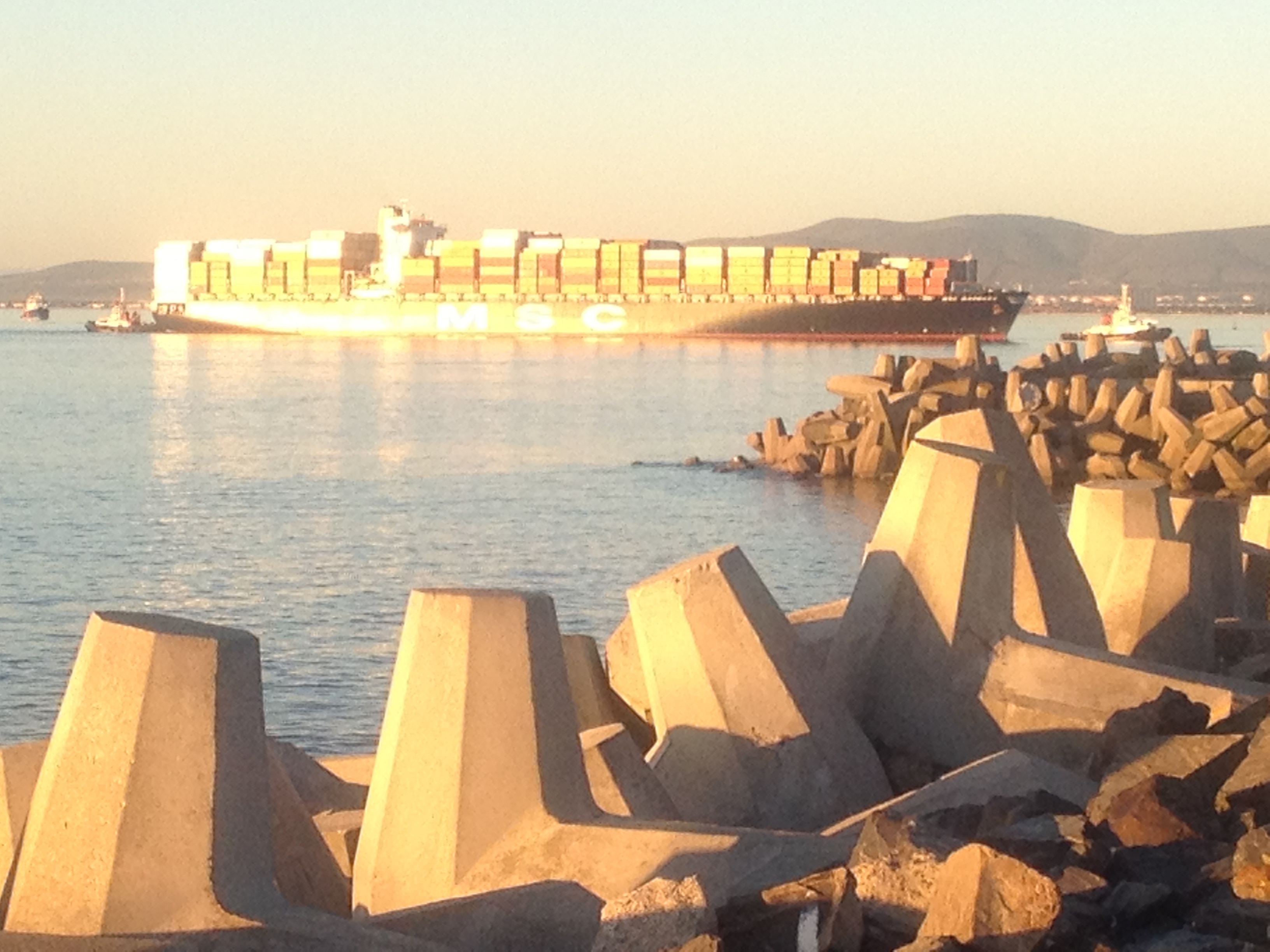
Last night I had to go to the Waterfront to attend a function at the V&A Hotel. With my mind on autopilot, I found myself on the far side of the Waterfront heading towards the Table Bay Hotel. Nonplussed, I was lured to park by the sight of the MSC Barbara being accompanied into the harbour by two tugs.

The lull in the winter weather seemed to have inspired a couple of ship spotters to the area and there were a few of us taking photos as she headed into the port.

The MSC Barbara enters Cape Town harbour.

At this point I was still under impression that I was at the correct venue for my function, so I ambled into the hotel only to find, of course, that I was meant to be on the other side of the Waterfront. A helpful employee of the hotel suggested I remain in their free parking area and just walk across, so I took advantage of the lovely evening and started the journey.

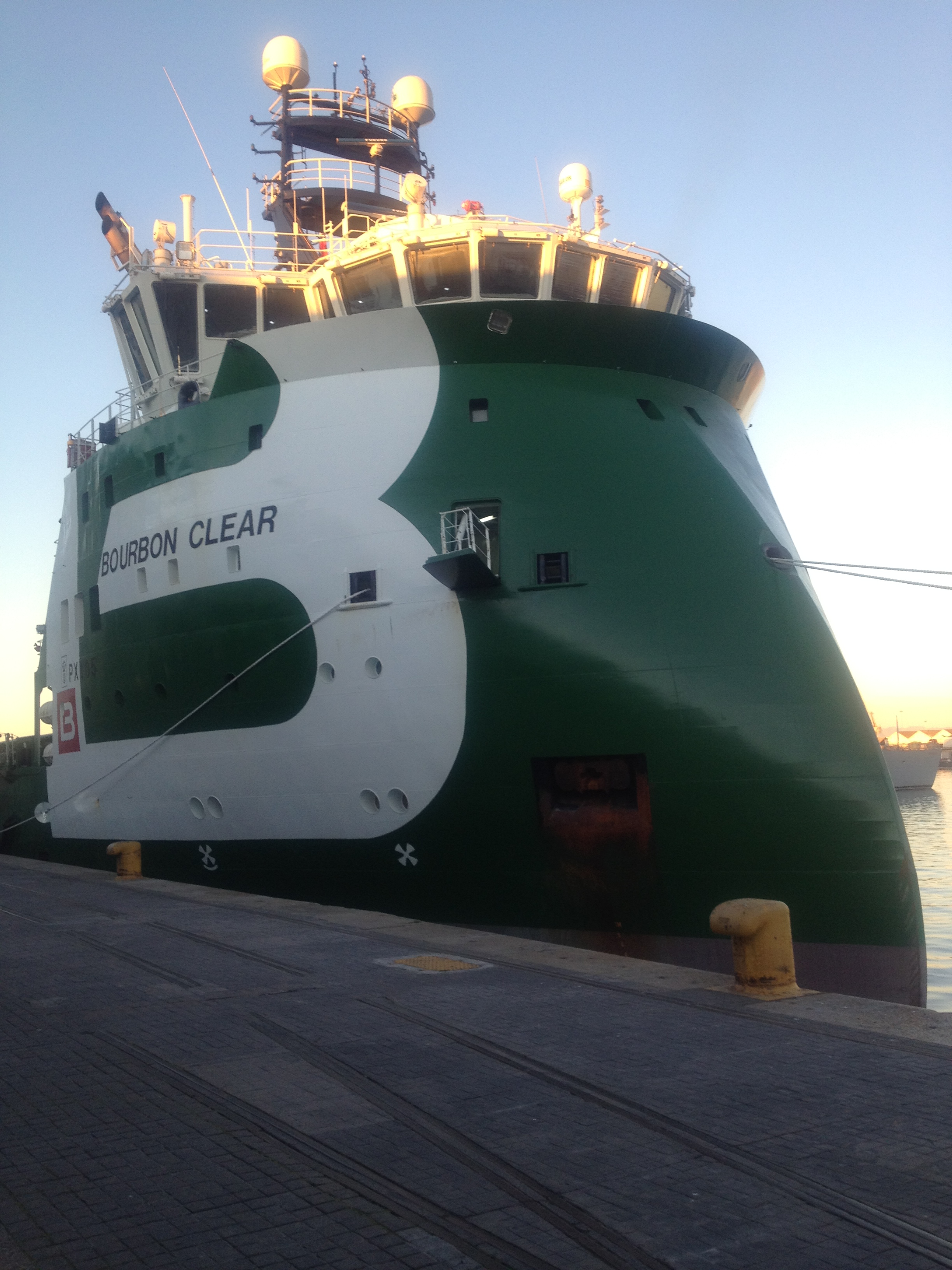
And I am glad I did. Berthed directly outside the Table Bay Hotel was the Navy Frigate, but what was really attracting some attention and cameras was the Bourbon Clear. With her distinctive bow and bright green hull, she cuts a striking figure and had more than a few people stop in their tracks.

The Bourbon Clear, a Large Platform Supply Vessel, in Cape Town harbour.

The Bourbon Clear is a Large Platform Supply Vessel designed by Ulstein Design and built by Zheijang Shipbuilding. She was delivered in 2010 to Bourbon Offshore (Norway). She is built according to Det Norske Veritas Clean Design notation and carries a Green Passport complying with IMO ship recycling recommendations.

Walking just a little further, an assortment of vessels were berthed facing the diners while just across the harbour I could easily see the fishing vessels bobbing against the I&J jetty.

The brightly lit oil rig currently occupying A-Berth and towering above the Waterfront buildings completed the maritime picture as I finally found my way to the correct venue.

We lament the fact that the ISPS code has restricted access to the harbour, but as an industry we could do more to project what is visible into the public eye. We just need to be a little more creative about showcasing our industry!

Conference Call rocks maritime sector

There are conferences aplenty in South Africa and Africa that plug into the maritime domain, but this week’s South African Maritime Industry Conference (SAMIC) hosted by SAMSA can truly be heralded as one that should repower the engines of the maritime industry in the country.

I sat there for the entire conference. I did not miss a minute of it. I ensured that every break-away group had a representative from the magazine in it – and we will publish a thorough and comprehensive report back of SAMIC in the next issue.

For those of you who did not attend and had to rely on newspaper reports of the highlights and headlines relating to the conference, please take comfort in the fact that the news that made it to daily newspapers relating to lack of legislation to bolster a ship registry; loss of bunker only opportunities or our lack of pollution fighting capabilities, should not be seen to represent the the entire focus of the conference. These are all headlines that spotlighted the industry during the SAMIC week and, while I am certainly not dismissing the importance of these facts, we as an industry know we are committed to addressing them, but we should also be able to walk away from the conference knowing that we did more than just air our dirty laundry.

And certainly, while we wont ignore the very real work that needs to be done to address those rather negative headlines; lets reflect on the positives that the conference highlighted:

  • Three Cabinet Ministers stood on the jetty in the V&A Waterfront on a dark cold winter’s morning to watch the SA Agulhas training ship depart with 32 cadets on board. That’s three Ministers who now have  more of a personal glimpse about what the industry can offer to young South Africans.
  • The new Minister of Transport, Ben Dikobe Martins, seemed well briefed and sounded committed to prioritising maritime matters in the Department of Transport.
  • Ruth Bhengu, Chairperson of the Portfolio Committee on Transport invited the industry to “knock on my door” to unblock policy and legislation before parliament.
  • Bridgette Gasa, National Planning Commissioner, admitted that the maritime sector had been “forgotten” in the National Development Plan and agreed to seek to correct the oversight.
  • A complete pipeline of skills development from primary to tertiary level for the maritime industry is being discussed at governmental level.
  • The Petroleum Agency reported that our offshore acreage is well marketed and fully subscribed with either exploration licenses or applications for exploration.  Increased activity in this sector is predicted in the next three to five years.
  • SAMSA launched an Industry Training Fund and raised significant funds directly at the Chairman’s Dinner on the second day of the conference.
  • CEO of SAMSA, Tsietsi Mokhele was summoned to meet with the President on Thursday and returned to alert the industry to the fact that he had proclaimed himself the governor of the Tenth Province to the presidency in an effort to convey the immense importance that the sector holds for the development of South Africa.
  • Entrepreneurs waiting to gain a foothold into the industry, stalwarts of the industry, government agents, neigbouring country officials, NGO’s and industry associations rubbed shoulders, debated, discussed and committed to a robust maritime sector.
  • The atrophy of conference delegates on the Friday afternoon was not significant!

Was SAMIC an all-encompassing solution to every problem facing the industry? Certainly not, but it was an excellent start that challenged the status-quo of conferences as a whole and the industry. We were not subjected to paper after paper, but rather given the opportunity to huddle down and shout out our opinions.

Was SAMIC totally representative of the industry? Well – no, there were a couple of industry players that perhaps should have been involved. Most notably was the absence of any representation from the Department of Agriculture, Forestry and Fisheries to engage with the fishing subsector, but there were others as well.

Was SAMIC completely unique in its topic selection? Hell – no, there were issues that have been debated at nausea for more than a decade in the industry, but there seemed to be an underlying will on a higher level than just industry frustration to move forward.

There is still a lot of work to be done. There is a lot of sensitisation to and education about the industry that still needs to happen at government level, but our new governor of the 10th province is the kind of man that has the ability to rally the troops; he has the passion to unite disparate sectors and he certainly seems to have managed to reach the ear of the president.

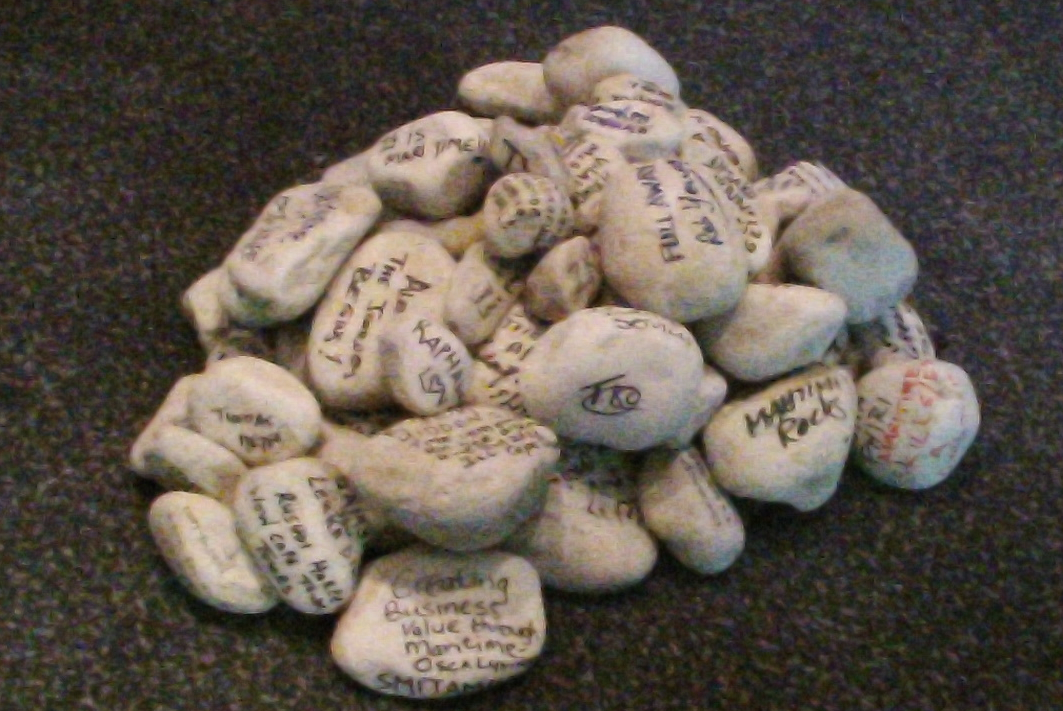
And for those of us that added our rock to the pile – let us live up to the commitment this symbolised and work to make our 10th province prosperous, influential and peaceful.
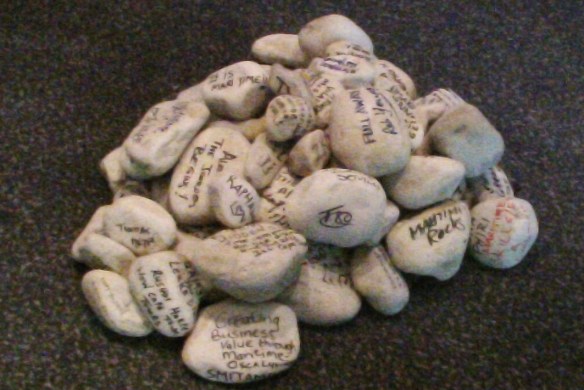
MARITIME ROCKS: Delegates at SAMIC were invited to take a rock, write their commitment on it and add it to the pile at the end of Day 2 at the conference.

Come out for seafarers!

This time last year we partnered with members of the maritime industry locally and attempted to bring attention to the vital work undertaken by the men and women who go to sea each day. We organised Flash Mobs in Durban, Cape Town, Pretoria and Mossel Bay to publicly acknowledge the role of seafarers.

I’ll be honest and say that getting some of the industry to buy into the concept of a Flash Mob was hard and the traditionally conservative industry tended to shy away from the idea of standing up in a public place and thanking seafarers. Yet there were those who stood up and came out.

Coming out in support of seafarers like that seemed totally alien to the industry – an industry totally reliant on their seagoing crew and I wondered: if the actual maritime industry was reluctant to stand up and thank seafarers; how on earth was the man in the street going to be able to conceptualise the need to thank them?

At the time we had grandiose ideas of what we would be doing this year to mark this day. From street parades to organising a harbour run; we were keen to expose landlubbers to the risks, challenges, duties and responsibilities of the seafarers!

But we decided to get in line with the rest of the world and embrace the social media campaign that marked last year and that again marks this year’s dedication to and celebration of seafarers.

And so this morning I got to work ready to start tweeting and blogging about the things in my life that I cannot do without that happened to be here after a journey by sea. And so as I sit at my desk and consider the contents of my office, my house and indeed my life I can’t help think that I have let down those seafarers that I was prepared to come out for last year.

I regret not organising that street parade. I regret not setting up the harbour run. And I believe we should be doing more than tweeting and blogging our thanks.

Next year – let’s take it to the streets and drive the message to the very doors of the consumers who simply cannot live without seafarers!

Pretoria Comedy Club

If it wasn’t so sad, she would be funny. Problem is that the industry cannot afford to laugh at this lady. In the light of today’s announcement that the performance and evaluation system for Heads of Department in government has been amended, we recommend that the following forum is the only one that makes sense for the evaluation of the performance of the Head of the Department of Agriculture, Forestry and Fisheries.

Recognising a different type of Maritime Master

In what can only be described as “long overdue” one of our own maritime champions was recognised for his contribution to maritime education at the Seatrade Awards dinner in London last night. While technically it was the Lawhill Maritime Centre that received the Investment in People award – Brian Ingpen is synonymous with the success of the centre and has instilled a passion for the maritime industry, respect, discipline and a set of uncompromising values in South African youth over the many years that Simons Town High School has offered Maritime Studies as a Matric subject.

My involvement with the industry goes back almost two decades and in that time Brian Ingpen has always been a prominent supporter of all maritime matters. His quiet, dignified persona is as much a part of our maritime legacy as the many legends that helped shape the South African maritime landscape. His uncompromising ability to see to the reality of all things maritime makes him an ideal commentator, educator and friend of the industry.

But it is the work that he does in Simonstown at the High School and within the Lawhill Maritime Centre that is truly remarkable. His learners (past and present) are noticeable and notable in the industry; and every year when I leave his annual Awards evening I am moved by the respect they have for him as well as the industry that they are hoping to enter.

Honestly there are few in the maritime as well as the education sector that can say they are leading our youth and championing our future maritime leaders to the same degree as Mr Brian Ingpen.

Congratulations Brian; it is an honour to have you on our editorial team and to witness what you are doing at the Lawhill Maritime Centre.


A pressing comment

Democratic Alliance Shadow Minister of Agriculture, Forestry and Fisheries, Pieter van Dalen, has stepped up to the pulpit largely created by the likes of fisheries commentator, Shaheen Moolla over recent months. On Friday he was once again catapulted into the media spotlight when he was asked to leave the Press Club meeting due to be addressed by none other than DAFF Minister, Tina Joemat-Pettersson.

The debate that has ensued has been interesting as have the comments made by the Minister during the briefing.

While I support the quest that Van Dalen has  undertaken to make the minister accountable to her constituency as defined by the Department’s title, and I support his right to be at the meeting as a member of the Press Club – I do wonder at the legitimacy of a Press Club’s constitution that opens its membership to unrelated sectors.

As a member of the media I do not (and cannot) belong to professional industry clubs for accountants, doctors or the like; and I wonder if politicians take an equal interest in joining such professional clubs.

And so my take on the whole affair:

Minister Joemat-Pettersson should probably have anticipated the (political and media) uproar that was going to follow her demands to have Pieter van Dalen removed and would have come out smelling sweeter than the perlemoen she keeps accumulating for the Department had she just got on with it. Let’s face it – any question that Van Dalen was likely to ask, the press had already got waiting for her anyway.

Pieter van Dalen as a member of the Press Club had every right to be there. Whether the Press Club should open their doors to politicians is an entirely different debate and one which should probably be addressed. His decision to leave can be considered political gesturing for the sake of the media, but at the end of the day it  was really probably  the only logical decision he could make.

The Press Club should reconsider their constitution in terms of membership criteria. Ironically – although currently not a member of the Cape Town Press Club – this incident has made me reconsider this decision.

The comments made by the minister are not the topic of this blog, but certainly worth following up on by both journalists and politicians, irrespective of their membership to any professional clubs! We should all be pressing on to ensure that the current questions surrounding the minister’s leadership of the Department of Agriculture, Forestry and Fisheries are fully answered.

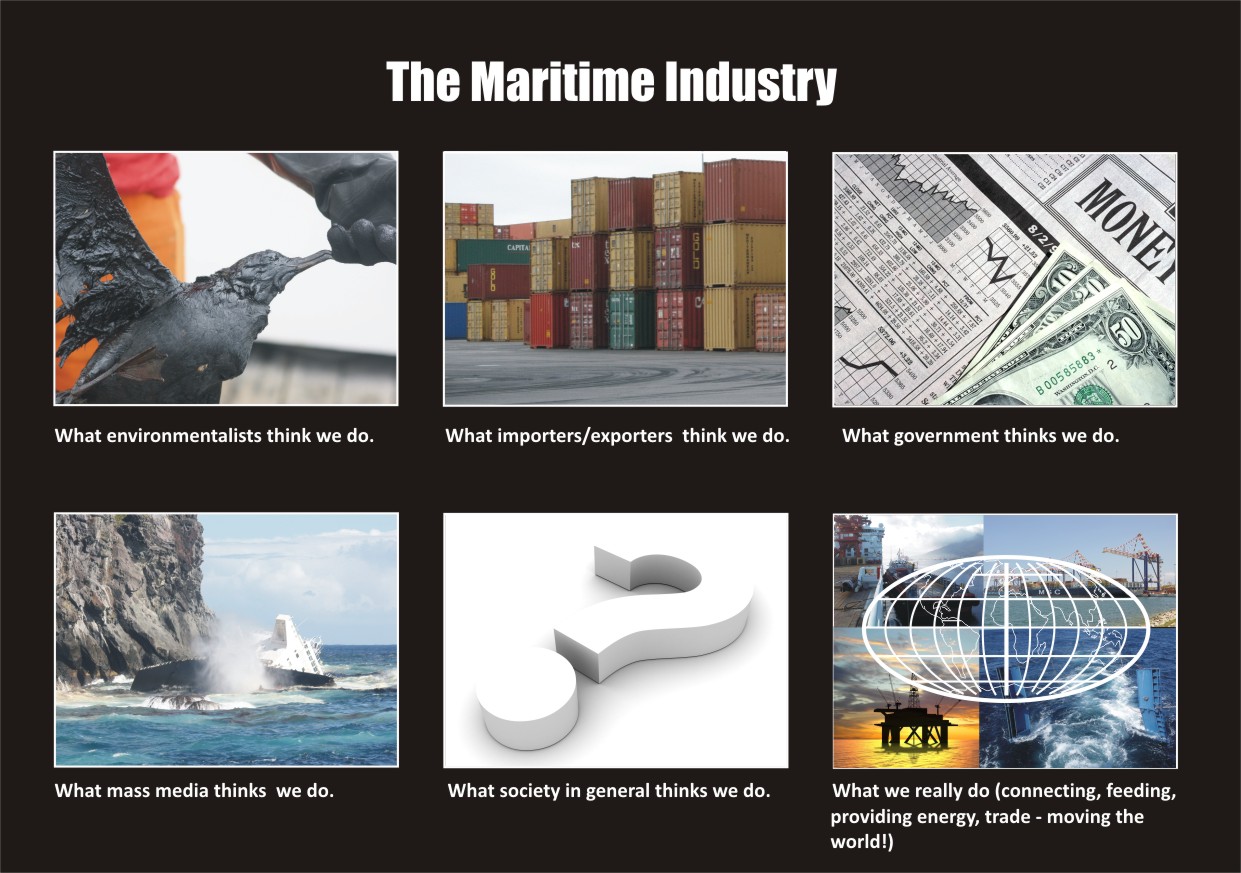
A maritime “meme”

According to thedailymeme.com  “Meme’s are viral and propagate around sometimes mutating as they propagate.”  Many of you may have seen the widely spreading graphic (meme) that takes a type of person, a place or a profession and breaks them down into six perceptions with the last perception purporting to the the “true” perception or reality. Over January and February Facebook was literally flooded with these perception meme’s so I have created one for the maritime industry. I hope you like it:

Don’t sign a petition to save the rhino!

If you’ve ever eaten a crayfish taken illegally out of the sea, please do not sign any anti-rhino poaching petitions. If you’ve ever snuck a perlemoen out the sea or eaten one that has been, please do not sign any anti-rhino poaching petitions. If you’ve ever eaten fish in a restaurant with questionable origins or on the endangered list, please do not sign any anti-rhino poaching petitions. Hell – if you’ve ever littered on a beach, please do not sign any anti-poaching petitions.

Thousands of South Africans are getting behind the plight of the rhino and with good reason. It’s quick and easy to sign a petition or post a facebook status about how outraged you are about the massacre of these animals, but how helpful is this really?

All poaching, illegal harvesting and unregulated fishing is a consequence of market demands. It’s that simple. Without a market, there is no one to supply. The consequences are depleted oceans, deforestation, extinct species and an ailing planet.

Overfishing around the world is being driven by demanding markets willing to pay a premium to satisfy their appetite. Just how different is that to the nature of the rhino poaching problem currently being experienced in South Africa?

The solution? The solution lies in education – in educating the market that demands the product. It’s irrelevant that we in South Africa know that rhino horn is not all it’s cracked up to be – the end user of the product needs to be informed.

So why am I asking you not to sign petitions? By all means go ahead, but please do not be naive about the impact it will have – and when you do add your name to the list, give some thought to your own role in creating market demands that impact the future health of the earth and its species.

The Safmarine Way

Today I received a press release that compels a comment. Apparently Safmarine was recognised at an awards ceremony yesterday. To quote the title of the press release: “Safmarine wins coveted Containerisation International Investment in People of the Year’ award”. Surely I am not alone in finding this just a little ironic?

This award comes exactly ten days after the announcement that Safmarine’s corporate functions would be “integrated” into Maersk and certainly not outside of the memory of the closing of a certain Safmarine department based in Cape Town.

Now one does understand that the judging was done some time back, but one cannot help but think that the some 240 people likely to be affected by this latest “integration” into Maersk may well find this announcement to be a bit of a slap in the face. Especially as the press release quotes a judge saying; “The entries demonstrated just how important staff are in any organisation and what can be achieved in terms of performance and branding ….”

To his credit, Safmarine’s HR Director Con De Ruig did have the decency to allude to the recent “changes in organisational structure” when he accepted the award. “Safmarine faces its greatest test ever and will, through its people, continue to serve customers in the Safmarine Way,” he said.

While one can certainly understand that the decision to integrate Safmarine into Maersk makes complete business sense and even commend them on maintaining separate operations for so long – it surely must have been a little embarrassing to accept such an award and send out a press release of this nature so soon after announcing the Maersk integration!

Perhaps that’s just the Safmarine Way!


International Maritime Day: an opportunity lost!

Today we celebrated International Maritime Day in South Africa. It’s a great way to elevate maritime matters and showcase the potential that the various industry sectors have to offer the South African economy and employment landscape. It’s a wonderful opportunity for industry and government to come together to prove that each is serious about realising the opportunities that still exist.

So it is somewhat disappointing to sit in the airport after leaving the festivities in Richards Bay feeling a little deflated. Yesterday’s Maritime Skills Summit was a wonderful introduction to herald in this day, but today’s parade of speeches from the Department of Transport and other invited as well as uninvited speakers (with the exception of the always eloquent Tsietsi Mokhele) simply did not give the industry the attention it deserves.

And so, as I reflect on the call from some in the industry to move towards the establishment of a dedicated Ministry of Maritime Affairs, I must admit I may well get behind this call. That the Department of Transport chose to launch October as Transport month at this function is still understandable, but to allow almost the entire proceedings of International MARITIME day to be dominated by road safety issues, speed limit debates and even the seemingly impromptu advertorial for Santaco Airlines is quite unforgivable.

In retrospect I should not be surprised. At last night’s Maritime Skills Summit dinner the Department of Transport’s banner on the stage boldly advertised the Arrive Alive (road safety) campaign – and not one of their roll-up banners in the hall of the venue today related to anything vaguely maritime until the one lone banner was revealed as the Minister launched Transport Month.

Even on this banner our industry was rather side-lined as the “maritime” picture amongst the other transport-related imagery depicted a stack of containers that may well have been taken at Gauteng’s “inland port”.

Sigh – but one has to give the South African Maritime Safety Authority (SAMSA) their due. They are almost a lone drummer in the wilderness that is government and are beating a passionate rhythm for our industry.

And so surely; if we can separate Higher Education into a separate ministry that can work towards progressing the much needed change in this sphere – surely we can move maritime matters from all the disparate departments that regard them only as periphery issues into a Maritime Department that can truly advance the vision that Commander Tsietsi Mokhele is so passionately advocating.

P.S. Industry needs to show up and be counted on such days as well.