Experience life at sea!

If life is about collecting a series of experiences that enrich your existence and perhaps even set you apart from those that are content to live their lives from their couches, then the maritime industry surely delivers more than most!

This morning I attended a presentation at the Department of Forestry and Fisheries where two young fisheries inspectors spoke of their six-week trip on board the Ocean Protector at the invitation of their Australian counterparts. It was plain to see that Asheem Khan and Andri van Niekerk had absorbed every possible aspect of the sea patrol that took them from Australia to  Heard Island, St Paul Island and Amsterdam Island before returning to Fremantle in Australia.

By all accounts they were exposed to a wealth of experiences while at sea that saw them engaging with potential illegal fishing vessels, practicing boardings, testing out their dry-suits, firearm training as well as fitness training. They visited the islands, noted the sea life and most importantly cemented relationships with the Australian and French inspectors and seafarers operating in these waters.

The South African duo also came back with their own recommendations for our local department to consider, but it was clear that the actual experience of being involved in this co-operative patrol will stay with them beyond the implementation of any of these possible recommendations and that the world that most of us do not get to see far from our shores offers so much to those who are willing to embrace an exhilarating life.

You can read more about their actual trip in the forthcoming issue of Maritime Review Southern Africa which will be in the post mid-June.

Get ready to flash your support for seafarers!

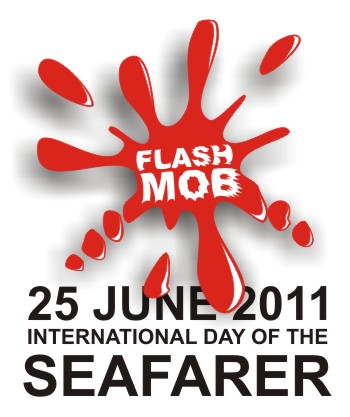
In exactly a month’s time – on the 25th June 2011 – the shipping sector will acknowledge the role of seafarers as they celebrate the International Day of the Seafarer. For the public at large, however, the day will probably go largely unnoticed. Most will not spare a thought for the men and women who go to sea to navigate the produce, the appliances, the toys, the luxuries and the necessities of daily living to their doorsteps. Most will not understand the sacrifices and the challenges that seafarers make and overcome to ensure that 90 percent of all goods in our shopping malls are available to us.

The International Maritime Organisation understands this situation and has challenged the maritime community to help promote the very vital work undertaken by those at sea. They are encouraging bloggers, companies and individuals to write and talk about the contribution made by all seafarers and have even created a package to assist those wanting to participate.

Here in South Africa – I thought we could try something a little different. We at Maritime Southern Africa are initiating [with our friends in the maritime industry] the SA Seafarer Flash Mob!

The idea is to create Flash Mobs in all our port cities as well as in Gauteng in places that show the impact of international trade. For example in Cape Town – the V&A Waterfront is an ideal location as it neighbours the port and vividly showcases international trade that the retailers rely on to stock their stores.

The group will seemingly appear out of the general public and activate attention by: Putting on a lifejacket and saluting at attention while a designated person (or the whole group) sings the South African National Anthem. As the Anthem draws to an end, the group will once again remove their lifejackets and merge into the general public.

The “incident” will be video recorded and photographed to document our efforts to acknowledge the contribution made by seafarers.

JOIN ON FACEBOOK!

We have created a Facebook page for South African Seafarers and listed the Flash Mob under the events section to make it easy for people to sign up and become involved. Simply click on the link above and join the conversation.

We already have team leaders in Cape Town and Durban, but will welcome candidates from other areas who would like to spearhead a Flash Mob in their own region. Groups can be any size and do not have to consist of people in the industry!

I look forward to engaging with the industry in this initiative!


A vote of thanks to our seafarers

As we all prepare to vote tomorrow, it’s quite ironic that just over a month ago I wrote about how 18 young cadets had been challenged to “save South Africa’s democracy”. At the time I quoted the CEO of SAMSA, Tsietsi Mokhele who emphasised the role that our seafarers have in moving our economy forward and entrenching our democracy.

Their important contribution to our economy means that they are oftentimes far from home. It means that they miss birthdays, anniversaries, public holidays and of course tomorrow they will miss the opportunity to vote.

While there are structures in place for those who cannot attend a polling station tomorrow to cast their vote earlier – there do not seem to be mechanisms in place for those at sea to have their say in the future of their own government.

These are not South Africans who have chosen to work abroad or who have emigrated, leaving behind the potholes, the crime, the debates about open toilets or service delivery. These are citizens who do still live in the cities, the suburbs and the provinces that will have their leadership structures challenged tomorrow.

Don’t waste your voice – make sure you honour those that are unable to do so and make your vote count.

Mother’s advice

In honour of Mothers’ Day on Sunday I will dedicate this post to some good advice that I am sure many mothers have served up – and relate it to a current predicament in the Cape Town Container Terminal.

I remember being advised to “admit when you are wrong and apologise before correcting the mistake” by my mother way back when I was still squabbling with my sister. In those days my sister and I could not move forward without one or the other realising their mistake and rectifying the situation through a simple acknowledgment thereof.

So it is disappointing to return from a morning in the company of Transnet’s Executive Board to celebrate the milestones being made in the expansion of the Cape Town Container Terminal without so much as a nod in the direction of the decision to convert the terminal to RTG’s (Rubber Tyred Gantries).

Well, actually that’s not entirely accurate. Both Willie van Dyk and  Brian Molefe referred to the decision in their presentations to the Minister of Public Enterprises, customers and the media. What they failed to point out was the mounting criticism of the decision to deploy wind-sensitive equipment in a port plagued by the South Easter during the summer months – some of the busiest months for the port.

We covered this issue in depth in the last issue of the magazine which cited a number of sources that clearly indicate that the blanket denial by Transnet that the RTG’s may not be the most suitable equipment in Cape Town, is beyond comprehension.

Leaving the function this morning I chatted to a representative from one of the big shipping lines using the port. He pointed out that we lost 200 hours to wind during this critical period this year as compared to only 90 hours over the same period last year. Transnet points out that we’ve had more wind and therefore shifts the blame to mother nature, but some still believe that this indeed the mother of all mistakes.

And so many still hope that this mistake will be acknowledged and some action taken because a newly expanded port with significantly improved capacity is useless without the operational infrastructure to take full advantage of it.

A bonus for safety?

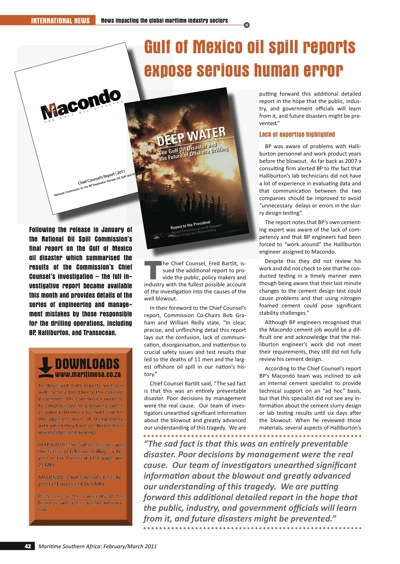
Maritime Southern Africa (Feb/March issue) highlights findings of Gulf of Mexico reports

In a press release issued by Transocean the senior management is lauded for “voluntarily donating the safety bonuses that were awarded to them for 2010 to the Deepwater Horizon Memorial Fund”. If you read the findings of the reports on the Gulf of Mexico disaster you will certainly understand that Transocean was in no way exempt from blame in this incident that resulted in the death of 11 workers and a hideous amount of oil pollution.

So the question must surely be: how can the company justify awarding safety bonuses in the same year?  It’s as bad as multi-nationals issuing performance bonuses on the back of massive retrenchments!

Surely a better PR exercise would simply have been to donate the same amount directly from the balance sheet to the Deepwater Horizon Memorial Fund? By highlighting that the money is from safety bonuses seems to send out the message that the company actually believes their safety status was good for 2010.

Once again I point out that 11 people died in the disaster; that the impact of the oil pollution is still being felt and that human error has been fingered as a major factor!

A bonus for safety? I think not!

Saving South Africa’s democracy!

Yesterday, the 4th April 2011, eighteen young South Africans signed up to save the country’s democracy! Forgive for a moment the hyperbole and let me explain:

Yesterday 18 students were officially welcomed as the first entrants into the SAMSA (South African Maritime Safety Authority) Cadet Programme in Simons Town. Seated in a lecture hall at the South African Maritime Training Academy (SAMTRA), each of them received a warm hand shake from the CEO of SAMSA, Commander Tsietsi Mokhele and were motivated by his call to action.

The commander was not only aiming to welcome these new recruits; he was lighting a fire under each of them in the hope that they would realise the very unique and important position that they are in. For him they are not just 18 lucky youngsters who have been given an opportunity to complete their maritime training with sea time; they represent the future potential of some 35 000 future South African seafarers.

If successful the SAMSA Cadet Programme, which aims to place 140 cadets by the end of the year, will expand to place 480 cadets at sea by the end of 2012. But that’s not all. Mokhele sees the programme expanding by 50 percent year on year with the eventual aim of placing 2000 cadets at sea EVERY year.

So how does this scheme hope to save South Africa’s democracy? Well as the Commander points out: the maritime industry is not about ships – it’s about the world’s economy. “Your country needs you more than you know,” he said. “Without the maritime industry there will be no trade. Without trade we cannot improve the standards of living of our people and without improved standards of living there will be no future for our democracy. This is not about ships – this is about the future of our country!”

And so 18 youngsters signed up for more than just a career at sea!

For more information about the SAMSA Cadet Programme get the March/April 2011 issue of Maritime Southern Africa.

Piracy puts us on the big screen

Is it unfair to say that Tom Hanks is the next to actually stand to benefit from the scourge of piracy off the Somali coast? Breaking news from Hollywood at the beginning of the week names the actor as the chosen lead in a film depicting the true-life drama that played out on board the Maersk Alabama when it was captured by pirates. The film is to be based on the book by Captain Richard Phillips who was in charge of the vessel at the time.

Tom Hanks is an actor who can demand up to $30 million per movie plus profit participation which, in the case of Forest Gump, saw him walk away with $70 million. That’s not a bad pay check – higher in fact than most pirates’ ransoms!

In the 15 years that I have been reporting on the maritime industry for specialist publications – piracy has been the topic that I have received the most calls from the daily newspapers for information on. It’s unfortunate that this is the reality that has catapulted the world of shipping into the headlines and it does nothing for the industry’s very real need to attract youngsters into a career at sea.

Indeed most feature films depicting aspects of the maritime world revolve around disaster. That many are based on true stories does not bode well for the image of the industry, but then where would the drama be in plain sailing?

And so while legal, emergency and medical vocations are glamourised in shows such as ER, Gray’s Anatomy, LA Law and so forth – surely a case can be made for a series that follows the lives of a crew across the globe. It’s a perfect set-up for a show that relies on the need to focus on the relationships between a small group of people who interact on a daily basis. Yes, certainly there will be incidents that will do nothing to attract new seafarers – but on the whole it may go a long way towards promoting the industry by exposing more people to the fact that there are other options for them outside of being a doctor, a lawyer, a policeman or a firefighter.

Flying the Flag

Imagine if every car owner in the Western Province decided to license their vehicle in Gauteng. Imagine what that would do to the relevant municipal coffers and what impact it could have on their ability to deliver services. Essentially the monies collected from Cape Town vehicle owners would be used to benefit the lives of Gauteng drivers.

It would be crazy to think that we would want to enrich some other jurisdiction – or would it?

What if another town or suburb waived the need for our car to be roadworthy? Or the conditions of our chosen  licensing authority made our lives easier every time we had an accident? What if choosing a licensing authority also meant less taxation; fewer rules of the road or even access to cheap servicing? Now would you consider licensing your vehicle elsewhere?

Now suddenly the idea of driving around with a license plate that bears no relevance to your home address makes sense. Would it matter if you were forced to use Gauteng mechanics every time you required a service? Would you care if Capetonians no longer had access to employment based on this decision?

Choosing a flag – a matter of conscience or convenience?

This may sound ludicrous and you may wonder what it has to do with the maritime industry, but this is exactly what is happening in the world of shipping. As an owner of a ship that trades around the world, you have a global choice of where to license your vessel and many nations have spent time and money on creating Flag States that attract tonnage (ships) to their registry.

Choosing a jurisdiction or a Flag for your ship impacts on the way you manage and operate that vessel. The regulatory and legislative mechanisms associated with each Flag State will have implications on the manning, the financing and even the insurance of the vessel.

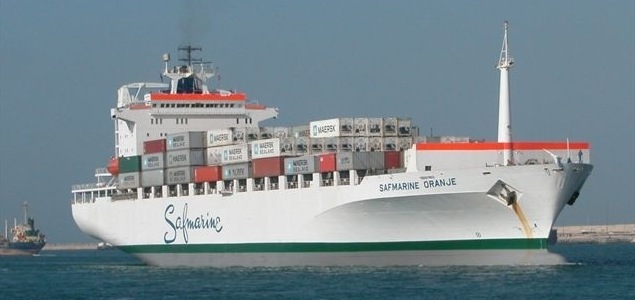
As one of the key trading nations on the African continent and with almost 3000km of coastline, you would not be forgiven for thinking that South Africa should have a robust ships’ register. The sad fact is, however, that we lost the last trading vessel on our register towards the end of 2010 and are unlikely to attract any significant number in the near future.

The Safmarine Oranje was the last trading vessel on the SA Ships' Register.

The Safmarine Oranje was the last trading vessel on the SA Ships' Register.

The reasons for the demise of the South African Ships registry are many and relate largely to the way in which some of our key maritime law is structured.

Over and above the obvious loss in potential revenue associated with a robust Ships Registry; we are putting all our youngsters keen to follow a career at sea at a distinct disadvantage. It stands to reason that all seafarers need to complete a portion of their training at sea and the lack of South African registered ships impacts directly on their ability to be placed as a cadet and gain valuable sea time.

Revisiting the car analogy above – it would be like saying all those with Learner’s Licenses from the Western Province would not have access to vehicles to gain practical experience before trying to pass their Drivers’ License because all of the cars in Cape Town were being used by learners from Gauteng as stipulated by the licensing criteria.

It’s certainly not a new debate for the industry, but given the government’s recent proclamations about job creation coupled with a well-documented shortage of seafarers (globally), it’s certainly an area that should continue to be addressed.

Shipping will show the ripple effect of quake

Japan may be showing the very real physical and traumatic effects of last week’s earthquake, but the shipping industry will demonstrate the ripple effect of globalisation as the economic impact of damaged port infrastructure on the island takes hold.

With some 1020 ports in Japan, it may not seem significant that Reuters is reporting damage to only six major ports, but a closer look at the trade as well as commodities handled by these ports should point to an even larger impact.

Consider too Japan’s current ranking as an economic superpower. Third only to the US and China – Japan’s ability to trade will impact on the global market and consequently the wheels (or more accurately the propellers) that drive that trade.

To put this in perspective, Lloyds List predicts a  $3.4 billion a day loss in seaborne trade each day the ports remain closed in Japan and attributes a total of $1.5 trillion to maritime trade in 2010 for the island.

And so at a time when the global shipping industry debates freight rates in an environment of overcapacity, some economists are predicting an increase in dry bulk rates as Japan attempts to replenish stocks of coal and imports materials required for the rebuild process.

Indeed, there is no doubt that certain companies will already be mobilising for a piece of the very large pie that will most certainly result from the world’s third most economically active nation preparing  to rebuild its port infrastructure to ensure that it remains economically connected to its trading partners.